


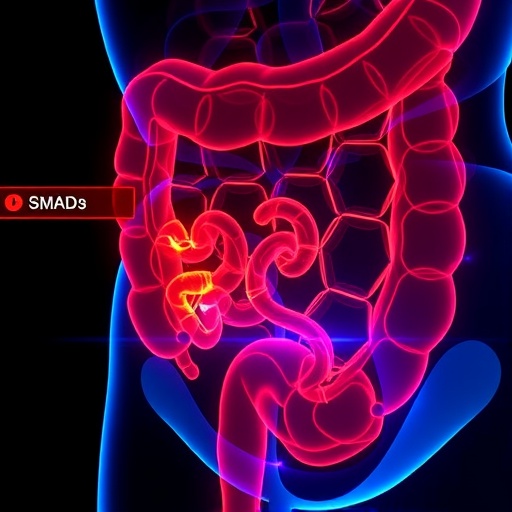
In an extraordinary breakthrough, researchers have unveiled critical insights into the enigmatic relationship between Notch and TGF-β signaling pathways in the context of colorectal cancer (CRC) metastasis. This discovery, recently published in the British Journal of Cancer, sheds light on the molecular crosstalk that orchestrates the progression and dissemination of colorectal tumors, opening promising avenues for targeted therapeutic interventions.
Colorectal cancer remains one of the leading causes of cancer-related mortality worldwide, largely due to its high metastatic potential. Despite significant advances in understanding CRC biology, the precise molecular mechanisms driving metastasis have remained elusive. At the heart of this intricate cellular dialogue lies the interplay between the Notch signaling cascade and the transforming growth factor-beta (TGF-β) pathway, both pivotal regulators of cell fate, proliferation, and differentiation.
The study, led by Wang et al., meticulously delineates how the Notch signaling pathway exerts control over colorectal cancer metastasis by directly influencing the transcriptional activity of key TGF-β effectors—namely, SMAD2 and SMAD3. These intracellular messengers are renowned for their central role in transducing signals from the TGF-β receptor to the nucleus, thereby modulating gene expression programs that govern epithelial-to-mesenchymal transition (EMT), invasion, and migration.
Wang and colleagues employed sophisticated molecular biology techniques, including chromatin immunoprecipitation and reporter assays, to demonstrate that components of the Notch pathway bind and promote the transcription of SMAD2 and SMAD3 genes. This transcriptional upregulation potentiates the downstream signaling of TGF-β, intensifying the pro-metastatic cellular behaviors that facilitate cancer cell dissemination beyond the primary tumor site.
The implications of these findings are profound, as they suggest a hierarchical regulatory mechanism where Notch signaling acts upstream to fine-tune TGF-β effector availability, thereby modulating the metastatic competence of colorectal cancer cells. Such insights challenge previous paradigms that treated these pathways as independent, underscoring the necessity to consider their integrated functions within the tumor microenvironment.
Notch signaling, historically recognized for its diverse roles in embryogenesis, stem cell maintenance, and cell fate determination, has increasingly been implicated in oncogenic processes. Its context-dependent functions range from tumor suppression to tumor promotion, making it a complex but enticing target for cancer therapy. This study’s revelation that Notch directly governs SMAD2/3 expression unveils a new dimension of pathway interplay that could be exploited for intervention.
Equally, the TGF-β pathway, a double-edged sword in cancer biology, operates as a tumor suppressor in early stages but switches to a tumor promoter in advanced cancers. By elucidating Notch’s influence over TGF-β effectors, the research provides a molecular explanation for this switch, offering opportunities to disrupt metastatic signaling circuits selectively.
Clinically, targeting the Notch-SMAD axis may revolutionize therapeutic strategies aimed at halting colorectal cancer progression. Current treatments often fall short in controlling metastasis, which ultimately drives patient morbidity and mortality. The identification of Notch as a transcriptional regulator of SMAD2 and SMAD3 suggests that dual inhibition could synergistically suppress metastatic dissemination more effectively than monotherapies.
Furthermore, this study’s findings resonate with the broader understanding of cancer signaling networks, emphasizing the importance of transcriptional control in metastasis. It implies that therapeutic approaches need to address not only signaling activity but also the transcriptional landscape that primes cancer cells for invasion and migration.
Wang and co-authors also highlight potential biomarkers arising from this pathway interplay. Elevated expression levels of SMAD2/3 under Notch regulation might serve as prognostic indicators of metastatic potential, facilitating more precise patient stratification and personalized treatment plans.
From a translational perspective, the challenge lies in developing agents capable of modulating Notch-driven transcriptional programs without disrupting Notch’s physiological functions in healthy tissues. Novel strategies leveraging selective inhibitors or gene therapy could offer solutions, ameliorating side effects while achieving potent anti-metastatic effects.
Moreover, this research underscores the dynamic and context-dependent nature of cancer signaling, urging the scientific community to rethink the binary classifications of oncogenic pathways. The cross-regulation between Notch and TGF-β signals exemplifies this complexity, necessitating integrated experimental and computational approaches to unravel multifaceted tumor biology.
The discovery also has implications beyond colorectal cancer, as both Notch and TGF-β pathways are conserved and implicated in multiple malignancies. The mechanistic insights garnered here could inform broader cancer research and stimulate investigations into similar regulatory networks across cancer types.
This emerging knowledge base not only enriches our molecular understanding of cancer metastasis but also redefines therapeutic targets in the relentless pursuit of curing colorectal cancer. Future research endeavors are warranted to explore the downstream gene targets of SMAD2/3 in this regulatory axis and to validate these findings in clinical cohorts.
In sum, the study by Wang et al. represents a paradigm shift in cancer biology, unraveling the transcriptional governance exerted by Notch signaling over TGF-β effectors SMAD2 and SMAD3. This interplay constitutes a critical mechanism driving colorectal cancer metastasis and offers a fertile ground for developing innovative, targeted anti-metastatic therapies aimed at improving patient outcomes.
—
Cite Scienmag News
Nathaniel Bowman. (April 15, 2026). Notch Signaling Drives Colorectal Cancer Metastasis via SMADs. Scienmag. https://scienmag.com/notch-signaling-drives-colorectal-cancer-metastasis-via-smads/
Nathaniel Bowman. "Notch Signaling Drives Colorectal Cancer Metastasis via SMADs." Scienmag, 15 April 2026, https://scienmag.com/notch-signaling-drives-colorectal-cancer-metastasis-via-smads/. Accessed 4 September 2026.
Nathaniel Bowman. "Notch Signaling Drives Colorectal Cancer Metastasis via SMADs." Scienmag. April 15, 2026. https://scienmag.com/notch-signaling-drives-colorectal-cancer-metastasis-via-smads/


