


In addition to exhaust emissions, abrasion emissions from tyres and brakes have become increasingly important when assessing the environmental impact of traffic. However, the focus here was on road vehicles; rail was hardly considered. In a study commissioned by the German Centre for Rail Transport Research (DZSF), researchers from the Institute of Thermodynamics and Sustainable Propulsion Systems at Graz University of Technology (TU Graz) have now been able to prove that so-called non-exhaust emissions from rail transport also have a relevant influence on air quality and soil pollution.

Credit: ITnA – TU Graz
In addition to exhaust emissions, abrasion emissions from tyres and brakes have become increasingly important when assessing the environmental impact of traffic. However, the focus here was on road vehicles; rail was hardly considered. In a study commissioned by the German Centre for Rail Transport Research (DZSF), researchers from the Institute of Thermodynamics and Sustainable Propulsion Systems at Graz University of Technology (TU Graz) have now been able to prove that so-called non-exhaust emissions from rail transport also have a relevant influence on air quality and soil pollution.
Half of the daily particulate matter limit due to trains alone
This applies especially to areas along railway line sections where there is increased braking; this includes station approaches and sections with speed limits. The abrasion emissions from rail vehicles alone reached values of up to 25 micrograms of particulate matter in the PM10 category (particles with a diameter of less than ten micrometres) per cubic metre as a daily average in Augsburg along the railway lines investigated for the study. This already corresponds to half of the permissible limit of 50 micrograms per cubic metre.
With increasing distance from the railway lines – from about ten metres – the pollution from the abrasion of the rail vehicles decreases rapidly, but the fine particulate matter also enters the soil and water and is deposited there. The proportion of heavy metals in railway emissions is significantly higher than in other modes of transport, which is reflected in more heavily polluted deposits. DZSF chemists involved in the project were able to detect these residues in bodies of water.
Contribution to closing the data gap
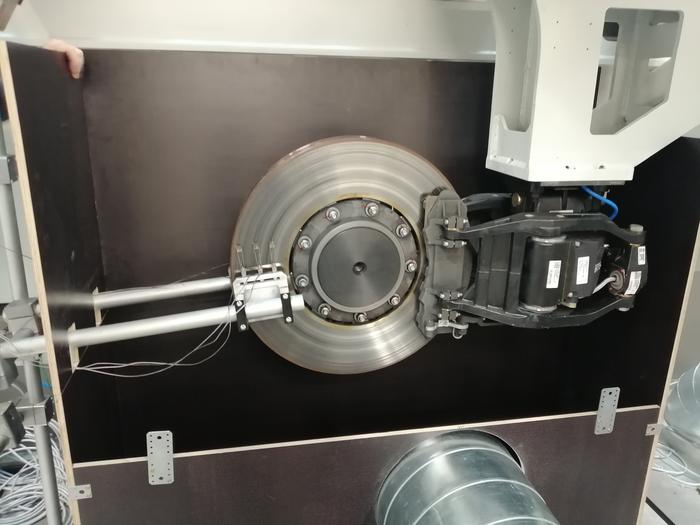
In order to determine the composition and source of the abrasion particles, the components involved were analysed in various laboratories. Daniel Fruhwirt and his team tested several brake pads in the new brake test rig for rail vehicles at TU Graz. At the Politecnico di Milano, researchers analysed the abrasion of the contact wire and the pantograph in order to be able to classify the fine dust emissions from trains on overhead lines. And at DB Systemtechnik in Berlin, the team scrutinised the wheel-rail contact. The resulting data made it possible to allocate the emissions to air, soil and water to the rail vehicles.
“Based on our study, we can clearly say that non-exhaust emissions from rail are not negligible,” explains Daniel Fruhwirt from the Institute of Thermodynamics and Sustainable Propulsion Systems at TU Graz. “Before we did this study, there was a huge gap in the data on abrasion emissions from rail vehicles and we were able to make a significant contribution to closing it. Although emissions do not single-handedly cause pollutant limits to be exceeded, they certainly play a role in the overall mix. It is therefore important that efforts are made to also assess emissions behaviour in the future when certifying brakes.”
Journal
Transportation Research
Method of Research
Experimental study
Subject of Research
Not applicable
Article Title
Characterization of emissions from axle-mounted rail disc brakes
Article Publication Date
29-May-2024
Cite Scienmag News
Denise Maddox. (July 23, 2024). Study by TU Graz shows that abrasion emissions from trains are not negligible. Scienmag. https://scienmag.com/study-by-tu-graz-shows-that-abrasion-emissions-from-trains-are-not-negligible/
Denise Maddox. "Study by TU Graz shows that abrasion emissions from trains are not negligible." Scienmag, 23 July 2024, https://scienmag.com/study-by-tu-graz-shows-that-abrasion-emissions-from-trains-are-not-negligible/. Accessed 3 September 2026.
Denise Maddox. "Study by TU Graz shows that abrasion emissions from trains are not negligible." Scienmag. July 23, 2024. https://scienmag.com/study-by-tu-graz-shows-that-abrasion-emissions-from-trains-are-not-negligible/

