


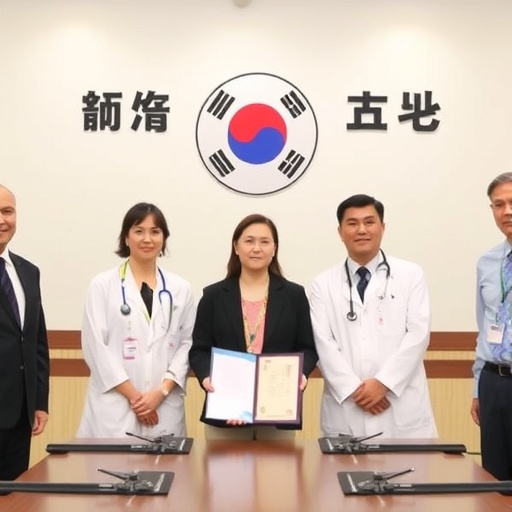
The Institute for Environmental Medicine at Korea University recently hosted a high-level delegation from the Ministry of Health of Uzbekistan, engaging in comprehensive discussions and visits aimed at deepening bilateral cooperation in healthcare and medical education. Led by Professor Jae Wook Choi of Korea University’s Department of Preventive Medicine, this institutional exchange underscores the increasing importance of integrated medical systems in advancing national healthcare capabilities. The delegation comprised seven senior officials, notably including Deputy Minister Farkhodjon Tashpulatov, alongside key personnel focused on economic strategy, foreign investment, project administration, procurement, and international collaboration, highlighting the multifaceted approach Uzbekistan is taking toward healthcare modernization.
The delegation’s visit began with an extensive tour of Korea University Anam Hospital, a flagship medical center known for its integrated clinical care and cutting-edge research. Here, the Uzbek stakeholders were able to witness firsthand the hospital’s seamless integration of patient care, medical education, and translational research. Emphasizing the nexus between these core components, Korea University demonstrates a model in which academic medicine not only informs clinical protocols but also propels innovative research and fosters robust educational frameworks. This holistic integration is particularly relevant for countries such as Uzbekistan seeking to develop sustainable and modern healthcare infrastructure.
Subsequent sessions involved institutional briefings at Korea University College of Medicine. The delegation was introduced to Korea University’s medical education system, which is distinguished by its emphasis on research integration and international collaborations. Notably, Korea University has established diverse initiatives in partnership with Uzbek institutions, ranging from environmental health department support at Tashkent Medical Academy and Karakalpak Medical Academy, to strategic advisory roles in response to infectious disease outbreaks such as COVID-19. These collaborative ventures have provided Korea University with a deep, context-specific understanding of Uzbekistan’s healthcare challenges and educational landscape.
One of the focal points in the discussions was the structural design of Korea University’s integrated medical system. This system is characterized by its ability to synergize hospital operations, medical school curricula, and research activities into a unified pipeline that ensures continuous feedback and innovation. Such an integrated framework facilitates rapid translation of research findings into clinical practice, enhanced training of healthcare professionals, and optimized allocation of resources. Members of the Uzbek delegation expressed keen interest in adopting elements of this system to accelerate healthcare modernization efforts in Uzbekistan.
The collaborative relationship between Korea University College of Medicine and Uzbekistan extends beyond educational exchange into critical infrastructure feasibility studies. Among the projects underway is an assessment for the Uzbekistan National Cancer Center, a facility envisioned to be equipped with advanced oncologic diagnostic and treatment capabilities. Supported by Korea’s Economic Development Cooperation Fund (EDCF), this initiative represents not only a bilateral investment in health infrastructure but also a potential catalyst for regional excellence in cancer care. By leveraging Korea University’s expertise, Uzbekistan aims to establish a center that meets international standards of cancer treatment and research.
In addition to cancer care, Korea University’s support in establishing environmental health departments at leading Uzbek medical academies is indicative of the increasing recognition of environmental determinants in public health. The Institute for Environmental Medicine at Korea University, under Professor Choi’s direction, facilitates applied research and educational programming targeted at understanding and mitigating environmental risks. This collaboration enables Uzbekistan to enhance its national capacity for environmental health surveillance, policy development, and disease prevention, thereby broadening the scope of its public health initiatives.
The COVID-19 pandemic highlighted the critical need for international cooperation in infectious disease management, an area in which Korea University provided advisory support to Uzbek authorities. Leveraging its research proficiency and healthcare infrastructure, the university contributed guidance on epidemiological measures, clinical management, and vaccine deployment strategies. This experience not only fortified bilateral ties but also underscored the value of cross-border collaboration in addressing shared global health threats.
Dean Sung Bom Pyun of Korea University College of Medicine emphasized the institution’s commitment to fostering an integrated medical system that bridges clinical practice, research, and education. He articulated the vision that such systems are essential for enhancing healthcare delivery and innovation. The current visit by the Uzbek delegation serves as a platform to consolidate existing collaborations and explore avenues for expanding joint initiatives in medical education, research, and healthcare service delivery.
Director Jae Wook Choi highlighted the mutual benefit of collaborative projects that provide in-depth insights into Uzbekistan’s healthcare system from multiple perspectives. The dialogue initiated during this visit is anticipated to facilitate constructive discussions aimed at charting a clear direction for future partnership endeavors. The integration of clinical, educational, and research domains in Korea University’s approach offers a replicable model for institutional capacity-building in Uzbekistan.
Deputy Minister Farkhodjon Tashpulatov acknowledged that Korea’s hospital operational structure and medical education paradigm are closely aligned with Uzbekistan’s aspirations for healthcare modernization. By observing and engaging with Korea University’s systems, Uzbekistan seeks to identify actionable strategies and best practices that can be adapted to its national context. The visit is poised to enhance knowledge exchange and reinforce cooperative ties between the two countries’ institutions.
This institutional visit and its subsequent engagements exemplify a dynamic model of international collaboration in healthcare, wherein academic medicine serves as a linchpin for systemic development. Korea University’s integrative framework not only fosters medical innovation but also cultivates global partnerships that contribute to sustainable health system strengthening. As Uzbekistan embarks on its path to healthcare reform, the ongoing cooperation with Korea University represents a cornerstone in achieving comprehensive, research-driven, and education-fueled healthcare modernization.
Looking forward, the sustained dialogue and partnership between Korea University and Uzbekistan’s Ministry of Health is anticipated to yield multifaceted benefits. Joint efforts in research, education, and clinical service development will likely lead to innovations in disease management, training of healthcare professionals, and public health policy formulation. The strategic alignment of these components, as demonstrated by Korea University’s integrated medical system, provides a benchmark for institutional excellence that Uzbekistan aspires to emulate and customize according to its national needs.
Such collaborations on an international scale illustrate the evolving landscape of global health, where knowledge-sharing and cooperative frameworks drive progress beyond individual borders. Korea University’s role as an academic and clinical leader positions it as a pivotal partner in facilitating Uzbekistan’s healthcare transformation. This partnership highlights the increasing interconnectedness of science, education, and health policy in addressing contemporary health challenges and advancing population well-being.
In conclusion, the visit from Uzbekistan’s Ministry of Health delegation to Korea University marks a significant milestone in international health cooperation. It illuminates the value of integrated medical systems and institutional partnerships in addressing the complexities of healthcare modernization. The ongoing exchange sets a promising trajectory for enhanced collaboration between Korea and Uzbekistan, promising advances in medical education, research innovation, and healthcare delivery that resonate beyond their national confines.
News Publication Date: Information not provided.
Web References: Information not provided.
References: Information not provided.
Cite Scienmag News
Ophelia Keating. (April 13, 2026). Korea University Institute for Environmental Medicine Welcomes Uzbekistan Ministry of Health Delegation for Strategic Scientific Collaboration. Scienmag. https://scienmag.com/korea-university-institute-for-environmental-medicine-welcomes-uzbekistan-ministry-of-health-delegation-for-strategic-scientific-collaboration/
Ophelia Keating. "Korea University Institute for Environmental Medicine Welcomes Uzbekistan Ministry of Health Delegation for Strategic Scientific Collaboration." Scienmag, 13 April 2026, https://scienmag.com/korea-university-institute-for-environmental-medicine-welcomes-uzbekistan-ministry-of-health-delegation-for-strategic-scientific-collaboration/. Accessed 6 September 2026.
Ophelia Keating. "Korea University Institute for Environmental Medicine Welcomes Uzbekistan Ministry of Health Delegation for Strategic Scientific Collaboration." Scienmag. April 13, 2026. https://scienmag.com/korea-university-institute-for-environmental-medicine-welcomes-uzbekistan-ministry-of-health-delegation-for-strategic-scientific-collaboration/


