


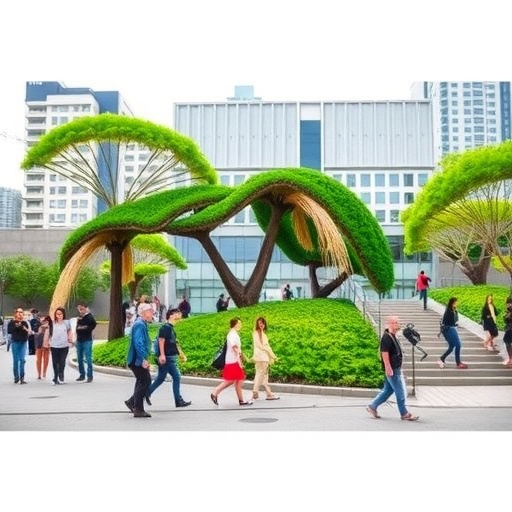
In the rapidly urbanizing world, the quest for green justice in cities has become a critical frontier in sustainability and social equity. Urban green spaces (UGSs) are increasingly recognized not just for their environmental benefits but also for their role in promoting social well-being and inclusivity. However, achieving green justice—defined as the fair and equitable distribution of green spaces alongside meaningful public engagement—remains a complex challenge, particularly in politically constrained environments like Beijing. A groundbreaking new study sheds light on the pivotal yet nuanced role that nongovernmental organizations (NGOs) play in reshaping UGS justice, revealing how these actors navigate intricate socio-political landscapes to influence urban environmental governance.
The research, based on 58 in-depth interviews with NGO staff, government officials, and other relevant stakeholders in Beijing, alongside participant observations and social media analysis, offers an unprecedented look into the operational strategies of NGOs in the context of urban green space justice. Contrary to common assumptions that emphasize equitable distribution as the core of green justice, the study reveals that NGOs in Beijing tend to deprioritize distributive equity. Instead, their efforts concentrate on enhancing procedural justice, which involves fostering inclusive participation mechanisms, transparency, and accountability in urban environmental decision-making processes.
This procedural focus manifests in several strategic actions by NGOs. They engage in supervision roles to monitor government practices and advocate for openness, cultivate expansive networks to strengthen their influence, and leverage existing legal frameworks to institutionalize public participation. These approaches reflect an adaptive strategy to work within the current governance system while gently pushing for greater inclusiveness. Notably, the NGOs’ advocacy does not overtly challenge the status quo but rather seeks to carve out participatory spaces within the existing political constraints, subtly shifting the parameters of urban planning discourse.
A particularly compelling dimension of the study is its exploration of the recognitional aspect of green justice—how different social groups and their identities are acknowledged in the governance of urban green spaces. In Beijing’s tightly regulated governance environment, NGOs employ innovative and covert tactics to influence dominant narratives. They skillfully engage with government bodies, aligning their messaging and activities with official expectations to maintain operational legitimacy while slowly reframing the discourse to include marginalized voices. This balancing act reflects the NGOs’ pragmatic understanding of their political context, where overt dissent may jeopardize their ability to function.
One of the most striking findings of the study is how NGOs strategically downplay distributional inequities in UGS access within Beijing. This approach is not a denial of these inequities but a calculated tactic to avoid direct confrontation with powerful state actors and to ensure continued participation in decision-making spaces. By foregrounding procedural justice and recognition, NGOs aim to create conditions that might eventually lead to more equitable outcomes, albeit through incremental change rather than immediate redistribution.
The implications of these findings challenge prevailing theoretical frameworks in urban environmental justice that often prioritize distributive outcomes over procedural and recognitional dimensions. In the context of Beijing and potentially other similarly governed cities, the path to green justice is less about immediate reallocation of resources and more about establishing legitimate, participatory governance processes. Such an approach recognizes that procedural justice can serve as a foundation for future distributional equity if public involvement and representation are genuinely realized.
The study also underscores the critical role of counter-narratives and information disclosure in advancing green justice. NGOs’ efforts to disseminate alternative viewpoints and to increase transparency in urban green space planning emerge as vital tools for empowering communities and influencing policy. In an environment where official narratives dominate and information flows are tightly controlled, these counter-narratives become instrumental in questioning prevailing assumptions, highlighting injustices, and mobilizing public support.
Furthermore, the research highlights the importance of earlier NGO involvement in UGS planning processes. By participating at the initial stages of policy formulation and design, NGOs can help embed principles of participation and recognition before decisions become entrenched. This proactive engagement is essential in political contexts where later-stage advocacy often faces significant obstacles. Early involvement allows NGOs to shape agendas, frame problems differently, and open governance spaces that might otherwise remain closed.
The methodological rigor of this study, leveraging qualitative data from diverse sources, allows for a comprehensive understanding of the nuanced and dynamic role NGOs play within Beijing’s urban governance framework. The combination of in-depth interviews, direct observation, and social media analysis provides rich insights into both formal institutional processes and informal social dynamics, painting a multifaceted picture of NGO strategies and impacts.
These findings speak to broader global debates on urban sustainability and justice. They contribute to a growing recognition that achieving equitable green spaces is not solely a matter of spatial redistribution but also fundamentally about governance—how decisions are made, who gets to participate, and whose voices are heard. This governance-centric perspective aligns with emerging scholarship calling for multidimensional approaches to urban justice that transcend simplistic metrics of access.
Moreover, the study’s focus on Beijing offers valuable lessons for urban centers facing similar political complexities and governance constraints. It highlights the potential for NGOs to act as mediators and facilitators within restrictive political systems, navigating the fine line between advocacy and accommodation. This pragmatic approach may prove essential for advancing green justice in cities where more confrontational activism is neither viable nor strategically effective.
As cities worldwide grapple with climate change, rapid urban growth, and increasing inequality, understanding the mechanisms by which NGOs can influence urban green space governance becomes critical. This research emphasizes that NGOs’ contributions extend beyond service delivery or protesting inequities—they are active architects of governance processes that determine future urban sustainability pathways.
Ultimately, the study calls attention to the need for policymakers and planners to recognize and support the procedural and recognitional roles of NGOs in urban green space justice. Facilitating transparent information sharing, fostering platforms for meaningful public engagement, and legitimizing NGO participation can create more resilient and just urban environments. In restrictive contexts like Beijing, such changes represent crucial steps toward inclusive and sustainable city-making.
This research invites further investigation into how different urban contexts shape NGO strategies and effectiveness. Comparative studies could illuminate how political systems, cultural norms, and governance traditions interact to influence the pursuit of green justice. Understanding these dynamics will be essential for designing context-sensitive policies that harness the positive potential of NGOs in urban sustainability.
In conclusion, reshaping urban green space justice involves more than equitable park distribution—it requires transformative shifts in how cities govern, engage citizens, and incorporate diverse identities. NGOs in Beijing exemplify the complex, adaptive work needed to advance green justice under significant political constraints. Their experience offers hope and guidance for cities worldwide striving for greener, fairer futures.
Nongovernmental organizations’ role in shaping urban green space justice in Beijing through enhancing procedural and recognitional justice amid political constraints.
How NGOs reshape urban green space justice in Beijing
Liang, L., Han, S.S. & Day, J. How NGOs reshape urban green space justice in Beijing. Nat Cities (2026). https://doi.org/10.1038/s44284-026-00431-1
AI Generated
https://doi.org/10.1038/s44284-026-00431-1
Cite Scienmag News
Denise Maddox. (April 13, 2026). NGOs Transforming Urban Green Space Justice in Beijing. Scienmag. https://scienmag.com/ngos-transforming-urban-green-space-justice-in-beijing/
Denise Maddox. "NGOs Transforming Urban Green Space Justice in Beijing." Scienmag, 13 April 2026, https://scienmag.com/ngos-transforming-urban-green-space-justice-in-beijing/. Accessed 5 September 2026.
Denise Maddox. "NGOs Transforming Urban Green Space Justice in Beijing." Scienmag. April 13, 2026. https://scienmag.com/ngos-transforming-urban-green-space-justice-in-beijing/


