


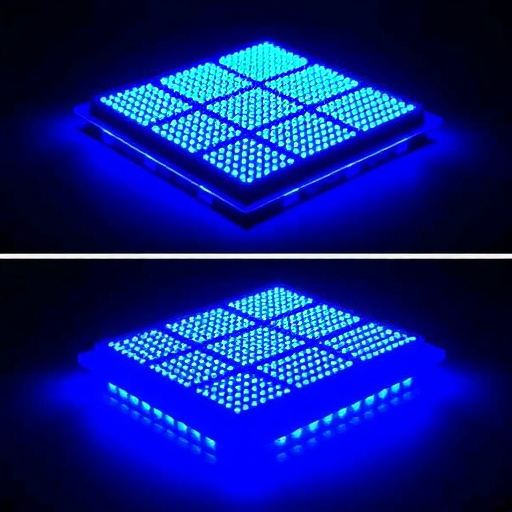
The relentless pursuit of vibrant, efficient, and long-lasting light-emitting diodes (LEDs) has fueled remarkable progress in perovskite quantum dot (QD) technology. Notably, blue perovskite LEDs have experienced significant breakthroughs, achieving external quantum efficiencies (EQE) surpassing 20%, thus rivaling conventional cadmium-based QLEDs. However, these enhancements often come with a trade-off: poor color purity. Most devices delivering the highest efficiencies display CIEy coordinates exceeding 0.1, which falls short of the stringent Rec. 2020 color gamut standards for pure blue. Furthermore, devices optimized for superior color fidelity—with CIEy less than 0.1—suffer from dramatic efficiency roll-offs at elevated luminance and have relatively short operational lifetimes, posing a considerable challenge for practical applications in displays.
This conundrum primarily arises due to an interplay of intrinsic material and device-level factors. Surface defects act as nonradiative recombination centers, severely limiting device efficiency and stability. Moreover, Auger recombination, a nonradiative process where energy from an electron-hole pair recombination is transferred to a third carrier, becomes more pronounced in these nanoscale materials, especially under high excitation densities. Charge injection imbalance within the device architecture further exacerbates these issues, collectively hindering the realization of high-purity blue perovskite QLEDs that maintain both efficiency and durability.
In a groundbreaking study recently published in Light: Science & Applications, a research team led by Professor Silu Tao from the School of Optoelectronic Science and Engineering at the University of Electronic Science and Technology of China presents a novel multifunctional molecule passivation strategy that addresses these longstanding challenges. Their innovative approach employs 1-ethyl-3-methylimidazolium hexafluorophosphate (EMIMPF6) as a surface modifier on perovskite QDs. This tailored molecular engineering not only quenches surface defects but also actively tunes electronic properties and suppresses efficiency-limiting recombination pathways.
The EMIMPF6 molecule is composed of two key components: the [PF6]⁻ anions and the [EMIM]⁺ cations. Through careful heterogeneous treatment, these molecules attach to the QD surface, with the hexafluorophosphate anions coordinating with lead dangling bonds and cesium sites. This coordination effectively passivates surface traps and diminishes interdot coupling by reducing undesired electronic interactions between adjacent QDs. Simultaneously, the 1-ethyl-3-methylimidazolium cations mitigate bromine-related defects, which are notorious for degrading optical performance. Most importantly, the EMIM moiety also regulates band alignment and suppresses Auger recombination by enhancing the dielectric screening within the QDs, a crucial breakthrough that enables operation at high luminance levels without significant efficiency loss.
Devices fabricated with EMIMPF6-passivated blue perovskite QDs showcase unprecedented performance metrics. They achieve a record-high EQE of over 20% at a luminance of 6,441 cd/m²—a luminance level well beyond typical operational thresholds. Moreover, these devices maintain an impressive 18.47% EQE at 9,587 cd/m², demonstrating a practically eliminated efficiency roll-off. Such performance benchmarks represent the highest reported for blue perovskite QLEDs with color purity below the critical CIEy = 0.1 mark, positioning these devices far ahead of prior art.
Beyond efficiency, the operational stability of these LEDs is dramatically enhanced. The team reports device lifetimes (T50) extending to 692 minutes at an initial brightness of 106 cd/m², a tenfold improvement over prior records fabricated via thermal evaporation processes. This leap in longevity is essential for commercial viability, especially for display applications requiring prolonged and stable light emission.
To validate the mechanisms underlying this improved performance, the researchers employed advanced spectroscopic and microscopic techniques. Time-resolved photoluminescence (TRPL) spectroscopy and photoluminescence quantum yield (PLQY) measurements revealed a significant suppression of nonradiative pathways, affirming the efficacy of EMIMPF6 in reducing surface trap density. Stability tests under continuous illumination and elevated temperatures corroborated the enhanced robustness imparted by this molecular passivation.
Complementing optical characterization, structural analyses offered insight into the interaction dynamics between EMIMPF6 molecules and the QD surface. X-ray diffraction (XRD) measurements confirmed that the multifunctional molecule does not intercalate into the perovskite lattice itself, preserving the intrinsic crystal structure. Meanwhile, Fourier transform infrared (FTIR) and Raman spectroscopy, paired with X-ray photoelectron spectroscopy (XPS), illuminated strong chemical interactions at the surface interface, highlighting the coordination bonds responsible for defect passivation. Furthermore, scanning transmission electron microscopy (STEM) revealed that EMIMPF6 improves the ordering within the QD ensemble and weakens interdot electronic coupling—a vital factor to enhance radiative recombination and reduce quenching.
An additional remarkable discovery relates to the dielectric properties of EMIM cations. Their high permittivity effectively screens Coulombic interactions within the QDs, resulting in less pronounced Auger recombination processes. This dielectric screening role represents a fresh avenue in combating efficiency roll-off that has hampered the development of blue perovskite QLED technologies to date.
In their synthesis, the authors emphasize that the multifunctional molecule simultaneously tackles three pivotal issues: carrier trapping, interdot coupling, and Auger recombination. This holistic approach enables blue perovskite QLEDs that uniquely balance high color purity (CIEy = 0.091) with excellent efficiency across a broad luminance range, establishing new paradigms for device engineering. Importantly, the emission spectrum remains stably consistent throughout the operational lifetime, a critical parameter for display fidelity.
This breakthrough marks a significant milestone in the commercialization prospects of perovskite QLEDs for demanding applications such as next-generation displays and lighting. The ability to achieve ultra-low efficiency roll-off at high luminance while maintaining stringent color purity standards not only meets but surpasses key industrial benchmarks. It paves the way for blue perovskite QLEDs to rival, and potentially overtake, incumbent technologies based on cadmium-containing materials.
Looking forward, this study is poised to inspire focused efforts in multifunctional ligand design, aiming to further optimize surface chemistry and electronic structure. The findings also motivate investigations into scalable manufacturing and integration strategies, bringing these promising materials closer to real-world applications. The multifunctional molecule concept may extend beyond blue emitters, potentially transforming broader optoelectronic device research.
In conclusion, the innovative utilization of EMIMPF6 as a multifunctional passivant presents a compelling solution to the persistent challenge of balancing color purity, efficiency, and operational longevity in blue perovskite quantum dot LEDs. Professor Silu Tao and colleagues have not only demonstrated record-breaking device performance but also elucidated fundamental material-science insights that deepen our understanding of perovskite nanocrystal surfaces. This work decisively advances the quest for commercially viable, high-performance blue perovskite QLEDs that can meet the exacting demands of modern display technologies.
News Publication Date: Not specified in provided content
Web References: DOI 10.1038/s41377-026-02231-7
References: Silu Tao et al., Light: Science & Applications, 2026
Cite Scienmag News
Bethany Barker. (April 10, 2026). Ultra-Low Efficiency Roll-Off and Over 20% Efficiency Achieved in High Color Purity Blue Perovskite QLEDs. Scienmag. https://scienmag.com/ultra-low-efficiency-roll-off-and-over-20-efficiency-achieved-in-high-color-purity-blue-perovskite-qleds/
Bethany Barker. "Ultra-Low Efficiency Roll-Off and Over 20% Efficiency Achieved in High Color Purity Blue Perovskite QLEDs." Scienmag, 10 April 2026, https://scienmag.com/ultra-low-efficiency-roll-off-and-over-20-efficiency-achieved-in-high-color-purity-blue-perovskite-qleds/. Accessed 3 September 2026.
Bethany Barker. "Ultra-Low Efficiency Roll-Off and Over 20% Efficiency Achieved in High Color Purity Blue Perovskite QLEDs." Scienmag. April 10, 2026. https://scienmag.com/ultra-low-efficiency-roll-off-and-over-20-efficiency-achieved-in-high-color-purity-blue-perovskite-qleds/


