


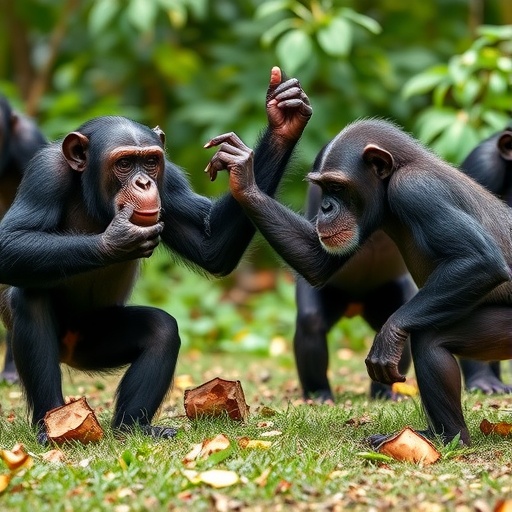
In a groundbreaking and meticulously documented study spanning over three decades, researchers have captured what could be the first direct observation of a “civil war” among wild chimpanzees. This phenomenon, unprecedented in its clarity and duration, reveals how complex social structures can fracture dramatically, leading to violent, sustained conflict among individuals once united within a single cohesive group. Traditionally, war and large-scale collective violence in humans have been theorized to stem from cultural divergences, which simultaneously forge internal unity and exacerbate hostility toward outsiders. However, these frameworks fall short when explaining violent ruptures in formerly unified populations—a puzzle as relevant for understanding human civil wars as it is for interpreting behavior in other primates.
Chimpanzees, our closest living relatives alongside bonobos, exhibit sophisticated social bonds, coalition-building, and occasionally lethal aggression, yet direct observation of intra-group warfare has been scant. Drawing upon an unparalleled dataset from the Ngogo chimpanzee community in Uganda’s Kibale National Park, Aaron Sandel and his collaborators provide compelling evidence of a historic fission event that culminated in a violent schism with fatal consequences. This event isn’t merely a brief skirmish but an enduring fragmentation whose social and ecological implications ripple through the population.
The Ngogo chimpanzee group, until recently one of the largest known chimpanzee communities, began experiencing significant social destabilization around 2015. This destabilization was marked by a rapid cleavage into two polarized camps—a division underscored not just by social allegiances but by clear spatial boundaries and reproductive isolation. By 2018, the fission was absolute; the once homogenized group existed as two separate entities with no affiliative ties. The gradual erosion of ties and increased antagonism fueled a spiral into protracted aggression, irrevocably transforming intra-species social dynamics.
Following the split, a stark transformation in inter-group interactions emerged. What had been cooperative alliances gave way to relentless, coordinated raids by one faction against the other, marking a clear escalation in hostile behavior. These attacks were marked by lethal intent and efficiency, with multiple adult male chimpanzees killed over the years. Beginning in 2021, this violence expanded to target infants, with documented cases of infanticide occurring at alarming rates. Such episodes not only demonstrate a devastating level of social rupture but also reveal the potential adaptive functions of lethal aggression in wild primate societies.
The researchers emphasize that the recorded fatalities likely underestimate the true scale of the conflict. Numerous individuals vanished under suspicious circumstances, suggesting additional unobserved attacks or fatalities. This covert dimension of intra-group violence underscores the challenges inherent in wildlife behavioral studies and the importance of continuous, long-term observation for capturing the totality of complex social phenomena.
Critically, the Ngogo conflict reshapes our understanding of group identity among chimpanzees. The turning of long-time allies into mortal enemies illustrates that group cohesion transcends familiarity and that group identity can be fluid, redefined in response to shifting social and ecological pressures. Unlike human societies where cultural markers often delineate enemy lines, chimpanzee groups contend with dynamic social factors that can rapidly redefine friendship and enmity.
Several ecological and demographic drivers appear to have contributed to this social breakdown. The unusually large size of the Ngogo community likely intensified competition for limited resources, including food and mating opportunities. The deaths of pivotal individuals—those who may have served as social glue or conflict mediators—combined with changes in leadership and disease outbreaks, appear to have exacerbated tensions, catalyzing the split. These factors, acting in concert, illustrate the delicate balance within primate societies and how perturbations can precipitate profound social upheaval.
From a broader perspective, this vivid natural experiment offers essential insights into the origins of violent conflict more generally. It suggests that deeply entrenched social structures can swiftly unravel under pressure, with lethal consequences, even among species lacking the complex cultural frameworks humans possess. This insight reframes longstanding assumptions about the roots of war and violence, emphasizing the role of social instability and rivalry independent of cultural differentiation.
James Brooks, in a commentary accompanying the study, highlights the broader significance: the hostile fissure in wild chimpanzees serves as a powerful analogue and warning for human societies. The parallels between chimpanzee group fission and human civil strife underscore that division within communities inherently threatens collective stability and survival. This underscores the urgent need to understand and mitigate the social fractures that lead to conflict.
The study also underscores the scientific value of long-term field research. Such research requires unwavering commitment and sustained resources but yields unparalleled insights into the nuanced dynamics of wild animal societies over generations. The Ngogo chimpanzee community, preserved within Kibale National Park, would have been inaccessible for such revelations without decades of consistent observation and data collection.
This research also reinforces the imperative of wildlife conservation. The preservation of endangered species is not solely an ethical act but also a scientific one, enabling the study of complex social and ecological processes pivotal to understanding evolution, behavior, and even the origins of human societal structures. The intricate and tragic saga unfolding among Ngogo’s chimpanzees serves as both a profound biological lesson and a cautionary tale for conservationists and social scientists alike.
In sum, the observed lethal conflict following group fission at Ngogo rewrites paradigms about chimpanzee social organization while offering a sobering reflection on the fragility of social bonds. It reveals that shifts in social networks can precipitate violence as devastating as any human intra-group warfare. This unprecedented account beckons a reevaluation of violent conflict’s roots both in the wild and in human contexts, advancing our understanding of social cohesion, identity, and the biological underpinnings of conflict.
News Publication Date:
9-Apr-2026
Web References:
http://dx.doi.org/10.1126/science.adz4944
References:
Sandel, A. et al. “Lethal conflict following group fission in wild chimpanzees.” Science, 2026.
Cite Scienmag News
Courtney Benton. (April 9, 2026). Unprecedented “Civil War” Behavior Documented Among Wild Chimpanzees. Scienmag. https://scienmag.com/unprecedented-civil-war-behavior-documented-among-wild-chimpanzees/
Courtney Benton. "Unprecedented “Civil War” Behavior Documented Among Wild Chimpanzees." Scienmag, 9 April 2026, https://scienmag.com/unprecedented-civil-war-behavior-documented-among-wild-chimpanzees/. Accessed 3 September 2026.
Courtney Benton. "Unprecedented “Civil War” Behavior Documented Among Wild Chimpanzees." Scienmag. April 9, 2026. https://scienmag.com/unprecedented-civil-war-behavior-documented-among-wild-chimpanzees/


