


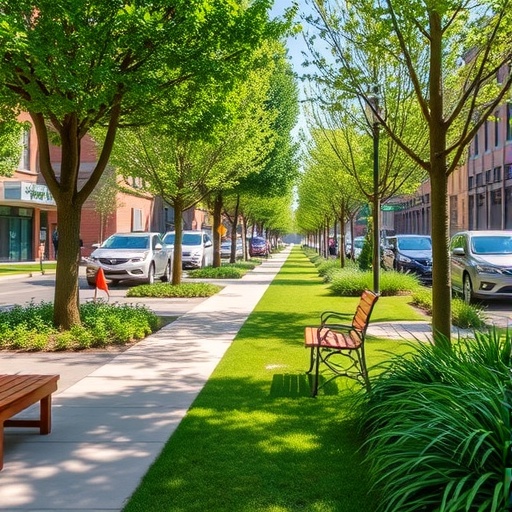
As global temperatures steadily climb, cities around the world find themselves grappling with escalating urban heat and the associated dangers to public health, economic productivity, and overall living conditions. Heat stress within these urban environments poses a profound threat, disproportionately affecting vulnerable populations and exacerbating existing social inequalities. In response, city planners and environmental scientists have long championed the expansion of street green space — the trees, shrubs, and other vegetation lining city streets — as a nature-based solution to this intensifying crisis. The promise of urban greenery lies in its ability to provide shade, facilitate evaporative cooling, and enhance psychological well-being. However, until recently, the scientific community lacked a comprehensive, global-scale understanding of the extent to which street greenery can mitigate urban heat, especially under future climate scenarios.
A pioneering new study spearheaded by researchers at the International Institute for Applied Systems Analysis (IIASA) in collaboration with VITO Belgium breaks ground by harnessing high-resolution urban greenery data alongside fine-scale (100-meter resolution) microclimate model outputs for 133 cities worldwide. This unprecedented approach transcends the common reliance on satellite-derived surface temperatures, instead focusing on ambient air temperature and wet-bulb globe temperature (WBGT) metrics. WBGT is a more nuanced indicator of heat stress as it incorporates factors such as humidity, wind, and radiant heat, providing a more accurate reflection of the thermal strain experienced by urban inhabitants.
The study reveals a multifaceted and geographically differentiated cooling effect of street greenery. Tropical and continental climates benefit most substantially from increased urban vegetation, where the interplay between dense foliage and climatic characteristics amplifies cooling effects. Conversely, dry and temperate zones demonstrate weaker cooling potentials, suggesting that vegetation’s capacity to moderate heat is intricately tied to local atmospheric and environmental conditions. Moreover, the morphology of urban areas plays a decisive role; open, low-rise neighborhoods display the strongest cooling benefits, likely due to the greater spatial extent available for vegetation to impact air flow and shading. In contrast, dense, high-rise areas see diminished returns from street greenery interventions.
One striking insight uncovered by the research is the disparity between where urban heat stress is most severe and where the urban fabric allows for substantial increases in green space. Arid and continental regions, which confront some of the harshest urban heat challenges, simultaneously face structural and climatic constraints limiting feasible greenery expansion. This misalignment presents a formidable policy and planning puzzle: how can cities most in need of cooling harness the benefits of urban vegetation when physical and ecological conditions impose strict limits?
Projecting these dynamics into the mid-21st century, the study evaluates multiple future climate scenarios alongside plausible urban greening pathways. Under a “current policies” trajectory — reflecting ongoing climate mitigation efforts — ambitious yet realistic expansions of street greenery could offset between 3% and 11% of the projected escalation in maximum WBGT values by 2050. Notably, this ameliorative capacity diminishes under high-emission futures, with reductions ranging from just 2% to 7%. These findings imply that while urban greenery constitutes a critical adaptation lever, its efficacy is strongly contingent on broader climate outcomes. Should emissions continue unabated, the relative benefits of greening interventions wane, illustrating the imperative for integrated mitigation and adaptation strategies in tandem.
The researchers also caution against complacency. The loss of existing street vegetation — whether through neglect, urban infrastructure development, or increased plant mortality from extreme heat and drought — risks exacerbating heat stress beyond current projections. Maintaining and enhancing urban tree canopies must therefore be prioritized alongside new planting initiatives to preserve crucial cooling services. This maintenance is particularly urgent given the threats posed by climate-induced plant stress, which could undermine the longevity and efficacy of urban greenery investments.
From a policy perspective, the study underscores the importance of contextualized and multi-pronged urban cooling strategies. Simply expanding street greenery is necessary but insufficient in isolation. Complementary measures that encompass heat-resilient building materials, optimized urban design for air circulation, and equitable distribution of green infrastructure are vital for comprehensive adaptation. The complex interplay of urban form, climate zone, and socio-spatial inequalities means that a one-size-fits-all approach will fall short in safeguarding vulnerable urban populations.
Critically, the research draws attention to the need for strategic placement and preservation of street green spaces to avoid exacerbating existing health disparities. Uneven distribution of greenery can worsen urban heat exposure inequalities, disproportionately impacting low-income or marginalized communities. Effective adaptation thus requires inclusive urban planning processes that prioritize equitable access to cooling benefits across all societal groups.
By synthesizing and standardizing data from diverse cities around the globe, this study marks a substantial advance in the urban heat mitigation literature. It highlights the real, albeit variable, potential of street green space as an adaptive measure and forges a clearer path for policymakers seeking evidence-based guidance. The findings argue compellingly that urban greenery should be incorporated as a core element in climate adaptation frameworks, integrated with aggressive emissions reductions and thoughtful urban development.
In a warming world, cities will increasingly find themselves grappling with the twin challenges of rising temperatures and intensifying social inequities. This research offers a sobering yet hopeful vision: street greenery can play a meaningful role in cooling urban environments and protecting public health, but only as part of a broader mosaic of well-coordinated, locally tailored actions. The path towards climate-resilient, livable cities requires grappling with complexity and embracing nature-based solutions alongside innovative engineering and policy innovations.
As researchers and city planners continue to refine models and gather data, ongoing monitoring will be essential to adapt strategies dynamically in response to evolving climatic and urban conditions. Preserving and expanding street green spaces, particularly in rapidly urbanizing regions, emerges not merely as an environmental gesture but as a necessary investment in human well-being and climate justice for the decades ahead.
News Publication Date: 7-Apr-2026
Web References:
https://iopscience.iop.org/article/10.1088/1748-9326/ae5c20
References:
Falchetta, G., Lohrey, S., Souverijns, N., Lauwaet, D., Schleussner, C.-F., and Niamir, L. (2026). Street green space is relevant but not sufficient for adapting to growing urban heat in world cities. Environmental Research Letters. DOI: 10.1088/1748-9326/ae5c20
Keywords
Urban heat, street greenery, climate adaptation, wet-bulb globe temperature, urban microclimate, nature-based solutions, heat stress mitigation, urban planning, climate resilience, global cities, green infrastructure, environmental equity
Cite Scienmag News
Grant Pearson. (April 9, 2026). Street Green Spaces Help Cool Cities, But Alone They Aren’t Enough. Scienmag. https://scienmag.com/street-green-spaces-help-cool-cities-but-alone-they-arent-enough/
Grant Pearson. "Street Green Spaces Help Cool Cities, But Alone They Aren’t Enough." Scienmag, 9 April 2026, https://scienmag.com/street-green-spaces-help-cool-cities-but-alone-they-arent-enough/. Accessed 3 September 2026.
Grant Pearson. "Street Green Spaces Help Cool Cities, But Alone They Aren’t Enough." Scienmag. April 9, 2026. https://scienmag.com/street-green-spaces-help-cool-cities-but-alone-they-arent-enough/


