


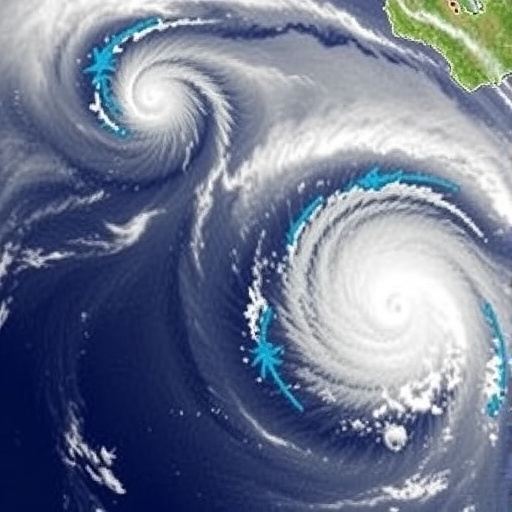
In a groundbreaking study, scientists at the University of Hawai‘i at Mānoa have uncovered compelling evidence that the Madden–Julian Oscillation (MJO) plays a pivotal role in shaping the climate patterns of the Hawaiian Islands. The MJO, a large-scale tropical atmospheric disturbance characterized by an eastward progression through the tropics every 30 to 60 days, has long been recognized for its influence on tropical weather systems globally. However, this recent research offers the first detailed analysis of how the MJO specifically modulates weather conditions in Hawai‘i with profound implications for precipitation variability and temperature fluctuations across the region.
Historically, the MJO has been studied extensively for its role in affecting monsoons, cyclones, and rainfall patterns in Southeast Asia and the Indian Ocean, but its effects on Pacific island microclimates have remained understudied. The University of Hawai‘i researchers, led by doctoral candidate Audrey Nash, rigorously tested the hypothesis that the MJO influences Hawai‘i’s climate through changes in wind, humidity, and temperature profiles. By utilizing high-resolution atmospheric and precipitation datasets spanning several decades, coupled with advanced compositing techniques, the team delineated a clear, consistent correlation between the MJO’s phases and rainfall anomalies on the islands.
During the MJO’s active phases, the Hawaiian Islands experience a marked increase in rainfall, particularly pronounced on windward slopes, which receive moist trade winds originating from the northeast. These phases are characterized by enhanced atmospheric convection and cloud formation, resulting in persistent heavy rains and swollen streams, phenomena increasingly observed in recent years. Conversely, the suppressed phases of the MJO correspond with significantly drier conditions, reduced humidity, and diminished precipitation events, deepening the regional drought risk. This dynamic interplay contributes to a complex mosaic of wet and dry spells that can last several weeks to months, profoundly impacting water resource availability.
A striking aspect of the findings is the consistent temperature reduction across the islands during active MJO phases. The researchers attribute this to enhanced cloud cover and convective activity, which inhibits solar radiation reaching the surface. Additionally, they identified stronger northeasterly trade winds promoting localized atmospheric cooling. These meteorological changes dovetail with large-scale atmospheric patterns, including slow-moving Rossby waves across the central North Pacific. Rossby waves, meandering planetary-scale atmospheric waves, appear to intensify and slow down in conjunction with the MJO’s active phases, reinforcing the climatic modulation observed locally.
Crucially, the study highlights the role of the Hadley Circulation—a fundamental component of global atmospheric dynamics responsible for transporting heat from the equator towards the poles. The researchers found that during active MJO periods, the Hadley Circulation is notably strengthened in the central Pacific region. This intensification results in enhanced subsidence in the subtropics and uplift near the equator, creating favorable conditions for increased precipitation and cooler temperatures in Hawai‘i. This link between large-scale circulation changes and regional climate underscores the interconnected nature of tropical atmospheric phenomena.
The methodological framework employed by Nash and her team relied heavily on long-term meteorological datasets, including those curated by the Hawai‘i Climate Data Portal. Their approach involved isolating different phases of the MJO through real-time indices and statistically compositing atmospheric variables to discern patterns over monthly to seasonal timescales. Such granularity is essential because it allows scientists to predict and characterize intermediate climate variability that often eludes conventional forecasting models focused on daily or annual scales.
This enhanced understanding of MJO-driven climate modulation carries significant implications for water resource management, agriculture, and hazard preparedness in Hawai‘i. Given that the islands are among the most remote human habitations globally, they depend heavily on local rainfall for freshwater supplies. Variability in precipitation directly affects groundwater recharge rates, reservoir levels, and agricultural productivity. By integrating MJO phase monitoring into forecasting systems, stakeholders can better anticipate periods of heavy rainfall that may lead to flooding or suppressed rainfall that can exacerbate drought conditions, enabling proactive mitigation strategies.
Furthermore, the research represents a critical step forward in extending skillful weather and climate prediction capabilities for Hawai‘i from weeks to months in advance. Seasonal forecasts that incorporate MJO dynamics could revolutionize planning for water utilities, farmers, emergency response agencies, and even tourism sectors sensitive to weather variability. This capability is especially vital in a changing climate context, where extreme weather events are expected to increase in frequency and intensity, challenging traditional resilience frameworks.
From a scientific standpoint, the study elucidates the subtleties of tropical atmospheric teleconnections—how phenomena originating in one region propagate and influence remote climatological outcomes. The demonstrated interaction between the Madden–Julian Oscillation and regional weather in Hawai‘i exemplifies an intricate dance between tropical convection, wave dynamics, and localized orographic effects unique to island topography. This multi-scale coupling invites further research into other isolated regions similarly impacted by broader ocean-atmosphere oscillations.
The lead researcher, Audrey Nash, emphasized that comprehensively understanding the MJO’s slow evolution and real-time monitoring potential enhances forecasting accuracy and provides invaluable insights into the mechanisms driving Hawaiian climate variability. Her collaboration with atmospheric sciences faculty further leveraged expertise in dynamical meteorology and statistical analysis, resulting in robust, peer-reviewed findings recently published in the prestigious Journal of Hydrometeorology.
In summary, this study sheds new light on the critical influence of the Madden–Julian Oscillation on Hawai‘i’s climate, revealing how its active and suppressed phases lead to reliable, predictable swings in rainfall, wind flow, humidity, and temperature. These findings possess transformative potential for improving weather forecasts, informing water and land use management, and bolstering natural disaster preparedness in one of the world’s most vulnerable island ecosystems. As research efforts continue, integrating these insights with broader climate modeling promises to refine our grasp of tropical atmospheric processes and their far-reaching impacts.
News Publication Date: 1-Apr-2026
Web References: https://journals.ametsoc.org/view/journals/hydr/aop/JHM-D-25-0054.1/JHM-D-25-0054.1.xml, http://dx.doi.org/10.1175/JHM-D-25-0054.1
Cite Scienmag News
Russell Cooper. (April 9, 2026). Tropical Disturbance Brings Increased Rainfall to the Hawaiian Islands. Scienmag. https://scienmag.com/tropical-disturbance-brings-increased-rainfall-to-the-hawaiian-islands/
Russell Cooper. "Tropical Disturbance Brings Increased Rainfall to the Hawaiian Islands." Scienmag, 9 April 2026, https://scienmag.com/tropical-disturbance-brings-increased-rainfall-to-the-hawaiian-islands/. Accessed 4 September 2026.
Russell Cooper. "Tropical Disturbance Brings Increased Rainfall to the Hawaiian Islands." Scienmag. April 9, 2026. https://scienmag.com/tropical-disturbance-brings-increased-rainfall-to-the-hawaiian-islands/


