


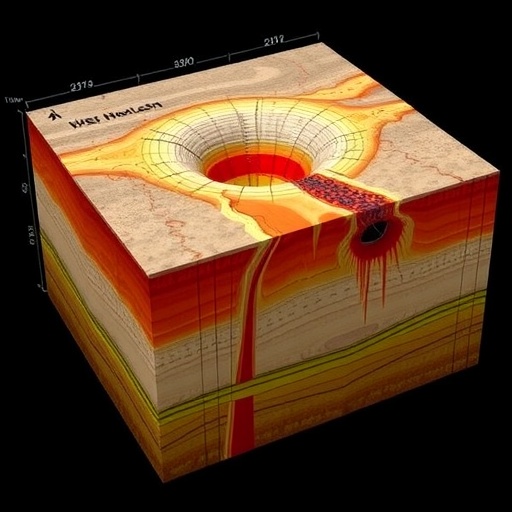
In a groundbreaking study published in Nature Communications, a team of geophysicists led by Wolf, Li, and Romanowicz unveils compelling evidence of fossilized mantle deformation patterns linked to a previously enigmatic geological feature known as the Perm Anomaly. This discovery offers unprecedented insights into the deep Earth processes that shaped continental configurations hundreds of millions of years ago, potentially rewriting our understanding of mantle convection dynamics during the Permian period.
The Earth’s mantle, a thick layer of semi-solid rock beneath the crust, is the engine room of tectonic activity and plate movement. However, deciphering its complex, slow-moving internal processes has long challenged scientists due to the mantle’s inaccessibility and complex behavior. By examining seismic anisotropy and deformation records, the research team has illuminated a previously unrecognized pattern of mantle upwelling linked to convergent tectonic forces, dating back to nearly 299 million years ago.
The Perm Anomaly, named for its temporal association with the Permian geological period, presented a puzzling seismic signature that remained poorly understood until now. Previous seismic tomography studies had hinted at anomalous low-velocity regions in the lower mantle, but the exact mechanisms and historical significance behind these anomalies were speculative at best. Wolf and colleagues have bridged this knowledge gap by meticulously correlating mantle strain records with plate tectonic reconstructions, revealing a fossilized convergent upwelling process.
Crucially, the study uses mantle deformation as a paleogeodynamic archive. Through advanced seismic waveform analysis and computational modeling, the authors identified ancient strain patterns indicative of sustained, localized mantle upwelling beneath zones of convergent plate boundaries. This phenomenon contrasts with the typically envisaged mantle plumes associated with hotspot volcanism, revealing a unique geodynamic process driving mantle dynamics in the deep past.
The implications of this discovery are profound for understanding mantle convection mechanisms. Convergent upwelling implies a scenario where subducted slabs induce counterflow within the mantle, forcing material to ascend at boundaries rather than solely descend or circulate horizontally. This could mean that mantle convection is more heterogeneous and influenced by subduction histories than classical models have suggested, affecting heat and material transfer on a global scale.
Wolf and colleagues’ investigation also sheds light on the role of the Perm Anomaly in supercontinent cycles. The fossil mantle deformation patterns correspond spatially and temporally to the assembly of Pangea, suggesting that deep mantle processes intimately influenced the tectonic reorganization responsible for one of Earth’s greatest continental amalgamations. The study posits that such convergent upwelling could have affected mantle plume generation, volcanic activity, and ultimately continental breakup in the Permian and subsequent periods.
Methodologically, the research harnesses the synergy between seismic anisotropy measurements derived from shear-wave splitting and state-of-the-art geodynamic modeling to reconstruct mantle flow fields. By integrating tomographic images with synthetic seismic data, the researchers could infer strain rates and flow directions at depths exceeding 700 kilometers, offering an unprecedented window into mantle deformation frozen in geological time.
The team also explores how mantle composition and temperature heterogeneities influenced the observed deformation patterns. Variations in mineral physics, temperature gradients, and phase changes within the mantle likely modulated the rheological behavior of materials, enabling the mantle to record deformation imprints for millions of years. This intersection of mineral physics and geodynamics underscores the importance of multidisciplinary approaches in unraveling deep Earth mysteries.
Furthermore, the authors discuss how these convergent upwellings may have interacted with surface geology. The deformation beneath subduction zones potentially influenced magmatism, uplift, and basin formation, connecting mantle flow to crustal processes in a tangible way. This insight challenges the conventional compartmentalization of Earth’s interior processes and surface expressions, advocating for holistic models of Earth system evolution.
The research breaks new ground by identifying fossilized mantle deformation as a proxy for ancient mantle flow patterns, a novel concept that could revolutionize our ability to read the mantle’s geological record. By demonstrating that these deformation fields survive over geological timescales, the study opens the door for future explorations into the links between mantle dynamics and tectonic history, offering a new lens to investigate Earth’s geodynamic past.
Beyond the Perm Anomaly, the study’s findings invite comparative analyses of other mantle anomalies globally. Could similar fossilized deformation records exist beneath other ancient convergent margins? Answering this requires extending seismic studies and refining geodynamic models, tasks that Wolf and colleagues advocate for, promoting a new era of mantle tectonics research.
Additionally, the interrelation between mantle deformation and the geochemical signatures of volcanic rocks becomes a promising avenue. If upwelling zones induced by convergence have distinct chemical fingerprints, geologists could better correlate mantle processes with observed geochemical anomalies in the rock record, bridging geophysics and geochemistry in an integrative framework.
While the study focuses on a deep-time event, its methodology and conceptual advancements resonate with broader concerns. Understanding modern mantle convection patterns and their implications for seismic hazards, volcanism, and plate dynamics may benefit from insights gained by studying fossil analogs, enhancing predictive geodynamics on both human and geological timescales.
In conclusion, the landmark study by Wolf, Li, and Romanowicz offers a transformative perspective on mantle convection during the Permian period. By identifying fossilized convergent mantle upwelling beneath the Perm Anomaly, the research not only deepens our understanding of deep Earth processes but also bridges mantle dynamics with surface tectonic evolution. This work exemplifies the power of integrating seismic data, computational modeling, and geological history to unravel Earth’s most profound secrets, setting a new benchmark for geophysical research in the decades to come.
Cite Scienmag News
Violet Maxwell. (April 3, 2026). Mantle Deformation Reveals Perm Anomaly Upwelling. Scienmag. https://scienmag.com/mantle-deformation-reveals-perm-anomaly-upwelling/
Violet Maxwell. "Mantle Deformation Reveals Perm Anomaly Upwelling." Scienmag, 3 April 2026, https://scienmag.com/mantle-deformation-reveals-perm-anomaly-upwelling/. Accessed 3 September 2026.
Violet Maxwell. "Mantle Deformation Reveals Perm Anomaly Upwelling." Scienmag. April 3, 2026. https://scienmag.com/mantle-deformation-reveals-perm-anomaly-upwelling/


