


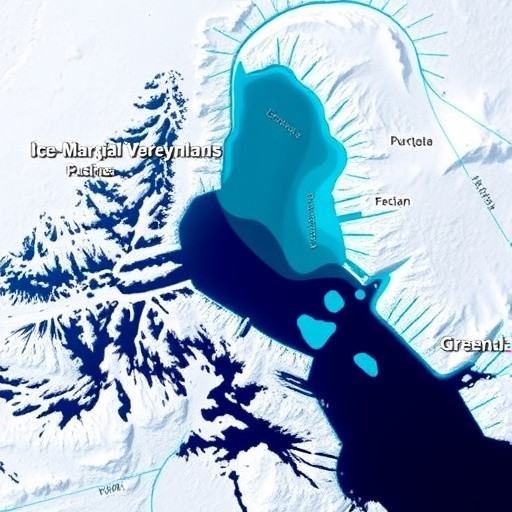
In a groundbreaking study poised to reshape our understanding of ice dynamics in Greenland, researchers have uncovered compelling evidence that ice-marginal proglacial lakes significantly accelerate the velocities of outlet glaciers. This discovery, published in Communications Earth & Environment, heralds a pivotal advancement in glaciology by illuminating the intricate hydrological and mechanical interactions at the ice sheet margins, with profound implications for predicting sea-level rise in a warming climate.
The Greenland Ice Sheet, a colossal frozen archive holding centuries of climate history and one of the largest freshwater reservoirs on Earth, has been under intensive scrutiny as global temperatures climb. Central to the current research is the often-overlooked role of proglacial lakes—transient bodies of water that form along glacier margins at the interface where ice meets the underlying bedrock or terminates into the ocean. These lakes, shaped by meltwater pooling in depressions adjacent to the glacier fronts, have now been directly linked to modulating the pace at which outlet glaciers drain ice from the interior to the ocean.
The study integrates a robust synthesis of satellite remote sensing, field measurements, and numerical ice flow modeling to expose a clear relationship between the presence of ice-marginal proglacial lakes and increased glacier velocities. Specifically, the research team identified that lakes situated along the glacier margins act as hydraulic hubs that enhance basal lubrication, thereby facilitating more rapid glacier sliding over the bed. This lubricant effect weakens frictional resistance at the glacier base, enabling the ice to surge forward with unprecedented speed, a phenomenon previously underestimated in ice flow models.
By deploying high-resolution synthetic aperture radar interferometry (InSAR) across multiple Greenland outlet glaciers, the authors documented spatially coherent acceleration zones correlating strongly with lake locations. These glaciers exhibited velocity increases up to 30% higher than upstream areas devoid of proglacial lakes. The temporal correspondence was equally striking; seasonal variations in lake extent, driven by meltwater dynamics, aligned closely with fluctuations in glacier speed, underscoring a direct causal mechanism.
The hydrodynamic interplay between lakes and subglacial environments is further elucidated through field campaigns equipped with GPS arrays and sediment probes that measure basal sliding rates and bed deformation. Data from these instruments revealed that proglacial lakes act as reservoirs that not only funnel meltwater to glacier beds but also exert spatially variable pressure, destabilizing ice masses and potentially triggering episodic velocity boosts known as glacier surges.
Numerical ice flow simulations including realistic lake–glacier interactions were pivotal in capturing these dynamics. Models incorporating proglacial lake hydraulics generated velocity outputs remarkably consistent with observed accelerations, reinforcing the hypothesis that lakes fundamentally alter ice sheet behavior. This contrasts sharply with traditional models ignoring liquid water storage at glacier margins, which substantially underestimated outlet glacier contributions to ice discharge.
The ramifications of these insights extend beyond pure glaciological interest, as accelerating outlet glaciers translate directly into enhanced ice mass loss, contributing to global sea-level rise. Greenland’s contribution to sea level has surged in recent decades, and this study suggests that proglacial lakes could accelerate this trend by creating feedback loops that amplify ice flow response to melting. Understanding these mechanisms opens a new frontier in sea-level rise projections, demanding incorporation of lake-driven dynamics into climate impact assessments.
Moreover, the spatial heterogeneity of proglacial lakes across Greenland’s diverse topographic and climatic zones points to regional variability in glacier response. The study highlights that southern and western outlet glaciers, where lakes are more prevalent due to favorable bed geometry and meltwater accumulation, exhibit pronounced velocity enhancements relative to their northern counterparts. This heterogeneity underscores the importance of localized field studies combined with continental scale remote sensing to accurately capture system-wide behavior.
Importantly, the research sheds light on how future climate scenarios may exacerbate these effects. As meltwater production intensifies with rising temperatures, the expansion and persistence of proglacial lakes could grow, further lubricating glacier beds and driving faster ice flows. This positive feedback mechanism could accelerate ice mass loss at rates not currently considered in large-scale ice sheet models, presenting a sobering challenge for climate mitigation and adaptation efforts.
The mechanistic understanding advanced by this study also prompts reconsideration of ice shelf stability in Greenland’s marine-terminating glaciers. Enhanced glacier velocities driven by lakes could lead to more rapid calving and thinning, undermining ice shelf integrity and potentially precipitating further dynamic instabilities. This domino effect accentuates the vulnerability of polar ice to subtle yet potent surface meltwater processes.
Furthermore, the methodology developed for detecting and quantifying the influence of proglacial lakes offers a new toolkit for glaciologists. By integrating state-of-the-art remote sensing with ground-based observations and refined numerical models, scientists can now monitor these lakes in near-real time and forecast their impact on glacier flow dynamics with improved fidelity. This capability is vital for early warning systems addressing flood risks from lake outburst events, which pose significant hazards in Greenland’s rapidly changing environment.
This study also invites interdisciplinary collaboration, bridging hydrology, glaciology, climatology, and geophysics to unravel the complexities of ice margin processes. It exemplifies the power of coupling observational data with theoretical and computational frameworks to decode environmental phenomena that have eluded comprehensive understanding until now.
In summary, the revelation that ice-marginal proglacial lakes enhance outlet glacier velocities across Greenland represents a monumental stride in comprehending the intricacies of ice sheet dynamics amid climate change. It challenges prevailing paradigms and compels the scientific community to refine existing models to capture the nuanced feedbacks shaping ice mass balance and sea-level projections. As Greenland’s ice continues to respond sensitively to a warming world, these findings emphasize the critical role of meltwater storage in determining the future trajectory of global sea-level rise and polar ice stability.
This transformative research underscores the urgency of sustained monitoring and pioneering modeling efforts to anticipate and mitigate the consequences of accelerating glacier dynamics. It heralds a new chapter in cryospheric science where subtle hydrological features emerge as powerful agents sculpting Earth’s frozen frontiers.
Cite Scienmag News
Violet Maxwell. (April 1, 2026). Ice-Marginal Lakes Speed Greenland’s Outlet Glaciers. Scienmag. https://scienmag.com/ice-marginal-lakes-speed-greenlands-outlet-glaciers/
Violet Maxwell. "Ice-Marginal Lakes Speed Greenland’s Outlet Glaciers." Scienmag, 1 April 2026, https://scienmag.com/ice-marginal-lakes-speed-greenlands-outlet-glaciers/. Accessed 4 September 2026.
Violet Maxwell. "Ice-Marginal Lakes Speed Greenland’s Outlet Glaciers." Scienmag. April 1, 2026. https://scienmag.com/ice-marginal-lakes-speed-greenlands-outlet-glaciers/


