


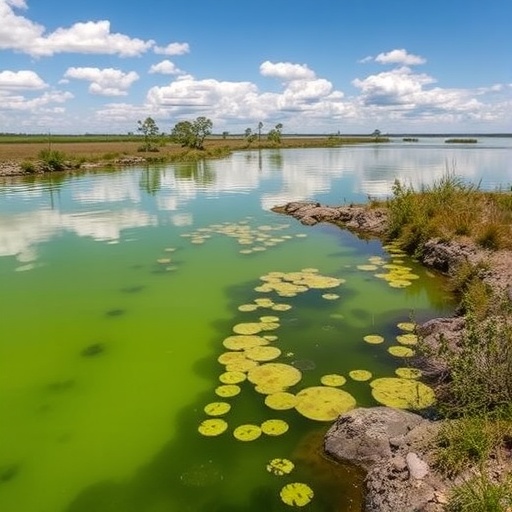
The global proliferation of algal blooms in freshwater ecosystems has become an urgent environmental concern, intensifying as climate change accelerates. A groundbreaking study recently published in Communications Earth & Environment provides compelling evidence on how a combination of anthropogenic activities and climatic factors governs both the intensity and timing of algal blooms in lakes worldwide. This research offers unprecedented insights into the mechanistic underpinnings of bloom dynamics, raising alarm bells about the cascading ecological, economic, and public health consequences.
Lakes serve as critical sources of freshwater and biodiversity, but they are increasingly jeopardized by large-scale algal bloom events. These blooms, often dominated by cyanobacteria or green algae, can produce toxins detrimental to aquatic life and humans. The new study by Xue, Ma, Hu, and colleagues synthesizes global datasets and climate model projections to unravel the complex interplay between human influences—such as nutrient runoff—and climatic drivers, including temperature elevation and precipitation variability. Their findings underscore a shifting paradigm in freshwater ecology where legacy and emerging anthropogenic pressures converge with global warming to reshape lake biogeochemistry.
At the core of the analysis is the recognition that algal bloom timing is no longer a static seasonal phenomenon but one that is increasingly asynchronous and unpredictable. By integrating high-resolution lake monitoring data from continents around the globe, the research team identified that warmer temperatures lead to earlier onset and prolonged duration of bloom periods across many regions. These phenological shifts challenge traditional lake management strategies and complicate forecasting efforts, which often rely on historical bloom patterns.
More revealing is how anthropogenic nutrient inputs—chiefly phosphorus and nitrogen from agricultural runoff and urban wastewater—interact synergistically with climatic factors. Nutrient enrichment alone provides the essential substrates for algal proliferation, but when combined with elevated temperatures and altered hydrological cycles, it creates a feedback loop that magnifies bloom severity. For instance, increased rainfall intensity accelerates nutrient flushing into lakes, while drought conditions concentrate nutrients during low water periods, both scenarios intensifying bloom outbreaks.
In addition to quantitative telemetry, the researchers utilized advanced ecological models that incorporate both human-induced nutrient loading and projected climate variables extending toward the mid-21st century. The models predict that in temperate zones, algal blooms will not only become more frequent but also shift their peak intensity toward earlier months, effectively lengthening the window of ecological stress. Tropical lakes, already experiencing year-round warm temperatures, risk heightened bloom toxicity due to nutrient accumulation and thermal stratification effects.
Underlying these projections is the crucial influence of temperature-driven changes to lake stratification regimes. Warmer surface waters reduce mixing with cooler bottom layers, creating hypolimnion oxygen depletion that favors cyanobacterial dominance. This stratification-induced hypoxia further accelerates phosphorus release from sediments, thus fueling continued bloom development in a self-reinforcing cycle. The study’s multifaceted approach, combining empirical data with mechanistic ecological theory, elucidates the feedback mechanisms amplifying these processes under future climate scenarios.
Crucially, the research highlights significant geographic heterogeneity in response to the dual pressures of climate and human impact. Lakes in densely populated or intensively farmed regions demonstrate disproportionately severe increases in bloom intensity. Conversely, some relatively pristine or high-altitude systems, though buffered from nutrient influx, are nevertheless vulnerable to warming-driven phenological shifts. This nuance underscores the necessity for regionally tailored mitigation policies that consider localized environmental conditions alongside global climate trends.
The implications for biodiversity are profound. Prolonged and intense algal blooms disrupt aquatic food webs by creating dead zones where oxygen depletion devastates fish and invertebrate populations. Toxic blooms carry further ramifications for wildlife and pose serious risks to drinking water safety, necessitating costly treatment interventions. The study warns that without urgent action to curb nutrient pollution and address climate change, these ecological crises will exacerbate, compromising freshwater resource security worldwide.
From a socio-economic perspective, algal bloom events increasingly threaten fisheries, tourism, and recreational activities, striking at the livelihoods of communities dependent on healthy water bodies. With the predicted intensification and shifting timing of blooms, traditional seasonal patterns of lake use may no longer be viable, demanding adaptive management frameworks that are both flexible and anticipatory. The researchers advocate for an integrated approach combining nutrient management, habitat restoration, and climate adaptation strategies.
Technological advances in remote sensing and in situ monitoring played a pivotal role in this research, enabling high-frequency mapping of bloom occurrences across diverse climates and landscapes. The study demonstrates the power of leveraging big data and artificial intelligence to detect subtle trends and predict future scenarios with greater accuracy. By harnessing these tools, scientists and policymakers can better identify critical thresholds and deploy timely interventions to mitigate bloom impacts.
The study’s novel contributions extend beyond descriptive analyses by identifying potential tipping points where incremental climatic or anthropogenic changes induce disproportionate bloom responses. These non-linearities complicate ecosystem management but provide crucial signals for early warning systems. Recognizing such thresholds before irreversible damage occurs is vital for formulating resilient environmental policies that safeguard freshwater systems under ongoing global change.
Looking forward, the authors emphasize the importance of interdisciplinary cooperation to address the multifaceted challenges algal blooms present. Integrating hydrology, climatology, ecology, and socio-economic sciences will enable more comprehensive risk assessments and innovative solutions. National and international policies must prioritize reducing nutrient emissions, enhancing land-use planning, and supporting climate mitigation efforts to limit further ecosystem degradation.
In conclusion, this seminal study illuminates the intricate and escalating challenges posed by algal blooms in the Anthropocene. By quantifying how anthropogenic nutrient loading synergizes with climatic warming to alter bloom dynamics, it provides a critical roadmap for scientists, regulators, and stakeholders. Immediate, coordinated action based on sound science is imperative to prevent widespread loss of freshwater quality, biodiversity, and the ecosystem services upon which humanity depends.
As the world grapples with accelerating climate change, freshwater lakes are sentinels reflecting the broader environmental shifts underway. The compelling evidence presented by Xue, Ma, Hu et al. underscores that human activity does not merely influence local water systems but interacts dynamically with global climate to reshape planetary ecology. Ensuring the resilience of these vital ecosystems is one of the foremost environmental challenges of the 21st century, demanding sustained scientific inquiry and proactive stewardship.
Cite Scienmag News
Violet Maxwell. (April 1, 2026). Human and Climate Forces Shape Global Lake Algal Blooms. Scienmag. https://scienmag.com/human-and-climate-forces-shape-global-lake-algal-blooms/
Violet Maxwell. "Human and Climate Forces Shape Global Lake Algal Blooms." Scienmag, 1 April 2026, https://scienmag.com/human-and-climate-forces-shape-global-lake-algal-blooms/. Accessed 4 September 2026.
Violet Maxwell. "Human and Climate Forces Shape Global Lake Algal Blooms." Scienmag. April 1, 2026. https://scienmag.com/human-and-climate-forces-shape-global-lake-algal-blooms/


