


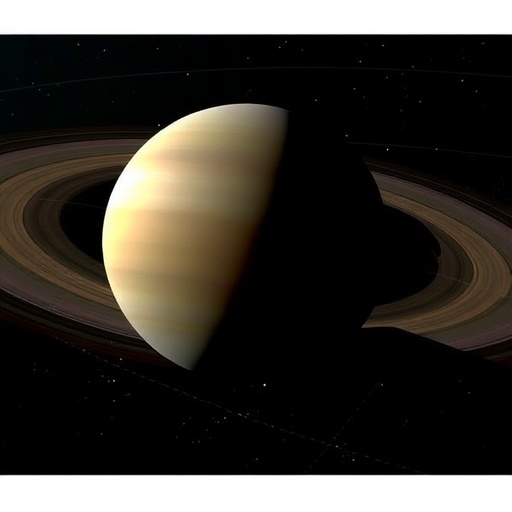
Saturn’s magnetic environment exhibits a striking asymmetry that sets it apart dramatically from Earth’s more symmetrical magnetic shield, a novel study has revealed. Researchers involved in this investigation, including experts from University College London (UCL), have analyzed long-term data to untangle the complex interplay between the planet’s fast rotation and the dense plasma generated by its active moons. These factors combine to sculpt a magnetosphere that behaves and structures itself unlike any other in our solar system, marking a transformative insight into planetary magnetic fields.
Planetary magnetospheres serve as protective bubbles that shield planets from the relentless bombardment of charged particles emanating from the solar wind. Saturn’s magnetosphere is particularly large, extending over ten times the planet’s diameter, creating one of the most expansive and dynamic magnetic environments among the gas giants. The research team, publishing their findings in Nature Communications, focused on precisely locating Saturn’s cusp region—the critical boundary where interplanetary magnetic field lines reconnect and direct solar wind particles into the planet’s polar atmosphere.
The study’s comprehensive analysis utilized six years’ worth of in-situ data from NASA’s Cassini spacecraft, which orbited Saturn from 2004 until 2017. By sifting through measurements from the spacecraft’s Magnetometer (MAG) and Plasma Spectrometer (CAPS), the scientists identified 67 cusp crossing events. These moments were distinguished by particular energy signatures from incoming electrons, signaling the spacecraft’s passage through this dynamic interface between Saturn’s magnetosphere and the solar wind.
A pivotal discovery revealed that Saturn’s cusp is not aligned symmetrically as it is on Earth. Instead of the cusp appearing at “12:00” as on Earth—meaning it is directly sunward—the Saturnian cusp was found predominantly shifted to the right side when viewed from the Sun, situated between the “13:00” and “15:00” positions on a theoretical clockface. This pronounced longitudinal offset reflects the unique environment shaped by the planet’s rapid rotational velocity and the intricate plasma interactions sourced from its moons.
Saturn completes a full rotation every 10.7 hours, an extraordinary speed given its immense size. This rapid rotation drags the ionized plasma—especially water vapor emitted from the geysers of Enceladus—into a corotating “plasma soup” that envelops the planet. The interaction between this heavy plasma and the magnetic field lines appears to twist and deflect the cusp region systematically, diverging from the patterns familiar in terrestrial magnetospheric dynamics. The concept that a planet’s own spin and moon-generated plasma can dominate its magnetospheric structure challenges long-standing paradigms anchored on solar wind dominance.
Professor Andrew Coates of UCL’s Mullard Space Science Laboratory, a co-author of the study, emphasized the significance of these findings by stating that comprehending the exact location of Saturn’s cusp is instrumental in mapping its entire magnetic bubble. Such understanding is crucial as space agencies plan ambitious missions to return to Saturn, particularly targeting Enceladus, whose subsurface ocean and rich organic chemistry make it a prime candidate in the search for extraterrestrial life within our solar system.
Enceladus’s plumes serve as a critical source of plasma, releasing vast quantities of water molecules that become ionized and trapped within Saturn’s magnetosphere. These heavy ions alter the magnetic environment significantly, producing a magnetospheric system that is both unique and complex. The study’s detection and analysis of low-energy electron populations, facilitated by sensors developed under Professor Coates’s guidance, were foundational in unraveling these unique plasma-magnetic field interactions on Saturn.
The international collaboration driving this research was led by institutions such as the Chinese Academy of Sciences, the Southern University of Science and Technology in China, and the University of Hong Kong. Their combined efforts leveraged both observational data and sophisticated computer simulations to validate the hypothesized magnetic asymmetry and its underlying drivers. By correlating Cassini data with dynamic magnetohydrodynamic models, the team demonstrated that Saturn’s magnetic field line behavior shares notable similarities with that observed at Jupiter, another rapidly spinning gas giant with complex moons and plasma environments.
Professor Zhonghua Yao from the University of Hong Kong highlighted how these comparative planetary studies shed light on unified physical mechanisms that govern solar wind interactions across diverse planetary systems. The insight gained not only broadens our understanding of terrestrial magnetism but also equips scientists to better comprehend magnetic environments around exoplanets orbiting distant stars, where direct measurement remains elusive.
Lead author Dr. Yan Xu noted that integrating Cassini’s rich dataset with numerical modeling enabled the team to conclude with reasonable confidence that Saturn’s magnetospheric cusp is markedly displaced due to the conjunction of rapid planetary rotation and moon-generated plasma influx. This pivotal finding sets a foundational reference point for interpreting magnetic environments not only around Saturn but also Jupiter and potentially other gas giants yet to be explored in detail.
This revelation invites a reevaluation of how magnetic environments are structured in rapidly rotating planetary systems. Unlike Earth, where solar wind pressure largely dictates magnetospheric shape and dynamics, Saturn—and presumably its gas giant siblings—demonstrate that internal processes, such as moon-driven plasma loading combined with high rotational velocities, can largely dominate the morphology and behavior of their magnetic shields.
Future exploration missions, particularly those focusing on Enceladus and other icy moons, will build upon this foundational understanding to better assess not only magnetospheric physics but also the potential habitability of these distant, ocean-bearing worlds. As mission designs progress, incorporating detailed magnetic field models that account for Saturn’s asymmetrical cusp location will be essential for accurately navigating and sampling these environments.
Funding support for this groundbreaking study was provided by the UK’s Science & Technology Facilities Council alongside the National Natural Science Foundation of China, underscoring the global scientific investment in unlocking the mysteries of our solar system’s largest magnetospheres.
News Publication Date: Not specified
Web References:
- DOI link: 10.1038/s41467-026-69666-9
References:
- Data sourced from NASA’s Cassini spacecraft Magnetometer (MAG) and Plasma Spectrometer (CAPS) instruments
- Study published in Nature Communications
Cite Scienmag News
Violet Maxwell. (April 1, 2026). Saturn’s Magnetic Bubble: A Peculiar Lopsidedness Compared to Earth’s. Scienmag. https://scienmag.com/saturns-magnetic-bubble-a-peculiar-lopsidedness-compared-to-earths/
Violet Maxwell. "Saturn’s Magnetic Bubble: A Peculiar Lopsidedness Compared to Earth’s." Scienmag, 1 April 2026, https://scienmag.com/saturns-magnetic-bubble-a-peculiar-lopsidedness-compared-to-earths/. Accessed 4 September 2026.
Violet Maxwell. "Saturn’s Magnetic Bubble: A Peculiar Lopsidedness Compared to Earth’s." Scienmag. April 1, 2026. https://scienmag.com/saturns-magnetic-bubble-a-peculiar-lopsidedness-compared-to-earths/


