


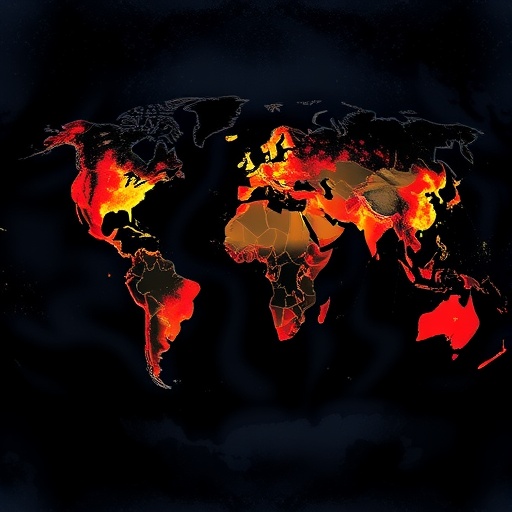
As the Earth’s climate continues to change at an unprecedented pace, a silent yet critical transformation is unfolding beneath our feet, impacting the very foundation of terrestrial ecosystems. Recent groundbreaking research has illuminated global hotspots where the loss of particulate organic carbon (POC) in soils is accelerating, threatening the stability of carbon reservoirs that help regulate our planet’s climate system. This discovery, published in Nature Communications by a team of international scientists led by Sun, Cotrufo, and Viscarra Rossel, paints a concerning picture of how climate change is reshaping soil carbon dynamics on a global scale.
Particulate organic carbon, a key component of soil organic matter, represents a complex mixture of decomposed plant and microbial residues. It acts as a critical carbon sink, locking away atmospheric carbon dioxide for extended periods and thus playing a pivotal role in mitigating climate change. The intricacy of POC lies in its vulnerability: it is both sensitive to environmental changes and essential for maintaining soil fertility, water retention, and overall ecosystem productivity.
The research draws upon an extensive array of soil samples, remote sensing technologies, and climate models to map regions where POC losses are most pronounced under changing climatic conditions. Their findings reveal that these losses are not uniformly distributed but concentrated in distinct global hotspots, where rising temperatures, altered precipitation patterns, and intensified land-use changes converge to accelerate the degradation and mineralization of particulate organic carbon.
One particularly alarming insight is the amplification of POC losses in boreal and temperate forests, regions historically considered stable carbon reservoirs. Warming temperatures in these biomes expedite microbial activity, which in turn enhances the breakdown of organic matter. This process releases stored carbon as greenhouse gases, creating a feedback loop that further exacerbates global warming, highlighting the delicate balance between climate and soil carbon storage.
Moreover, semi-arid and arid regions emerge as unexpected centers of concern. Shifts in precipitation regimes and increased frequency of droughts disturb the soil microbial ecosystems responsible for POC stabilization. These hydrological stressors compromise soil structure, leading to increased erosion and physical loss of particulate carbon. When combined with land degradation and human activities such as overgrazing and deforestation, the risk of permanent carbon loss escalates substantially.
This study also delves into the nuanced interplay between soil texture, mineralogy, and organic matter stability. Soil particles of certain sizes and mineral compositions interact with organic carbon differently, influencing its susceptibility to breakdown and loss. Climate change alters these interactions by modifying biological activity, soil moisture levels, and temperature regimes, illustrating the complex mechanisms underpinning soil carbon vulnerability.
Another dimension explored is the role of vegetation shifts triggered by climate perturbations. Changes in plant communities affect litter quality and quantity, which subsequently influence the input of organic carbon into soils. Species with litter that decomposes more rapidly can reduce the formation of persistent particulate organic carbon, thereby diminishing the soil’s carbon pool over time.
The implications of these soil carbon losses extend beyond climate feedbacks. They threaten agricultural productivity by degrading soil health, impair water quality due to increased erosion and nutrient runoff, and endanger biodiversity through habitat alteration. The study emphasizes the necessity for integrated land management practices that prioritize soil conservation as a climate mitigation strategy.
Of particular interest is the integration of high-resolution remote sensing data with ground-based observations. This methodological approach allows for unprecedented spatial precision in identifying POC loss hotspots, enabling targeted interventions. Advanced machine learning algorithms interpret spectral data to assess soil carbon content and changes over time, demonstrating the power of emerging technologies in ecological monitoring.
The researchers propose that addressing POC losses requires multidisciplinary collaboration, combining soil science, climatology, ecology, and socioeconomics. Policy frameworks should be informed by these scientific insights to implement adaptive strategies such as afforestation, sustainable agriculture, erosion control, and the restoration of degraded lands.
The article also challenges previous assumptions regarding the resilience of soil carbon stocks under future climate scenarios. It suggests that models must incorporate finer-scale soil processes and feedback mechanisms to accurately predict carbon-climate interactions. This refinement is critical for setting realistic targets in global carbon budgets and climate policies.
In summary, Sun and colleagues provide a compelling narrative that soil particulate organic carbon is at a crossroads, with climate change poised to trigger substantial losses in specific regions globally. Recognizing and mitigating these losses is imperative not only for maintaining soil health and ecosystem services but also for stabilizing global climate trajectories.
As the scientific community mobilizes to tackle the multifaceted challenges of climate change, this research underscores the urgency of expanding our focus to subterranean carbon reservoirs. Soils, often overlooked in public discourse, harbor immense potential both as victims and mitigators of climate change. Protecting particulate organic carbon could prove vital in curbing greenhouse gas emissions and securing the planet’s ecological future.
This landmark study invites deeper investigation into synergistic factors such as soil microbial communities, land management practices, and climate extremes. Only through comprehensive understanding can humanity hope to safeguard the invisible but invaluable carbon stocks beneath our feet.
The findings serve as a clarion call to integrate soil carbon conservation into global climate strategies, recognizing that the battle against climate change is inseparable from the stewardship of Earth’s most fundamental resources.
Sun, S., Cotrufo, M.F., Viscarra Rossel, R.A. et al. Global hotspots of particulate organic carbon losses under climate change. Nat Commun (2026). https://doi.org/10.1038/s41467-026-71321-2
Cite Scienmag News
Violet Maxwell. (April 1, 2026). Global Hotspots of Particulate Organic Carbon Decline. Scienmag. https://scienmag.com/global-hotspots-of-particulate-organic-carbon-decline/
Violet Maxwell. "Global Hotspots of Particulate Organic Carbon Decline." Scienmag, 1 April 2026, https://scienmag.com/global-hotspots-of-particulate-organic-carbon-decline/. Accessed 4 September 2026.
Violet Maxwell. "Global Hotspots of Particulate Organic Carbon Decline." Scienmag. April 1, 2026. https://scienmag.com/global-hotspots-of-particulate-organic-carbon-decline/


