


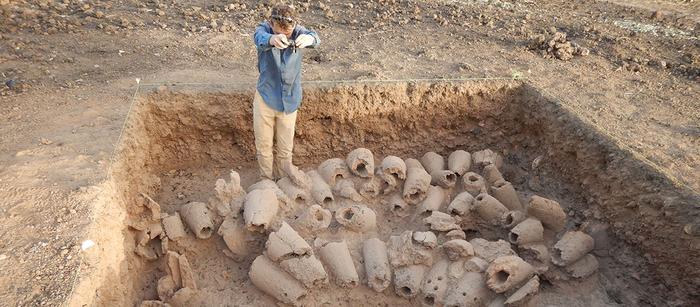
In a groundbreaking archaeological discovery that sheds fresh light on the technological history of sub-Saharan Africa, researchers have unearthed a remarkably well-preserved iron smelting workshop dating back over two millennia in eastern Senegal. This revelation challenges longstanding uncertainties about the origins and evolution of iron metallurgy on the African continent, offering unprecedented insight into the development of a technology crucial for societal advancement. The newly studied site, known as Didé West 1 (DDW1), was active from the 4th century BCE through nearly eight centuries, making it unique for its longevity and preservation.
Iron smelting, a transformative process that enabled societies to produce durable agricultural tools and weapons, marks a pivotal shift in human history. While Europe’s Iron Age traditionally spans from approximately 800 BCE to the end of the 1st century CE, the timeline and geographic spread of iron technology differ significantly worldwide. The earliest proven iron production emerged around the 2nd millennium BCE in regions like Anatolia and the Caucasus. From these areas, the techniques are thought to have disseminated into Europe and other continents. However, whether iron metallurgy developed independently in Africa or arrived through diffusion has remained a subject of intense academic debate.
The Didé West 1 excavation team, predominantly from the University of Geneva (UNIGE) in collaboration with the Institut Fondamental d’Afrique Noire (IFAN) in Dakar, embarked on a mission to explore this enigma further. Their work uncovered an iron-smelting workshop set within the Falémé River valley, one of eastern Senegal’s prominent archaeological landscapes. The site revealed a massive slag heap estimated to contain approximately one hundred tons of residual material from iron production, illustrating the scale and intensity of metallurgical activity conducted there.
Equally noteworthy are the site’s assemblage of about thirty used “tuyères” — clay blowpipe components crucial in delivering air to the furnace — and 35 circular furnace bases around 30 cm deep, each crafted with a precision implying advanced technical understanding. These furnaces and tuyères exhibit distinctive features, such as multiple small transverse openings rather than a singular air outlet, a design innovation that optimizes airflow distribution deep within the furnace chamber. This innovation likely enhanced combustion efficiency and metal extraction rates critical to ancient ironworking.
Adding to this technological uniqueness is the discovery of palm nut seeds used as packing material at the base of the furnaces—a phenomenon not previously documented in known African iron smelting contexts. This organic packing might have served purposes such as insulation, air regulation, or structural support during the smelting process, indicating sophisticated adaptation to locally available materials. The combination of these tools and techniques reflects a metallurgical tradition locally designated as FAL02, which exhibits remarkable stability over centuries.
What stands out about the DDW1 site is its prolonged continuous use, a rarity among other African ironworking locations that typically show occupational periods spanning only a few generations. This continuity underscores not only technological stability but potentially the cultural importance and social structures surrounding iron production in this region. Maintaining consistent technical methods over eight centuries speaks to a deliberate preservation of metallurgical knowledge and practice.
Ongoing ethnographic studies support these findings, with researchers comparing ancient methodologies to contemporary potters and blacksmiths still practicing in the Falémé Valley. These parallels help bridge millennia, illustrating how cultural transmission of technology may have occurred and highlighting the resilience of certain artisanal traditions. The insights gained may revise existing paradigms about how metallurgical knowledge evolved and spread across West Africa.
The study’s lead researchers emphasize that the enduring nature of the FAL02 smelting tradition contrasts sharply with other African metallurgy practices characterized by rapid shifts and technological diffusion. This points to localized decision-making and adaptation tailored to environmental and social conditions. The research further challenges prior assumptions of African ironworking as derivative, instead positioning it as an independent and dynamic center of innovation.
Iron metallurgy’s emergence in Africa has critical implications beyond archaeology; it influenced agricultural productivity, settlement patterns, and technological exchange, ultimately shaping complex societies. Discovering a site like DDW1, with its technical sophistication and prolonged activity, deepens appreciation of Africa’s role in global technological history. It invites a reevaluation of technological development timelines and contributes essential data to reconstruct prehistoric socio-economic networks.
Current research efforts are expanding to additional sites within Senegal to contextualize these smelting practices within a broader regional framework. Scientists aim to assemble a comprehensive picture of how ironworking technologies diversified and propagated throughout West Africa during the first millennium BCE. Given the scarcity of such well-preserved sites with reliable dating, the DDW1 workshop serves as a benchmark in understanding early African metallurgy.
These exciting findings not only enrich the academic discourse surrounding prehistoric ironworking but also provide new narratives for African technological heritage to be appreciated on a global stage. They affirm the continent’s centrality in early technological revolutions that have sculpted human civilization throughout history.
News Publication Date: 25-Mar-2026
Web References: http://dx.doi.org/10.1007/s10437-026-09653-z
Cite Scienmag News
Courtney Benton. (March 31, 2026). Tracing the Legacy of West Africa’s Prehistoric Metalworkers. Scienmag. https://scienmag.com/tracing-the-legacy-of-west-africas-prehistoric-metalworkers/
Courtney Benton. "Tracing the Legacy of West Africa’s Prehistoric Metalworkers." Scienmag, 31 March 2026, https://scienmag.com/tracing-the-legacy-of-west-africas-prehistoric-metalworkers/. Accessed 4 September 2026.
Courtney Benton. "Tracing the Legacy of West Africa’s Prehistoric Metalworkers." Scienmag. March 31, 2026. https://scienmag.com/tracing-the-legacy-of-west-africas-prehistoric-metalworkers/


