


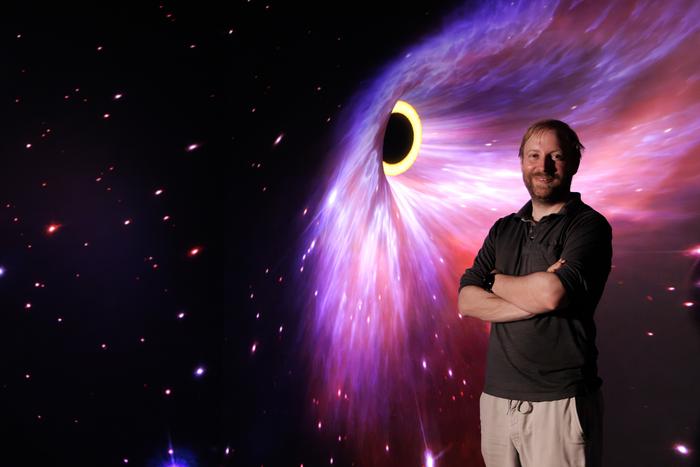
While researching a cluster of stars in the immediate vicinity of the supermassive black hole SgrA* (Sagittarius A*) at the centre of our galaxy, an international team of researchers led by PD Dr Florian Peißker has found signs of another, intermediate-mass black hole. Despite enormous research efforts, only about ten of these intermediate-mass black holes have been found in our entire universe so far. Scientists believe that they formed shortly after the Big Bang. By merging, they act as ‘seeds’ for supermassive black holes. The study ‘The Evaporating Massive Embedded Stellar Cluster IRS 13 Close to Sgr A*. II. Kinematic structure’ was published in The Astrophysical Journal.

Credit: Ludolf Dahmen | University of Cologne
While researching a cluster of stars in the immediate vicinity of the supermassive black hole SgrA* (Sagittarius A*) at the centre of our galaxy, an international team of researchers led by PD Dr Florian Peißker has found signs of another, intermediate-mass black hole. Despite enormous research efforts, only about ten of these intermediate-mass black holes have been found in our entire universe so far. Scientists believe that they formed shortly after the Big Bang. By merging, they act as ‘seeds’ for supermassive black holes. The study ‘The Evaporating Massive Embedded Stellar Cluster IRS 13 Close to Sgr A*. II. Kinematic structure’ was published in The Astrophysical Journal.
The analysed star cluster IRS 13 is located 0.1 light years from the centre of our galaxy. This is very close in astronomical terms, but would still require travelling from one end of our solar system to the other twenty times to cover the distance. The researchers noticed that the stars in IRS 13 move in an unexpectedly orderly pattern. They had actually expected the stars to be arranged randomly. Two conclusions can be drawn from this regular pattern: On the one hand, IRS 13 appears to interact with SgrA*, which leads to the orderly motion of the stars. On the other hand, there must be something inside the cluster for it to be able to maintain its observed compact shape.
Multi-wavelength observations with the Very Large Telescope as well as the ALMA and Chandra telescopes now suggest that the reason for the compact shape of IRS 13 could be an intermediate-mass black hole located at the centre of the star cluster. This would be supported by the fact that the researchers were able to observe characteristic X-rays and ionized gas rotating at a speed of several 100 km/s in a ring around the suspected location of the intermediate-mass black hole.
Another indication of the presence of an intermediate-mass black hole is the unusually high density of the star cluster, which is higher than that of any other known density of a star cluster in our Milky Way. “IRS 13 appears to be an essential building block for the growth of our central black hole SgrA*,” said Florian Peißker, first author of the study. “This fascinating star cluster has continued to surprise the scientific community ever since it was discovered around twenty years ago. At first it was thought to be an unusually heavy star. With the high-resolution data, however, we can now confirm the building-block composition with an intermediate-mass black hole at the centre.” Planned observations with the James Webb Space Telescope and the Extremely Large Telescope, which is currently under construction, will provide further insights into the processes within the star cluster.
Journal
The Astrophysical Journal
Method of Research
Imaging analysis
Subject of Research
Not applicable
Article Title
The Evaporating Massive Embedded Stellar Cluster IRS 13 Close to Sgr A*. II. Kinematic structure
Article Publication Date
18-Jul-2024
Cite Scienmag News
Grant Pearson. (July 18, 2024). Another intermediate-mass black hole discovered at the centre of our galaxy. Scienmag. https://scienmag.com/another-intermediate-mass-black-hole-discovered-at-the-centre-of-our-galaxy/
Grant Pearson. "Another intermediate-mass black hole discovered at the centre of our galaxy." Scienmag, 18 July 2024, https://scienmag.com/another-intermediate-mass-black-hole-discovered-at-the-centre-of-our-galaxy/. Accessed 3 September 2026.
Grant Pearson. "Another intermediate-mass black hole discovered at the centre of our galaxy." Scienmag. July 18, 2024. https://scienmag.com/another-intermediate-mass-black-hole-discovered-at-the-centre-of-our-galaxy/

