


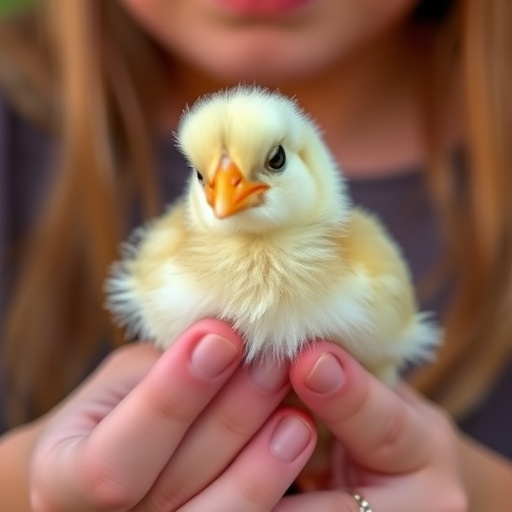
In a groundbreaking study conducted by researchers at the University of Bristol, new evidence has emerged showing that gentle human handling not only reduces fear but actively induces positive emotional responses in young laying hen chicks. This revelation opens new avenues in the understanding of early-life human-animal interactions, providing profound insights into improving the welfare and management of farm animals from the earliest stages of their development.
Historically, human contact has been recognized as a significant factor influencing the behavior and stress physiology of domesticated farm animals. However, the emotional valence of such interactions—whether they are truly perceived as positive or merely neutral—has long remained enigmatic, particularly in chicks, one of the most widely farmed bird species globally. The research from Bristol’s Veterinary School pioneers a methodical approach to understanding these affective experiences.
This novel investigation employed a scientifically rigorous “conditioned place preference” (CPP) paradigm, extensively utilized in neuroscience to assess animals’ memory and affective associations with their environment. The core logic behind CPP hinges on the principle that animals will develop a preference for environments associated with positive experiences, enabling researchers to infer the emotional quality of those experiences indirectly.
The experimental design involved twenty domestic laying hen chicks subjected to a two-chamber apparatus, each chamber distinctly marked with different color cues to allow clear environmental discrimination. Initial preferences of the chicks were recorded to establish baseline affinity. Following this phase, chicks underwent conditioning where one chamber was paired with gentle human handling comprising slow stroking and soft speech, while the other chamber featured the presence of a human who remained neutral—still and silent.
Post-conditioning observations revealed that the chicks consistently spent significantly more time in the chamber paired with gentle handling as compared to the neutral chamber. This behavioral preference clearly indicates a positive affective association formed through calm, gentle human contact. Intriguingly, the chicks did not avoid the neutral environment, demonstrating that the preference was driven by attraction rather than avoidance behavior.
Dr. Ben Lecorps, the lead scientist on the study, highlighted the importance of these findings, stating that the data convincingly establish that gentle human contact triggers positive emotional states in young chicks. He further emphasized that such simple and calm handling techniques possess the transformative potential to alter human-animal dynamics from fear-inducing encounters to affiliative, welfare-enhancing relationships.
Critically, this study offers a mechanistic understanding of how tactile and auditory stimuli from humans interface with the affective neural circuitry in birds. It suggests that early-life exposure to positive handling experiences can modulate the neurobehavioral profile of chicks, potentially influencing their long-term stress responses, social behavior, and overall well-being.
The implications of these findings extend far beyond academic interest. From an applied perspective, integrating gentle handling protocols into routine husbandry practices could serve as a low-cost, high-impact strategy to improve animal welfare standards in poultry farming. This aligns with increasing consumer demand for ethically produced animal products and offers a scientifically backed approach to enriching the lives of farmed animals.
Furthermore, the demonstration that chicks form positive emotional associations with human touch invites reconsideration of welfare assessment frameworks. Incorporating indicators of positive affect into welfare evaluations could help refocus practices from merely preventing suffering toward promoting positive emotional states, a crucial advancement in ethical animal husbandry.
The University of Bristol study thus marks a significant advance in the field of animal psychology and veterinary science, showcasing that the emotional lives of chickens, often overlooked in industrial farming settings, are more complex and responsive to humane treatment than previously appreciated.
The techniques and methodologies validated through this research pave the way for further exploration into early sensory experiences and their long-term impact on animal welfare. Future studies may investigate the neural underpinnings of these affective responses and assess how different handling intensities or durations influence behavioral outcomes.
In sum, the research confirms that gentle human interactions elicit genuine positive emotional states in laying hen chicks, offering promising opportunities for refining husbandry practices, enriching animal welfare frameworks, and enhancing the ethical standards of poultry management worldwide.
News Publication Date: 30 March 2026
Web References: http://dx.doi.org/10.1017/awf.2026.10081
Cite Scienmag News
William Thompson. (March 30, 2026). Study Finds Human Touch Boosts Chick Happiness, Leaving Them Feeling Egg-stra Joyful. Scienmag. https://scienmag.com/study-finds-human-touch-boosts-chick-happiness-leaving-them-feeling-egg-stra-joyful/
William Thompson. "Study Finds Human Touch Boosts Chick Happiness, Leaving Them Feeling Egg-stra Joyful." Scienmag, 30 March 2026, https://scienmag.com/study-finds-human-touch-boosts-chick-happiness-leaving-them-feeling-egg-stra-joyful/. Accessed 3 September 2026.
William Thompson. "Study Finds Human Touch Boosts Chick Happiness, Leaving Them Feeling Egg-stra Joyful." Scienmag. March 30, 2026. https://scienmag.com/study-finds-human-touch-boosts-chick-happiness-leaving-them-feeling-egg-stra-joyful/


