


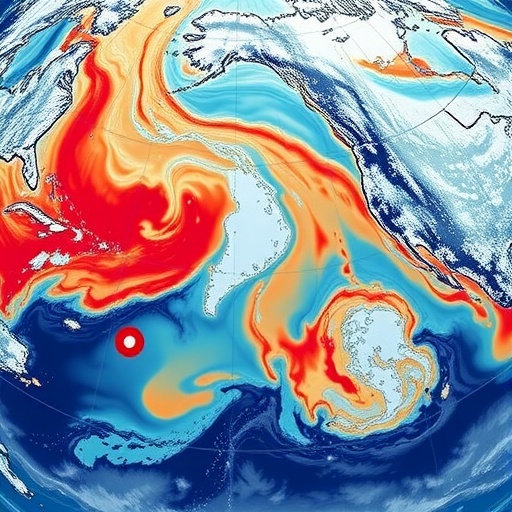
In a groundbreaking study published in Nature Communications in 2026, a team of international oceanographers and climate scientists led by L.C. Menviel, G. Pontes, and M. Lapeze have revealed rapidly accelerating subsurface warming in the subpolar North Atlantic, linked intimately to freshening of the water column. This discovery not only challenges existing paradigms about oceanic heat distribution but also forewarns of complex and potentially destabilizing changes to the global climate system triggered by shifts originating beneath the ocean’s surface.
The subpolar North Atlantic, a crucial region in the Atlantic Meridional Overturning Circulation (AMOC), acts as a major regulator of global climate by driving heat transport between the tropics and higher latitudes. Historically, surface temperature variations and sea ice extent in this region have been closely monitored, but subsurface processes have remained poorly understood. The study by Menviel et al. leverages a combination of state-of-the-art autonomous ocean profiling floats, satellite data, and advanced numerical models to uncover how freshwater input is reshaping the thermal structure far below the ocean surface.
Freshening, the process by which seawater becomes less salty, usually results from increased melting of Arctic ice and Greenland’s glaciers, combined with greater precipitation and runoff in the subpolar regions. This influx of freshwater significantly alters seawater density, stratifying the ocean layers and changing how heat is stored and transported. The research found that freshening is not simply a surface phenomenon; it propagates deeper, creating a thermal anomaly detectable hundreds of meters beneath the ocean surface, where temperatures have risen with unprecedented speed.
This subsurface warming contradicts earlier expectations that the upper ocean would cool or remain relatively unaffected as freshening reduces surface density and inhibits vertical mixing. Instead, the observed warming at depths between 200 and 800 meters indicates a more complex interplay: fresh waters cap the ocean surface, while warmer Atlantic waters intrude below, amplifying heat accumulation and potentially destabilizing deep water convection processes critical for AMOC function.
The team’s analysis demonstrates that this warming is not a transient feature but has persisted and intensified over recent decades, with implications extending well beyond regional climate. By coupling observational data with high-resolution ocean models, the scientists identified a feedback mechanism whereby freshening-driven stratification traps heat at depth, causing anomalies to amplify. These findings challenge previous assumptions that freshening would invariably cool deeper layers by limiting heat exchange higher up.
Importantly, the study underscores that subsurface warming is not uniformly distributed but is concentrated along key pathways transporting warm Atlantic waters northward. This topographically shaped heat accumulation threatens to accelerate melting under ice shelves and glacier fronts, particularly in Greenland’s southeast and northeast margins, where ocean-driven melting contributes significantly to global sea-level rise. As basal melting intensifies, the freshwater flux increases, fueling a vicious cycle of warming and freshening.
Moreover, the implications of such subsurface changes are geopolitical as well as environmental. The North Atlantic is a critical fishing ground and shipping corridor, and rapid changes to water temperature, salinity, and circulation impact marine ecosystems and economic activities. The further destabilization of the AMOC could lead to profound shifts in weather patterns across Europe, North America, and beyond, potentially exacerbating extreme events such as heat waves, cold spells, and intense storms.
Beyond climatic impacts, the posterity of this research lies in its methodological advancements. The use of biogeochemical and autonomously profiling floats allowed unprecedented temporal and spatial coverage, capturing transient subsurface thermal signatures invisible to traditional ship-based measurements. By combining this observational dataset with a robust modeling framework, Menviel and colleagues provide a blueprint for continuous ocean monitoring critical to improving climate projection skill.
Crucially, the study serves as a stark reminder that the climate system’s subsurface dynamics can evolve rapidly and with serious global ramifications, emphasizing the need for integrated, multidisciplinary research approaches. It pushes the scientific community to reassess the vulnerability of ocean circulation to perturbations and to incorporate subsurface warming trends into global climate models for better forecasting accuracy.
The observed rapid subsurface warming, paired with ongoing freshening, may presage a tipping point scenario where the AMOC’s ability to regulate heat flux weakens significantly or collapses altogether over decadal timescales. Such a shift would alter global heat distribution, leading to accelerated warming in some regions and cooling in others, deeply impacting ecosystems, economies, and human wellbeing.
This study also offers critical insight into feedback loops that intensify climate change impacts. As freshening traps heat beneath the surface, ice melt accelerates, further freshening the waters, and weakening overturning circulation that carries warm surface water northward. Without intervention, these processes could irreversibly alter ocean dynamics, climate stabilization efforts, and sea-level rise trajectories.
Looking forward, continued monitoring and modeling efforts are paramount. The implementation of expanded deep ocean observing systems, including enhancements in float deployments and satellite remote sensing, will be essential to track subsurface heat evolution. Policymakers and climate negotiators must incorporate these scientific revelations into adaptation and mitigation plans to address imminent risks linked to oceanic transformations.
In conclusion, the pioneering research by Menviel, Pontes, Lapeze, and their collaborators dramatically reshapes our understanding of the Atlantic’s subpolar oceans. By illuminating the hidden but accelerating subsurface warming driven by freshening, their work not only reveals a critical piece of the climate puzzle but also raises urgent alarms about the future stability of Earth’s oceanic and climatic systems. The cascading consequences of these changes emphasize how interconnected and sensitive the global environment truly is—highlighting that beneath the waves, changes are already underway with effects that will ripple far and wide.
Cite Scienmag News
Violet Maxwell. (March 27, 2026). Rapid Subsurface Warming in North Atlantic from Freshening. Scienmag. https://scienmag.com/rapid-subsurface-warming-in-north-atlantic-from-freshening/
Violet Maxwell. "Rapid Subsurface Warming in North Atlantic from Freshening." Scienmag, 27 March 2026, https://scienmag.com/rapid-subsurface-warming-in-north-atlantic-from-freshening/. Accessed 3 September 2026.
Violet Maxwell. "Rapid Subsurface Warming in North Atlantic from Freshening." Scienmag. March 27, 2026. https://scienmag.com/rapid-subsurface-warming-in-north-atlantic-from-freshening/


