


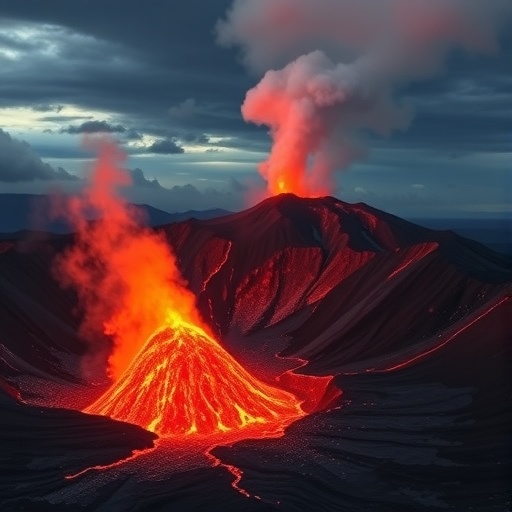
In a groundbreaking study published in Communications Earth & Environment, researchers have unveiled compelling evidence of melt re-injection into a massive magma reservoir beneath the Kikai Caldera Volcano following its cataclysmic giant caldera eruption. This intricate magmatic process sheds new light on post-eruptive volcanic dynamics and the long-term evolution of large magma chambers, redefining our understanding of volcanic systems and their potential hazards. The Kikai Caldera, located in the southwestern part of Japan, has long fascinated volcanologists due to its episodic super-eruptions and immense magma storage capacity. The recent findings provide exquisite insights into how melt fractions are replenished and reconfigured beneath giant calderas, significantly impacting future eruption predictions.
The Kikai Caldera’s giant eruption, which occurred approximately 7,300 years ago, released voluminous pyroclastic flows and tephra deposits, marking one of the most significant explosive volcanism events in the region’s geological history. Such eruptions leave behind vast magma reservoirs often referred to as magma chambers or reservoirs. Understanding how these reservoirs evolve post-eruption is crucial, as they represent the underlying source for subsequent volcanic activity. Traditionally, the consensus suggested that after large eruptions, magma reservoirs gradually cool and solidify. However, this new research overturns that assumption by documenting active melt re-injection, a process that replenishes and potentially rejuvenates the magma system.
Utilizing state-of-the-art geophysical imaging techniques combined with petrological analyses of deep-seated rock samples accessed through drilling expeditions, the research team led by Nagaya, Seama, and Fujie pieced together the complex subterranean magmatic architecture beneath the Kikai Caldera. Advanced seismic tomography and magnetotelluric surveys revealed anomalous zones characterized by partial melt fractions indicative of ongoing melt infiltration into the reservoir. Concurrently, analyses of phenocryst compositions and melt inclusions demonstrated chemical signatures consistent with recent magmatic recharge episodes. These integrated datasets provide irrefutable evidence of the dynamic nature of large magma reservoirs, emphasizing their capacity to undergo substantial modifications after major eruptive events.
One of the pivotal revelations of the study concerns the timescales and mechanisms by which melt is re-injected into the magma reservoir following colossal caldera collapse events. The researchers found that melt re-injection is not a transient phenomenon but can persist for millennia post-eruption. This prolonged magmatic activity results in the partial remobilization of crystallized mush zones within the reservoir, maintaining a significant volume of molten material that could fuel future eruptions. The researchers posit that the influx of fresh melt is driven by buoyancy contrasts and pressure gradients in the mantle and lower crust, facilitating sustained magma ascent and aggregation beneath the caldera structure.
These findings challenge traditional paradigms about magma chamber evolution and suggest more complex thermomechanical interactions between ascending melts and pre-existing crystallized reservoirs. As melt re-injection proceeds, heat transfer effectively re-heats and partially re-melts the previously solidified zones, altering their rheological properties. Such behavior significantly influences the structural integrity and mechanical stability of the magma reservoir roof and surrounding host rocks, factors critical for understanding eruption triggers. Furthermore, this dynamic interplay between melt replenishment and crustal deformation observed at Kikai Caldera could serve as an analog for similar supervolcanoes globally.
In addition to providing fresh insights into magma chamber dynamics, this study carries broad implications for volcanic hazard assessment and eruption forecasting. The prolonged presence of substantial melt volumes beneath calderas implies that these systems may remain viable magmatic sources for future activity much longer than previously assumed. Volcanic monitoring frameworks must therefore consider melt re-injection processes as key indicators of reservoir rejuvenation. Elevated melt volumes can increase the likelihood of future explosive eruptions, potentially of super-eruption scale, underscoring the necessity for continuous geophysical and geochemical surveillance of large volcanic systems like Kikai.
The researchers also emphasize the importance of integrating multidisciplinary approaches—combining geophysics, petrology, geochemistry, and numerical modeling—to unravel the intricacies of magma reservoir evolution. Their sophisticated models simulate the thermochemical evolution of reservoirs undergoing melt recharge, capturing the interplay between heat transport, crystallization, and magma ascent. Such predictive modeling tools offer promising avenues to forecast magma chamber behavior and eruption potential more accurately. This multidisciplinary strategy sets a new standard for volcanology research, highlighting how technological advances can unearth previously inaccessible details from deep within the Earth.
Moreover, the phenomenon of melt re-injection observed at Kikai bears significant implications for geothermal systems and mineral formation. The prolonged presence of partially molten zones enhances hydrothermal circulation and geochemical gradients, thereby influencing fluid-rock interactions and mineral deposit genesis. Understanding melt recharge cycles thus intersects with economic geology, particularly for regions with active or recent volcanic activity. The study opens up fresh pathways to explore how these processes impact resource formation, emphasizing a geosystem perspective in volcanic research.
Notably, this research demonstrates that the physical and chemical characteristics of melts entering the reservoir can vary significantly depending on mantle source heterogeneity, depth of storage, and interaction with crustal materials. Such variations contribute to the compositional diversity of erupted products over time. At Kikai, isotopic and trace element analyses suggest that re-injected melts may derive from heterogeneous mantle sources modified by crustal assimilation, leading to complex magma evolution pathways. Deciphering these pathways is crucial for reconstructing eruptive histories and assessing future magma compositions.
The findings surrounding melt re-injection mechanisms also raise intriguing questions about the feedback loops linking seismicity, deformation, and magmatic processes at large caldera systems. Melt ascent and reservoir pressurization can induce crustal stress changes manifested as earthquake swarms and ground deformation, phenomena commonly recorded during volcanic unrest. By establishing that melt recharge is an ongoing process, the study argues for more nuanced interpretations of seismic and deformation signals in volcanic regions, potentially refining eruption warning systems and public safety strategies.
Beyond its immediate scientific contributions, this study at Kikai exemplifies the value of long-term volcanic monitoring combined with targeted drilling initiatives. Accessing deep crustal materials provides unique windows into subsurface processes that surface observations alone cannot reveal. This underscores the importance of sustained investment in geoscientific infrastructure and international collaboration to tackle formidable challenges posed by supervolcanic systems. As the global population increasingly encroaches on volcanic hazard zones, advancing our knowledge on magma reservoir dynamics is critical for disaster preparedness and mitigation.
Looking ahead, Nagaya and colleagues plan to extend their investigations by conducting high-resolution seismic imaging and petrological studies of related caldera systems worldwide. By comparing melt re-injection phenomena across diverse tectonic and magmatic settings, the scientific community aims to develop generalized models of magma chamber renewal and caldera rejuvenation. These comprehensive frameworks will enhance our predictive capability for supervolcano behavior and deepen our grasp on Earth’s volatile and dynamic interior.
In summary, this landmark research offers a vivid portrayal of the rejuvenation of one of the Earth’s largest known magma reservoirs through melt re-injection following a giant caldera eruption. The work revolutionizes how scientists perceive post-eruptive magma chamber evolution, highlights the persistent threat posed by refilled reservoirs, and strengthens the scientific foundation for future volcanic risk assessment. By illuminating the hidden dance of molten rock deep beneath Kikai Caldera, the study propels volcanology into a new era of understanding, full of promise for unraveling volcanic enigmas that affect billions worldwide.
Cite Scienmag News
Violet Maxwell. (March 27, 2026). Melt Re-injection Following Giant Kikai Caldera Eruption. Scienmag. https://scienmag.com/melt-re-injection-following-giant-kikai-caldera-eruption/
Violet Maxwell. "Melt Re-injection Following Giant Kikai Caldera Eruption." Scienmag, 27 March 2026, https://scienmag.com/melt-re-injection-following-giant-kikai-caldera-eruption/. Accessed 4 September 2026.
Violet Maxwell. "Melt Re-injection Following Giant Kikai Caldera Eruption." Scienmag. March 27, 2026. https://scienmag.com/melt-re-injection-following-giant-kikai-caldera-eruption/


