


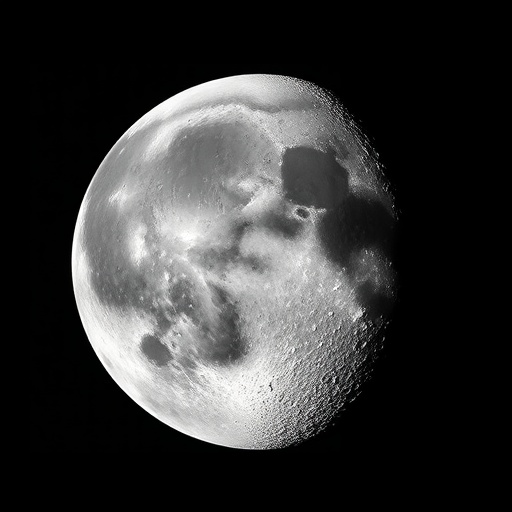
In a groundbreaking study published in Nature Communications, researchers have uncovered the presence of trivalent titanium (Ti³⁺) in high-titanium lunar ilmenite, a mineral integral to the Moon’s geological fabric. This discovery not only enhances our understanding of lunar mineralogy but also carries profound implications for future lunar exploration and resource utilization. Titanium traditionally exists in minerals predominantly in a tetravalent state (Ti⁴⁺), making the identification of Ti³⁺ on the lunar surface both unexpected and scientifically exciting due to its potential impact on the Moon’s geochemical and geophysical properties.
Ilmenite (FeTiO₃) is a principal titanium-bearing mineral found in lunar mare basalts, where it plays a crucial role in defining the Moon’s color and thermal behavior. The research team, led by A.D. Vira and colleagues, employed a suite of advanced spectroscopic techniques combined with synchrotron-based X-ray absorption near edge structure (XANES) analysis to quantify titanium’s oxidation states within lunar ilmenite samples brought back by Apollo missions. Their meticulous approach revealed a significant fraction of titanium not as the expected titanium(IV) but as titanium(III), a finding that forces a reevaluation of previously held notions about lunar mineral chemistry and conditions during rock formation.
The presence of trivalent titanium suggests that lunar ilmenite formed under highly reducing conditions, whereby the Moon’s interior or surface environments allowed the reduction of titanium from its common tetravalent state. This insight indicates that the lunar mantle and crust experienced localized redox heterogeneities, influencing the mineral’s crystallization pathways. Understanding these redox conditions is vital, as they affect melting, crystallization, and ultimately the differentiation history of the Moon’s interior. The discovery of Ti³⁺ thus provides a window into the ancient processes that shaped lunar geology.
One particularly intriguing aspect of this study is the implication of Ti³⁺ on the color and optical properties of lunar soil, or regolith. Titanium-bearing minerals influence the regolith’s spectral reflectance, impacting remote sensing observations which are key for lunar surface mapping and exploration. The identification of trivalent titanium suggests variations in spectral signatures that could refine compositional maps of the Moon’s surface. This refinement enhances the precision of selecting landing and resource extraction sites for future missions, making this research invaluable for both scientific and operational lunar endeavors.
The presence of Ti³⁺ in ilmenite also affects the mineral’s physical properties, including its electrical conductivity and magnetic behavior. Titanium’s oxidation state directly influences these properties, which in turn affect how lunar rocks interact with solar wind, cosmic radiation, and even the Sun’s magnetic field. These interactions are crucial for interpreting lunar surface processes and assessing environmental hazards for human explorers. Therefore, the discovery prompts a reevaluation of lunar environmental models that incorporate mineralogical properties derived from previous assumptions.
From a resource utilization perspective, the identification of Ti³⁺ in lunar ilmenite could revolutionize strategies for in situ resource utilization (ISRU). Ilmenite is a key target for extracting oxygen—a critical life-support and propellant component in space missions. Understanding the redox state of titanium within ilmenite impacts techniques for oxygen extraction, particularly those involving chemical reduction or electrolysis. A trivalent titanium component suggests altered reaction pathways and efficiencies, potentially optimizing oxygen yield and processing methodologies on the Moon’s surface, thus supporting sustainable human presence in extraterrestrial environments.
Additionally, the discovery raises fundamental questions about the Moon’s early volcanic activity and mantle composition. High-titanium basalts on the Moon are known for their unique geochemical signatures, and Ti³⁺ provides a new parameter to distinguish between different mantle sources or magmatic evolution trends. By integrating these findings into lunar petrology, scientists can develop more accurate models detailing the Moon’s volcanic history, magma genesis conditions, and the timing of major geological events that shaped the lunar surface thousands of millions of years ago.
This research also intersects with broader planetary science themes concerning oxidation state evolution on airless bodies. The identification of Ti³⁺ in lunar minerals provides an analog for studying redox processes on other terrestrial bodies lacking atmospheres, such as Mercury or certain asteroids. Insights gained from the Moon can guide interpretations of remote sensing data and sample analyses from these bodies, thereby enriching our understanding of solar system formation and differentiation on multiple fronts.
The methodology employed by Vira and colleagues is as notable as their findings. Combining state-of-the-art XANES spectroscopy with high-resolution electron microscopy allowed for pinpointing oxidation states at micro- and nanoscale resolution within individual mineral grains. This precision represents a leap forward in planetary mineralogy, as previous bulk methods often masked such subtle but significant chemical variations. This advancement showcases how technology can unravel complexities in extraterrestrial materials, encouraging similar approaches in upcoming sample-return missions.
In the context of lunar exploration missions, such as Artemis and various planned international efforts, the understanding of ilmenite’s oxidation states may drive instrument development to include detection of subtle compositional features. This would boost in situ analysis capabilities, enabling astronauts and robots to make more informed decisions about sample collection and resource processing onsite, effectively bridging scientific discovery and mission pragmatism.
Furthermore, the discovery of trivalent titanium in lunar materials holds potential implications for the interpretation of lunar magnetism. High-titanium basalts contribute to localized magnetic anomalies on the Moon’s surface. Changes in titanium valence state could influence magnetic mineralogy, potentially altering the understanding of how localized remanent magnetization was acquired. Reexamining these anomalies with the new perspective provided by Ti³⁺ could refine paleomagnetic records and reshape ideas about the Moon’s ancient magnetic field.
The study also opens avenues for comparative planetology, as titanium-bearing minerals are present in Martian and terrestrial basalts. Understanding how titanium oxidation states vary under different planetary conditions can provide clues about atmospheric and interior evolution on these bodies. This cross-planetary inference strengthens the role of mineral chemistry as a window into planetary histories and their habitability potential.
The revelation of Ti³⁺ in lunar ilmenite ultimately challenges the canonical view that lunar titanium is solely tetravalent. This nuanced understanding compels researchers to revisit prior assumptions derived from lunar sample studies, possibly redefining the geochemical paradigms that have persisted for decades. Such fundamental shifts emphasize the ever-evolving nature of lunar science, where new techniques and perspectives continue to unveil the Moon’s enigmatic past.
As humanity prepares for long-duration lunar missions and potentially permanent settlements, these scientific milestones underscore the importance of thorough mineralogical studies. By comprehending the chemical subtleties of lunar rocks, mission planners, engineers, and scientists can collaborate to develop technologies and strategies that harmonize with the Moon’s natural environment, ensuring both the safety and success of future explorers.
In conclusion, the identification of trivalent titanium in high-titanium lunar ilmenite marks a significant advance in planetary mineralogy. It enhances comprehension of lunar formation conditions, geochemical evolution, and resource potential. Beyond its immediate scientific significance, this discovery paves the way for refined exploration tactics and supports the broader quest of humanity to understand and inhabit other worlds.
Cite Scienmag News
Violet Maxwell. (March 27, 2026). Trivalent Titanium Found in High-Titanium Lunar Ilmenite. Scienmag. https://scienmag.com/trivalent-titanium-found-in-high-titanium-lunar-ilmenite/
Violet Maxwell. "Trivalent Titanium Found in High-Titanium Lunar Ilmenite." Scienmag, 27 March 2026, https://scienmag.com/trivalent-titanium-found-in-high-titanium-lunar-ilmenite/. Accessed 4 September 2026.
Violet Maxwell. "Trivalent Titanium Found in High-Titanium Lunar Ilmenite." Scienmag. March 27, 2026. https://scienmag.com/trivalent-titanium-found-in-high-titanium-lunar-ilmenite/


