


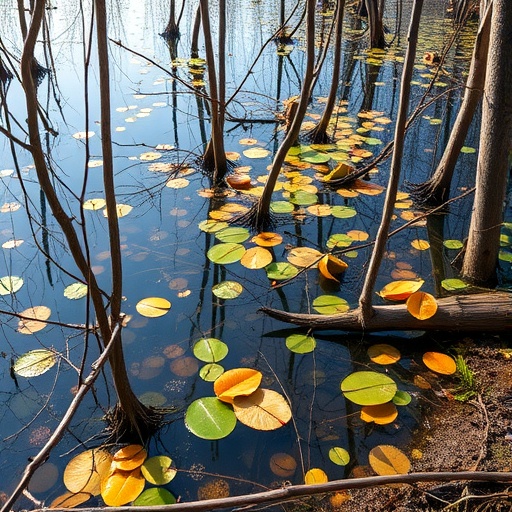
In recent decades, wetlands have garnered significant attention as crucial ecosystems for carbon sequestration—natural reservoirs capable of locking away enormous quantities of organic carbon from the atmosphere. However, widespread drainage and degradation of wetlands for agriculture, urban development, and other anthropogenic activities have transformed these vital environments from carbon sinks into sources of atmospheric carbon dioxide and methane. A groundbreaking study published in Communications Earth & Environment now sheds new light on the processes that govern organic carbon burial and stabilization in rewetted wetlands, revealing vital mechanisms that support climate change mitigation strategies and ecosystem restoration science.
The research, led by Priya Mistry and colleagues, meticulously examines the biochemical and physical transformations that occur following wetland rewetting, describing how these interventions create enhanced opportunities for organic carbon burial. Utilizing an array of field measurements, laboratory analyses, and advanced modeling techniques, the team traced carbon dynamics within recently rewetted wetlands, uncovering that the rewetting process sparks a critical period of intensified organic carbon burial. This period precedes the eventual long-term stabilization of carbon deposits, an insight that challenges earlier assumptions about the immediate permanence of carbon sequestration following restoration.
At the heart of their discovery lies the observation that flooded conditions drastically reduce oxygen availability in soil matrices, thereby slowing down microbial decomposition of plant detritus and other organic matter. Within weeks to months after rewetting, this hypoxic environment fosters a pulse of organic material accumulation, with microbes operating under limited respiration rates. This initial surge in organic carbon burial occurs despite ongoing microbial activity, indicating that carbon capture in these settings is governed by nuanced balance between anaerobic microbial metabolism and sedimentation rates of organic particles.
Crucially, Mistry and collaborators highlight how this enhanced burial does not translate into instantaneous long-term carbon stabilization. Rather, it sets the foundational groundwork necessary for subsequent biochemical transformations that gradually render organic carbon less bioavailable. Over years to decades, these buried organic compounds undergo processes such as humification and mineral association, effectively transforming labile carbon fractions into chemically recalcitrant forms bound within soil matrices. These stabilization pathways are essential for ensuring that carbon remains locked away over ecological and geological timescales, resisting re-release into the atmosphere under changing environmental conditions.
The study’s methodological rigor is notable, as it integrates multidisciplinary approaches spanning microbiology, soil chemistry, and hydrology. High-resolution isotopic tracing allowed the team to distinguish the origins and fates of carbon fractions throughout the decomposition continuum. Soil redox potentials were meticulously monitored, elucidating dynamic oxygen gradients and their influence on microbial respiration pathways. Furthermore, measurements of methane production and other greenhouse gases provided insights into trade-offs associated with wetland rewetting, helping define strategies that maximize carbon storage while minimizing potent emissions.
Beyond biogeochemical insights, the findings carry profound implications for global climate policies aimed at wetland restoration. Because wetlands occupy a relatively small fraction of terrestrial land yet disproportionately contribute to carbon storage, their management represents a leverage point for inverse climate feedback loops. Mistry et al.’s study underlines that rewetting alone is insufficient to guarantee stable long-term carbon sequestration, emphasizing the necessity of sustained hydrological management and consideration of carbon transformation kinetics in restoration protocols. Policymakers and conservationists must therefore adopt multifaceted frameworks that address both short-term burial processes and longer-term stabilization mechanisms.
The authors also contend with potential challenges in scaling up restoration-based carbon sequestration. Variability in wetland types, regional climate regimes, and historical land use influence rewetting outcomes and carbon burial efficiency. The interplay of microbial community composition and soil chemistry underpins heterogeneity in carbon turnover rates, suggesting that tailored restoration practices customized to local ecological contexts will be crucial. Moreover, the heightened methane emissions that often accompany rewetting require integrated monitoring and mitigation strategies to optimize net climate benefits.
Intriguingly, the study’s implications extend beyond climate mitigation, touching upon ecosystem services and biodiversity considerations. Increased organic carbon burial provides substrate enrichment that supports diverse microbial taxa, which in turn catalyzes nutrient cycling and detoxification processes. The restoration of wetland hydrology thereby triggers cascading ecological revitalizations that can restore native vegetation, improve water quality, and reinstate habitats for numerous species dependent on wetland ecosystems. This holistic view of carbon burial as part of a broader ecological restoration underscores the co-benefits that can arise from well-planned interventions.
Furthermore, the temporal dimension elucidated by the study adds a critical perspective for ecosystem monitoring. Restoration practitioners often focus on immediate or short-term carbon metrics; however, Mistry and colleagues demonstrate that the window of enhanced burial is transient, necessitating long-term observation to truly assess carbon sequestration outcomes. Soil sampling and greenhouse gas flux measurements must therefore extend over decadal timescales to capture the transition from rapid burial to stabilization, ensuring that reported carbon gains reflect durable climate mitigation.
The research also delves into the molecular transformations associated with carbon stabilization, revealing how biochemical recalcitrance arises through interactions with soil minerals and organo-mineral complexes. These complexes shield organic molecules from enzymatic degradation and microbial consumption, effectively immobilizing them. Techniques such as spectroscopic analysis and nuclear magnetic resonance (NMR) spectroscopy employed by the team elucidated these molecular-level associations, providing unprecedented detail into the chemical nature of stabilized carbon pools within wetland soils.
Importantly, the study sheds light on potential feedback mechanisms in the context of climate warming. Increased temperatures and altered precipitation patterns could shift redox dynamics and microbial metabolism, affecting both the burial rates and stability of organic carbon. Understanding these sensitivities is critical for predicting the future resilience of rewetted wetlands as carbon sinks under global change scenarios. Adaptive management informed by mechanistic data as provided here will be essential to safeguard and enhance wetland contributions to carbon sequestration in a warming world.
Mistry et al. have also pioneered novel conceptual frameworks to reconcile competing carbon fluxes within rewetted wetlands. Their synthesis maps out phases of carbon dynamics, including initial burial pulses, intermediary biochemical processing, and eventual sequestration equilibrium. This temporal and mechanistic schema facilitates integration into earth system models, enhancing predictive capacity for carbon cycle feedbacks on regional to global scales. Such models are indispensable tools for informing climate mitigation pathways and restoration investment decisions.
Overall, this seminal study redefines wetland rewetting not as a simple reversion but as a complex biogeochemical transition. Enhanced organic carbon burial precedes long-term stabilization, with multiple layers of microbial, chemical, and physical processes intricately intertwined over varied timescales. These findings not only elevate wetlands as critical natural climate solutions but also demand nuanced restoration approaches that embrace ecosystem complexity and foster extended monitoring.
As global initiatives rally to meet ambitious climate goals, insights from this work provide a roadmap and scientific foundation to leverage wetland ecosystems more effectively. Harnessing their carbon burial capacity with precision management can transform degraded landscapes into resilient carbon reservoirs whose benefits extend far beyond climate—nurturing biodiversity, improving hydrologic function, and fostering ecosystem health. The future of wetland restoration science is poised for exciting advancements built on these revelations, promising impactful contributions to global sustainability efforts.
Cite Scienmag News
Sloane Callahan. (March 27, 2026). Boosted Carbon Burial in Rewetted Wetlands Stabilizes Sooner. Scienmag. https://scienmag.com/boosted-carbon-burial-in-rewetted-wetlands-stabilizes-sooner/
Sloane Callahan. "Boosted Carbon Burial in Rewetted Wetlands Stabilizes Sooner." Scienmag, 27 March 2026, https://scienmag.com/boosted-carbon-burial-in-rewetted-wetlands-stabilizes-sooner/. Accessed 4 September 2026.
Sloane Callahan. "Boosted Carbon Burial in Rewetted Wetlands Stabilizes Sooner." Scienmag. March 27, 2026. https://scienmag.com/boosted-carbon-burial-in-rewetted-wetlands-stabilizes-sooner/


