


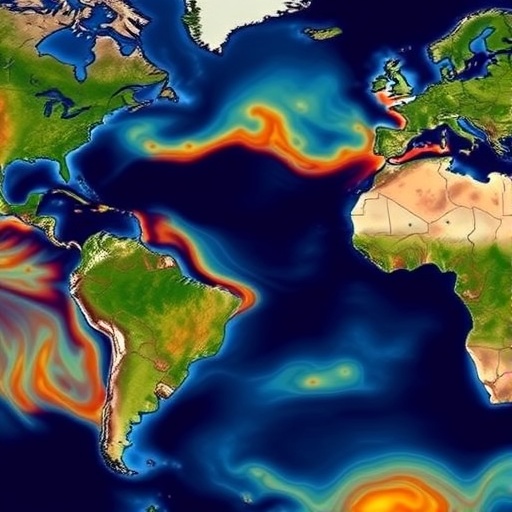
In a groundbreaking study published in Communications Earth & Environment, researchers have uncovered alarming new evidence suggesting that the collapse of the Atlantic Meridional Overturning Circulation (AMOC) could unleash a massive release of carbon stored in the oceans, exacerbating global warming far beyond current predictions. This revelation adds a critical dimension to the understanding of climate dynamics, indicating that disruptions in ocean circulation could propel the Earth toward more severe climatic tipping points than previously anticipated. The implications for climate policy and future global temperature trajectories are profound, demanding urgent attention from the scientific community and policymakers alike.
The AMOC, often described as Earth’s oceanic conveyor belt, is a crucial component of the global climate system. It involves a vast network of currents that transport warm, salty water from the tropics northward along the Atlantic Ocean, where it cools and sinks, driving a deep southward flow of colder ocean waters. This circulation regulates heat distribution across the planet, influencing weather patterns, sea level, and the carbon cycle. The new study, led by Nian et al., rigorously models the consequences of a potential AMOC collapse, showing how it could dramatically destabilize this delicate balance.
Central to their investigation is the ocean’s role as a massive carbon sink. Through complex physical and biological processes, the ocean absorbs about a quarter of the carbon dioxide emissions generated by human activity, acting as a buffer against rapid atmospheric warming. The AMOC facilitates vertical mixing and the sequestering of carbon in deep waters, keeping vast amounts of CO2 locked away for centuries. However, the disruption or shutdown of this circulation system may reverse this process, releasing previously stored carbon back into the atmosphere.
Utilizing advanced Earth system modeling that integrates ocean circulation dynamics, carbon cycling, and climate feedbacks, the authors demonstrate that a collapse of the AMOC would initiate a substantial outgassing of dissolved inorganic carbon. This outflux, they argue, could release a quantity of carbon equivalent to several decades of anthropogenic emissions within a few centuries. Such a rapid addition of CO2 to the atmosphere would not only accelerate global warming but also complicate efforts to meet international climate targets.
The methodology employed in this study involved coupling high-resolution ocean general circulation models with biogeochemical modules, enabling the simulation of carbon exchanges between ocean layers under various climate scenarios. This approach allowed the researchers to capture the feedback loops between warming, ocean stratification, and carbon release. The results underscore the sensitivity of oceanic carbon storage to changing circulation patterns and highlight the risk of triggering nonlinear shifts in Earth’s climate system.
Perhaps most alarming is the potential for a positive feedback loop. As global temperatures rise, ice melt from the Greenland Ice Sheet and Arctic regions injects fresh water into the North Atlantic, reducing seawater density and weakening the AMOC. A slowing or collapse of the AMOC then disrupts heat transport, altering precipitation and temperature patterns globally. This, in turn, impacts carbon uptake in ocean and terrestrial reservoirs—a feedback cycle that could amplify climate change impacts beyond our current projections.
The study contextualizes their findings within the broader framework of climate tipping points—thresholds beyond which the system undergoes irreversible changes. The AMOC’s collapse is widely regarded as one such tipping point, with previous research signaling it could occur within this century under high emission scenarios. By linking this physical shift to a concomitant carbon release, the current work strengthens the case for preventive action to maintain ocean circulation stability.
Moreover, the researchers emphasize regional disparities in how AMOC disruption would manifest. Western Europe, which benefits from the warmth carried northward by the AMOC, might face significant cooling despite overall global temperature increases. Simultaneously, regions like the tropical Atlantic could experience heightened warming and drought, exacerbating socio-economic impacts. These complex climate shifts complicate adaptation strategies and demand comprehensive global cooperation.
The interaction between ocean biogeochemistry and climate outlined in this paper reveals an urgent knowledge gap in current climate models. Most predictive models do not fully incorporate the dynamic feedbacks associated with AMOC-induced carbon release. By integrating these factors, the authors provide a more comprehensive and sobering forecast of future warming trends, calling for enhanced model resolution and interdisciplinary research.
Another dimension addressed is the implication for ocean acidification. The release of carbon dioxide from the ocean surface waters would increase their acidity, harming marine ecosystems, particularly calcifying organisms like corals and shellfish. This feedback not only threatens biodiversity but also the fisheries and food security dependent on healthy ocean systems, highlighting the intertwined nature of climate, ecological, and human health risks.
Policy implications of the study are far-reaching. The findings stress the critical importance of aggressive greenhouse gas mitigation to reduce the risk of AMOC collapse. They also underline the value of monitoring oceanic circulation changes and carbon fluxes with greater precision. Early warning systems leveraging satellite observations and autonomous ocean sensors could provide vital data to forecast and potentially mitigate abrupt climate shifts induced by AMOC disruptions.
In sum, this study acts as a clarion call, drawing attention to a dangerous feedback loop hitherto insufficiently accounted for in climate change discourse. The prospect of a weakened or collapsed Atlantic overturning circulation leading to a surge in oceanic carbon release poses an existential challenge to global climate stability. As the world races toward net-zero targets, integrating these oceanographic insights becomes paramount to crafting resilient, science-based responses to the climate crisis.
The comprehensive integration of ocean physics, carbon chemistry, and climate modeling presented here pushes the frontier of Earth system science. It compels a reevaluation of risk assessments associated with climate feedbacks and tipping points. With ocean circulation acting as a linchpin of planetary homeostasis, ensuring its continued function emerges as a cornerstone of sustainable climate stewardship.
Future research inspired by this paper is expected to delve deeper into the thresholds governing AMOC stability and the interplay with other key components such as the Southern Ocean and biological carbon pumps. Enhanced collaboration among oceanographers, climatologists, and ecologists will be essential to decode the cascading consequences forecasted here. Collectively, these efforts may chart a path toward mitigating an otherwise inexorable warming trajectory.
This pioneering study foregrounds the latent power of the oceans in influencing global climate feedbacks and the urgency of addressing them. As humanity’s carbon emissions approach levels capable of destabilizing ancient ocean currents, the scientific revelations by Nian et al. remind us that the Earth system is a tightly coupled whole where changes in one domain ripple through many others. The fate of the AMOC, and in turn the planet’s climate destiny, could hinge on decisions made in the next few years—a sobering prospect demanding immediate and sustained global action.
Cite Scienmag News
Violet Maxwell. (March 27, 2026). Atlantic Circulation Collapse Could Boost Carbon, Warming. Scienmag. https://scienmag.com/atlantic-circulation-collapse-could-boost-carbon-warming/
Violet Maxwell. "Atlantic Circulation Collapse Could Boost Carbon, Warming." Scienmag, 27 March 2026, https://scienmag.com/atlantic-circulation-collapse-could-boost-carbon-warming/. Accessed 4 September 2026.
Violet Maxwell. "Atlantic Circulation Collapse Could Boost Carbon, Warming." Scienmag. March 27, 2026. https://scienmag.com/atlantic-circulation-collapse-could-boost-carbon-warming/


