


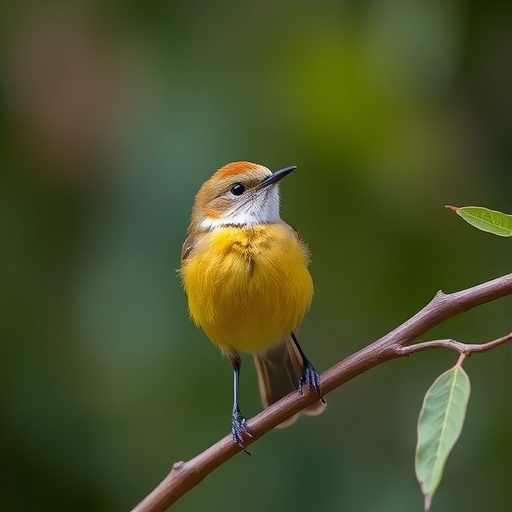
While temperate bird species have long been known to breed in well-defined spring seasons, a groundbreaking new study exposes a surprising complexity in the reproductive timing of tropical birds, challenging long-held assumptions about their breeding ecology. Over a five-year field study in the cloud forests of northern Peru, researchers documented that insectivorous tropical birds can delay breeding by nearly six months—more than four times the variation previously recorded—revealing a dynamic and locally asynchronous breeding strategy linked intricately to rainfall-driven fluctuations in insect prey populations.
In temperate regions, the onset of spring reliably triggers avian breeding with little annual deviation, typically only a few days. By contrast, tropical regions lack such marked seasonal temperature shifts, leading to the general belief that tropical birds breed year-round or within a narrow window. This notion was refined decades ago by ornithologist Alexander Skutch, who introduced the idea of a “tropical spring,” positing that breeding aligns with periods of increased resource abundance, particularly the rainy season. However, Skutch’s pioneering work, conducted in Costa Rica, was limited geographically and treated tropical bird reproduction as relatively synchronous.
Felicity Newell of the Florida Museum of Natural History, intrigued by this gap in understanding while conducting biological surveys in Honduras, initiated an ambitious project to systematically probe the breeding phenology of tropical montane birds. Collaborating with Ian Ausprey, Newell deployed a comprehensive, multi-site approach across eight mountains within a 60-mile radius in Peru’s cloud forests. Utilizing standardized methodologies including mist-netting for capturing individuals, monitoring physiological breeding markers, and directly recording nest presence, the team amassed unprecedented data on reproductive timing.
Throughout the five-year study, the team captured over 8,000 birds and documented nearly 4,000 breeding events, meticulously cross-referencing these with measures of insect biomass, floral abundance, fruit availability, and continuous rainfall data. This granular approach allowed for high-resolution correlations between environmental variables and breeding behaviors. The results dramatically expanded current paradigms, indicating that breeding season variation in tropical birds is far more spatially and temporally heterogeneous than previously recognized.
Crucially, the researchers categorized bird species into three trophic guilds—nectarivores, frugivores, and insectivores—revealing divergent patterns in reproductive timing tied to resource phenology. Nectarivorous birds, such as hummingbirds, tended to initiate nesting at the onset of the dry season, capitalizing on the flowering phenology of tropical plants pollinated by birds. Similarly, frugivorous species timed breeding to coincide with the peak of fruit production during the wet season. These patterns mirrored prior localized observations and clarified the resource-dependent reproductive strategies employed by these specialist feeders.
In stark contrast, insectivorous birds exhibited extraordinary flexibility, with breeding times varying by up to six months between nearby communities. These insectivores appeared to track insect biomass availability intimately, which itself fluctuates in complex response to rainfall patterns. The study identified a critical threshold: approximately 43 milligrams of insect biomass per square meter signaled sufficient prey abundance to support breeding during the drier season. Falling below this benchmark prompted a wholesale shift, with entire communities postponing reproduction until the commencement of the rainy season, an adaptive response previously undocumented.
This discovery underscores the modular nature of tropical trophic pathways, where rainfall acts as a master environmental driver, indirectly influencing avian reproduction via insect population dynamics. Interestingly, the study also revealed that insect biomass peaks under intermediate rainfall levels, highlighting a nuanced “Goldilocks” effect. Both drought and excessive precipitation can suppress insect abundance, complicating predictions of breeding success under changing climate regimes.
The implications of these findings extend beyond academic curiosity. Tropical insectivorous birds have undergone widespread declines in recent decades, with altered precipitation regimes and habitat fragmentation posited as key stressors. By elucidating the mechanistic links between climate variability, insect prey availability, and breeding phenology, this research provides critical insight into the vulnerabilities of tropical montane bird populations in the face of climate change.
Moreover, land use changes, particularly deforestation in the Andes, threaten the specialized forest habitats these birds depend on. The documented flexibility in breeding strategies may buffer some populations from environmental variability but could also mask underlying stressors eroding long-term viability. This study therefore highlights the urgent need for integrative conservation approaches addressing not only habitat preservation but also the preservation of ecological processes underpinning trophic interactions.
Published in the journal Global Change Biology, this work represents a milestone in tropical ecology, employing long-term, spatially explicit data sets to refine our understanding of how changing rainfall patterns drive asynchronous reproduction in complex bird communities. Led by Newell, Ausprey, and colleagues, the study exemplifies rigorous fieldwork combined with innovative ecological modeling, offering a powerful framework to anticipate the cascading impacts of global climate shifts on biodiversity.
By challenging entrenched assumptions about tropical avian phenology, this research compels scientists and conservationists to recognize the intricate and variable responses of tropical species to environmental cues. It underscores that tropical ecosystems, often perceived as stable and unchanging, harbor dynamic biotic rhythms finely attuned to climatic nuances. As global change accelerates, unraveling such complexities will be essential to safeguarding the extraordinary diversity and ecological functions of tropical birds.
News Publication Date: March 26, 2026
Web References: DOI 10.1111/gcb.70790 (Global Change Biology)
Cite Scienmag News
Gavin Prescott. (March 27, 2026). New Study Reveals Some Birds Shift Breeding Season in Response to Climate Changes. Scienmag. https://scienmag.com/new-study-reveals-some-birds-shift-breeding-season-in-response-to-climate-changes/
Gavin Prescott. "New Study Reveals Some Birds Shift Breeding Season in Response to Climate Changes." Scienmag, 27 March 2026, https://scienmag.com/new-study-reveals-some-birds-shift-breeding-season-in-response-to-climate-changes/. Accessed 4 September 2026.
Gavin Prescott. "New Study Reveals Some Birds Shift Breeding Season in Response to Climate Changes." Scienmag. March 27, 2026. https://scienmag.com/new-study-reveals-some-birds-shift-breeding-season-in-response-to-climate-changes/


