


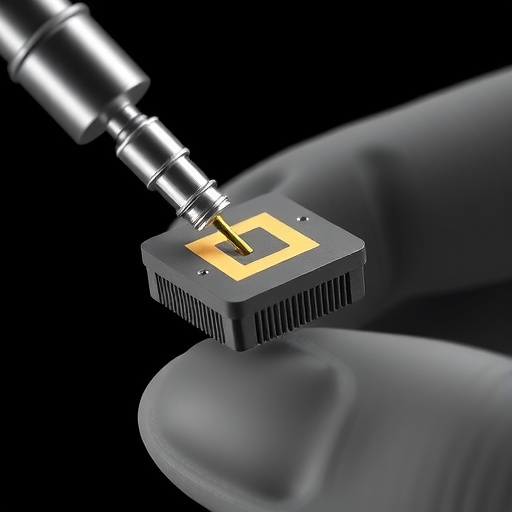
In a groundbreaking leap forward for medical technology, researchers have unveiled a miniature ultrasonic surgical device that promises to revolutionize minimally invasive procedures. The device, innovatively designed around a flextensional configuration combined with a pre-stressed piezoelectric stack, marks a significant advancement in the precision and efficacy of ultrasonic surgical tools. This pioneering development addresses long-standing challenges in surgical instrumentation, particularly the demand for compact yet powerful devices capable of delivering high-frequency vibrations to targeted tissue with exceptional control and minimal collateral damage.
At its core, the technology leverages the unique properties of piezoelectric materials—substances that convert electrical energy into mechanical vibrations. The research team, led by experts Li, Jones, Valdastri, and their collaborators, has harnessed the strength of a pre-stressed piezoelectric stack to enhance the energy output and mechanical resilience of the miniature device. This pre-stressing technique, which involves applying a controlled compressive force to the piezoelectric stack prior to operation, significantly improves both the efficiency and durability of the actuator. This ensures prolonged operational lifespan and reliable performance, even under the demanding conditions of surgical environments.
The flextensional configuration is central to the device’s remarkable performance. This design amplifies the small input displacements generated by the piezoelectric stack into larger output movements through a mechanical transformation. By strategically bending flexible elements in response to the stack’s expansion and contraction, the device can achieve enhanced vibrational amplitude without increasing the overall size or compromising compactness. This transformation is particularly critical in the context of miniature surgical tools, where space constraints are stringent and the ability to deliver sufficient mechanical energy is paramount.
Ultrasonic surgical devices operate by delivering high-frequency mechanical vibrations that cut, fragment, or emulsify tissue with high precision. Existing ultrasonic tools, while effective, often suffer from drawbacks related to their size and intricate assembly, limiting their utility in minimally invasive surgery. The innovation demonstrated by Li and colleagues introduces a compact device that integrates seamlessly within slim surgical instruments, facilitating access to delicate anatomical sites with minimal disruption. This capability is transformative for procedures requiring meticulous manipulation such as neurosurgery, ophthalmology, and minimally invasive tumor excision.
From a materials science perspective, the pre-stressed piezoelectric stack embodies a novel approach to overcoming the limitations posed by conventional piezoelectric actuators. Traditionally, piezoelectric materials can fracture under high tensile stresses, restricting their use in high-strain applications. Pre-stressing the stack in compression counterbalances these tensile forces during operation, effectively creating a self-stabilizing actuator. This design not only augments the maximum allowable excitation voltage but also enables the device to operate at higher frequencies and with improved linearity, delivering consistent ultrasonic energy output.
The team’s meticulous engineering of the flextensional mechanism entailed advanced computational modeling and rigorous experimental validation. By finely tuning the geometry, thickness, and material selection of the flexures, the researchers optimized the mechanical amplification ratio. This refinement ensures that the generated ultrasonic vibrations maintain their magnitude while minimizing energy loss due to damping and structural deformation. Furthermore, the integration of the piezoelectric stack within this mechanical framework was executed with precision to maximize coupling efficiency between electrical input and mechanical output.
Beyond engineering success, the miniature ultrasonic surgical device holds profound clinical implications. Surgeons can now utilize ultrasonically actuated instruments that fit comfortably within narrow operative channels, reducing patient trauma and accelerating recovery times. Additionally, the device’s high frequency and amplitude control permit selective tissue ablation with minimal thermal effect, mitigating risks of burn injury or unintended damage to adjacent structures. This opens avenues for safer and more refined surgical interventions, particularly in complex or sensitive surgical sites.
The device’s versatility extends towards numerous potential applications beyond traditional cutting and coagulation. Ultrasonic energy in medical procedures can facilitate enhanced drug delivery through sonoporation, improve tissue regeneration via mechanical stimulation, and assist in precise biopsy techniques by fragmenting targeted tissue specimens. The modular nature of the miniature unit means it can be adapted and integrated into a variety of medical instruments, enabling customization tailored to specific clinical needs.
Integral to the success of this innovation is the collaboration across multidisciplinary fields including biomedical engineering, materials science, and surgical practice. Each aspect of the device, from the piezoelectric element fabrication to the mechanical design and clinical integration, was addressed with comprehensive expertise. The research underscores the value of multidisciplinary efforts to create cutting-edge tools that push the boundaries of what modern surgery can achieve.
One of the more remarkable outcomes from this work is the pathway it creates for future advancements in robotic-assisted surgery. The compactness and precision of the ultrasonic actuator make it an ideal candidate for integration within surgical robots, potentially enhancing the dexterity and functionality of robotic instruments. By providing controlled high-frequency actuation at the miniaturized scale, these devices could broaden the functional repertoire of surgical robotics, leading to more refined and less invasive procedures.
Moreover, the device’s energy efficiency and robustness promise sustainability and cost-effectiveness in clinical settings. Its durable design minimizes maintenance requirements and downtime, critical factors for high-volume surgical centers. The simplified construction, enabled by the flextensional design and pre-stressed piezoelectric stack, can reduce manufacturing complexity and costs, potentially making such advanced technology more accessible across varied healthcare environments.
In summary, the miniature ultrasonic surgical device epitomizes the convergence of advanced materials engineering and practical clinical application. Its adoption is poised to redefine how ultrasonic energy is harnessed in surgery, providing physicians with a tool that combines precision, power, and portability like never before. As this technology progresses through further testing and clinical trials, it stands to dramatically improve patient outcomes and expand the frontiers of surgical innovation.
The work by Li, Jones, Valdastri, and their team represents a seminal contribution to the field of medical instrumentation. It showcases how innovative design principles, such as the flextensional configuration and pre-stressed piezoelectric actuation, can surmount limitations that have historically impeded the miniaturization and functional optimization of ultrasonic surgical tools. This achievement heralds a new era in surgical devices that are not only smaller but also smarter and more capable.
As research continues to refine and expand the applications of this miniature ultrasonic device, potential enhancements might include integration with imaging modalities for real-time surgical guidance, wireless power delivery for untethered operation, and further scaling down of dimensions for use in even more delicate anatomical regions. The foundational work laid out by this research opens the door to these exciting possibilities and paves the way for future innovations in medical technology.
Ultimately, this novel miniature ultrasonic surgical device stands as a testament to the power of interdisciplinary research to transform healthcare. It addresses clinical needs with elegant engineering solutions and exemplifies how technological ingenuity can yield tangible benefits in patient care. The future of minimally invasive surgery looks brighter and more precise thanks to this visionary advance.
Cite Scienmag News
Denise Maddox. (March 26, 2026). Miniature Ultrasonic Surgical Device with Pre-Stressed Piezoelectric Stack. Scienmag. https://scienmag.com/miniature-ultrasonic-surgical-device-with-pre-stressed-piezoelectric-stack/
Denise Maddox. "Miniature Ultrasonic Surgical Device with Pre-Stressed Piezoelectric Stack." Scienmag, 26 March 2026, https://scienmag.com/miniature-ultrasonic-surgical-device-with-pre-stressed-piezoelectric-stack/. Accessed 4 September 2026.
Denise Maddox. "Miniature Ultrasonic Surgical Device with Pre-Stressed Piezoelectric Stack." Scienmag. March 26, 2026. https://scienmag.com/miniature-ultrasonic-surgical-device-with-pre-stressed-piezoelectric-stack/


