


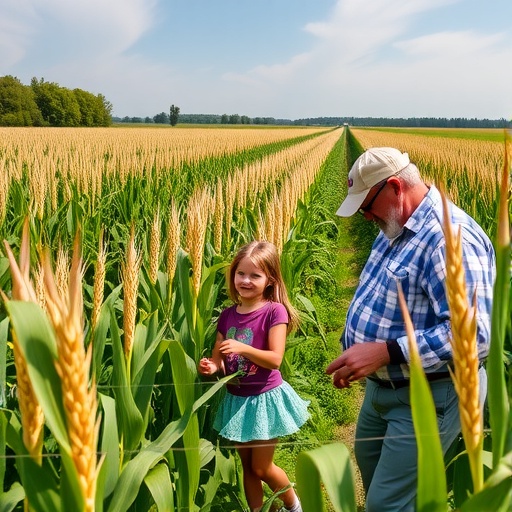
Agrivoltaics, a pioneering approach that marries agriculture with photovoltaic energy production, is fast emerging as a beacon of sustainability in modern farming. A recent groundbreaking study conducted over multiple years on maize cultivation under an elevated tracking agrivoltaic system has shed new light on the synergistic effects of solar panel integration with crop growth. This innovative research promises to redefine agricultural practices by optimizing land use and energy generation without compromising crop yields, a win-win for food security and clean energy proliferation.
At the heart of this study lies the elevated tracking agrivoltaic system, a technology designed to maximize both solar energy harvesting and agricultural productivity. Unlike traditional fixed-angle solar panels, this system incorporates dynamic tracking mechanisms that adjust the photovoltaic panels’ orientation in response to the sun’s trajectory. By elevating the panels, the system allows crops beneath to receive the necessary sunlight while simultaneously capturing solar energy, effectively transforming open farmland into dual-purpose landscapes.
Conducted by Sanchez, Agrawal, Brouder, and their colleagues, the study meticulously monitored maize growth and energy output across several growing seasons. The multi-year dataset stands out for its robustness in capturing inter-annual climate variability and its impact on both crop development and solar efficiency. This longitudinal approach offers a compelling narrative of how agrivoltaic systems perform over time, addressing one of the critical gaps in agrivoltaics research: sustainability and yield consistency beyond short-term trials.
One of the pivotal findings from the research is the impact of the elevated solar panels on microclimatic conditions experienced by the maize. The panels create a partial shading effect, which, surprisingly, can moderate temperature extremes and reduce evapotranspiration rates. For maize—a crop sensitive to heat stress—this microclimate modulation translates into more stable growing conditions, especially under conditions of climatic stress such as droughts or heatwaves. This highlights the agrivoltaic system’s potential to enhance crop resilience in the face of mounting climate uncertainties.
Taking a deep dive into the agronomic performance, the team utilized advanced modeling techniques to develop simplified yield prediction models tailored to the agrivoltaic system. These models adeptly combine key variables, including solar radiation interception, panel shading patterns, soil moisture dynamics, and plant physiological responses. By capturing the complex interactions between these variables, the researchers could accurately predict maize yields under varying solar arrangements, a tool that equips farmers and policymakers with actionable insights for system design and optimization.
The study also scrutinizes the energy economics of the elevated tracking system, calculating the trade-offs between shading-induced yield variations and the amount of electrical energy generated. Notably, the research reveals that elevated tracking enhances energy yield by aligning panel orientation optimally while minimizing adverse impacts on maize growth. This underscores the significance of implementing dynamic photovoltaic systems rather than static setups, offering a blueprint for maximizing land-use efficiency on farms.
Furthermore, the research extends its scope to environmental sustainability metrics. By studying the land-use efficiency and carbon footprint reductions attributable to dual land use, the team evidences that agrivoltaic systems can play a vital role in decarbonizing agriculture. This is achieved through the direct generation of renewable electricity on farmland, offsetting fossil fuel energy use, and supporting crop productivity enhancement, thereby aligning agricultural practices with carbon neutrality goals targeted in global climate frameworks.
Importantly, the study’s multi-year method allowed for accounting of seasonal fluctuations and weather variability, preventing overestimation of yield or energy benefits. This rigorous approach strengthens the confidence in agrivoltaics as a reliable innovation suitable for real-world agricultural deployment. It also addresses concerns regarding potential negative agroecological effects such as soil moisture depletion or unintended shifts in pest populations by revealing minimal adverse impacts over time.
The scientific contribution of this research extends beyond empirical data to propose practical design recommendations for future agrivoltaic installations. The findings advocate for panel elevation heights that balance shading benefits with adequate sunlight penetration, and tracking algorithms that optimize solar capture without hindering crop access to daylight. Such fine-tuned engineering guidance is crucial for scalable deployment and farmer adoption, mitigating the trial-and-error phases often challenging new technological integration in agriculture.
Equally significant is the interdisciplinary framework presented within the study. By bridging agronomy, solar engineering, environmental modeling, and agricultural economics, the research embodies a holistic pursuit of sustainability solutions. This integrative lens reflects the complexity of modern food-energy systems and demonstrates the necessity of combining expertise across domains to tackle intertwined challenges of food security and climate mitigation.
The implications of this study resonate strongly at policy levels as well. By providing empirically validated evidence on the feasibility and benefits of agrivoltaics, the research contributes to the growing momentum for supportive regulatory frameworks and incentive mechanisms. Encouraging such dual-use land technologies could expedite the transition to sustainable agricultural landscapes, promote renewable energy adoption in rural areas, and foster resilient food systems in the face of future climatic uncertainties.
Moreover, the scalability of elevated tracking agrivoltaic systems makes them adaptable for diverse geographic contexts and crop types beyond maize. Insights from this study open avenues for experimentation with other staple crops, offering a flexible model that could transform vast tracts of land worldwide into productive energy-agriculture hubs, catering to the escalating global demand for food and clean energy simultaneously.
The authors further emphasize the role of digital technologies, such as remote sensing and Internet of Things (IoT) sensors, integrated with the agrivoltaic infrastructure to enhance monitoring and decision-making. Such technologies can dynamically adjust panel angles based on real-time environmental and crop status data, further improving yield outcomes and energy efficiency, heralding a new era of precision agrivoltaics.
Beyond environmental and agronomic benefits, the socioeconomic dimensions of deploying agrivoltaics are profound. The study touches on how these systems can create new revenue streams for farmers through energy sales, reduce vulnerability to volatile energy markets, and foster rural electrification, thus enhancing community livelihoods and resilience. These social benefits accentuate agrivoltaics as more than a technical innovation, but a transformative force in sustainable rural development.
In sum, this comprehensive multi-year investigation into maize under elevated tracking agrivoltaic systems significantly advances our understanding of how solar energy and agriculture can coalesce synergistically. It establishes a scientific foundation for agrivoltaic technology scaling, rooted in robust empirical evidence and thoughtful system modeling, positioning agrivoltaics as a cornerstone technology in the global response to sustainable food and energy challenges.
The future of farming may well hinge on such innovative frameworks that transcend traditional land-use conflicts, seamlessly blending energy production with food cultivation. As the world grapples with escalating resource demands and climate crises, studies like this illuminate pathways toward resilient, productive, and sustainable agro-energy landscapes that are vital for generations to come.
Cite Scienmag News
Alan Morgan. (March 25, 2026). Multi-Year Maize Study Under Agrivoltaic Tracking. Scienmag. https://scienmag.com/multi-year-maize-study-under-agrivoltaic-tracking/
Alan Morgan. "Multi-Year Maize Study Under Agrivoltaic Tracking." Scienmag, 25 March 2026, https://scienmag.com/multi-year-maize-study-under-agrivoltaic-tracking/. Accessed 3 September 2026.
Alan Morgan. "Multi-Year Maize Study Under Agrivoltaic Tracking." Scienmag. March 25, 2026. https://scienmag.com/multi-year-maize-study-under-agrivoltaic-tracking/


