


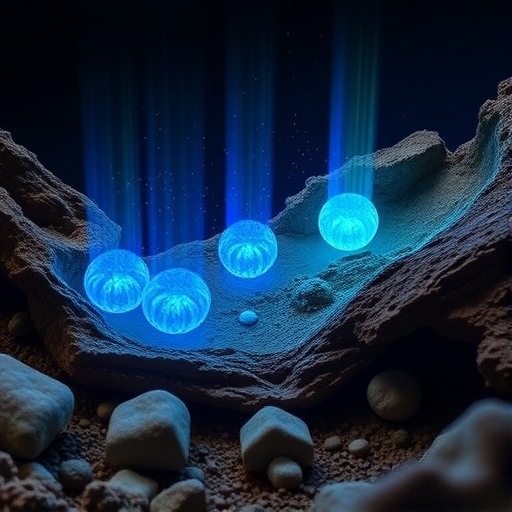
In a groundbreaking study that redefines our understanding of microbial interactions in marine environments, researchers have unveiled the presence of electroactive syntrophic consortia in coastal sediments, dependent on conductive particles for their metabolic synergy. Published in Nature Communications, this genome-centric metagenomic analysis not only illuminates the sophisticated electron exchange mechanisms underpinning these communities but also opens new frontiers in bioelectrochemical applications and environmental microbiology.
For decades, the intricate metabolic relationships among sediment-dwelling microorganisms remained an enigmatic topic, predominantly due to the technical challenges associated with studying uncultivated microbes in complex consortia. Traditional approaches often overlooked the electrochemical interdependencies that facilitate energy sharing in such environments. This latest research, spearheaded by Jovicic and colleagues, circumvents these limitations by employing cutting-edge genome-resolved metagenomic techniques paired with electrochemical characterizations. This methodology allowed for the identification and functional annotation of previously elusive electroactive syntrophs thriving through conductive particle-mediated interactions.
At the heart of the study lies the concept of syntrophy—a mutually beneficial metabolic partnership where the metabolic products of one microorganism serve as substrates for another, often necessitating tightly coupled biochemical pathways. What sets this discovery apart is the reliance of these syntrophic partnerships on conductive minerals present within coastal sediments, effectively functioning as natural electron conduits. This finding challenges the previously held notion that direct cell-to-cell contact or diffusible intermediates like hydrogen primarily facilitated interspecies electron transfer.
The researchers meticulously collected sediment samples from a coastal marine site and enriched these communities in laboratory conditions that replicated their natural environment. By integrating metagenomic sequencing with sophisticated binning strategies, they reconstructed high-quality genomes of key microbial players within the consortium. These genomic blueprints provided unprecedented insights into the genetic basis for extracellular electron transfer (EET), including the identification of multiheme cytochromes and other redox-active proteins indicative of electroactivity.
Crucially, the consortium’s functionality was tested under conditions with and without conductive particles, such as magnetite—an iron oxide mineral renowned for its electrical conductivity. Experimental data revealed a marked dependence of syntrophic interactions on the presence of these conductive particulates, which seemingly bridge the electron transfer between metabolically complementary microbes. This phenomenon not only underscores the ecological importance of sediment mineralogy but also highlights the evolutionary adaptations microbes have undergone to exploit their abiotic surroundings for bioenergetic gains.
Elucidating the electroactive capabilities of these microbial consortia bears profound implications for our understanding of sedimentary biogeochemical cycles, particularly carbon turnover and methane metabolism. The researchers found that these syntrophs potentially play pivotal roles in anaerobic degradation processes, facilitating the breakdown of complex organic matter in anoxic sediment layers. Their conductive networks enhance the efficiency of metabolic electron flow, thus accelerating syntrophic degradation pathways that were previously considered energetically unfavorable.
The genomic analyses further disclosed the presence of genes involved in multi-step electron transport chains, with hints toward novel electron shuttle mechanisms leveraging conductive particles as electron “wires.” Such strategies could represent evolutionary innovations to overcome spatial constraints within sediment matrices. Moreover, these electron transfer processes might influence the redox state of the surrounding environment, affecting metal cycling and even the geochemical properties of sediments.
From a biotechnological perspective, the elucidation of conductive particle-dependent syntrophic interactions inspires innovative strategies for designing artificial bioelectrochemical systems. Harnessing naturally occurring electroactive consortia could inform the development of microbial fuel cells, bioelectrosynthesis platforms, and bioremediation techniques aimed at pollutant degradation or energy recovery. These insights bridge microbial ecology with applied environmental engineering, forging pathways toward sustainable technologies that mimic or enhance nature’s electrochemical networks.
The study also calls attention to the vast microbial dark matter residing in sediment ecosystems, currently underrepresented in culture collections. By combining genome-centric metagenomics with environmental electrochemistry, the researchers provide a powerful framework to uncover metabolic capabilities encoded in environmental genomic reservoirs. This approach can be adapted to explore other conductive particle-dependent microbial communities across diverse habitats, broadening our comprehension of microbial ecology’s electrochemical dimension.
In reflecting on the broader scientific impact, the discovery underscores the vital role of abiotic factors such as mineral conductivity in shaping microbial community dynamics and functionality. It prompts a paradigm shift from viewing microbes as isolated biochemical entities to recognizing them as integrated components of electrically interactive environmental networks. This paradigm not only advances theoretical ecology but also has practical implications in predicting ecosystem responses to environmental perturbations, such as pollution, climate change, and sediment disturbance.
Future research trajectories may include in situ investigations to visualize and quantify electroactive syntrophic activity within natural sediments, coupled with high-resolution imaging and electrochemical profiling. Additionally, synthetic biology approaches could harness the identified electroactive genes to engineer bespoke microbial consortia tailored for specific environmental or industrial applications, enhancing efficiency through conductive particle-mediated electron transfer pathways.
Moreover, exploring the evolutionary origins and distribution of conductive particle-dependent syntrophy across global sediments could reveal key insights into the diversification of microbial metabolic strategies. Such knowledge holds the promise of uncovering new bioelectrochemical phenomena and expanding the catalog of functional genes contributing to environmental redox processes.
In conclusion, the revelation of electroactive syntrophic consortia dependent on conductive particles signifies a new milestone in microbial ecology and biogeochemistry. Through combining high-resolution metagenomics with functional assessments, this research exemplifies how integrating genomic data with environmental chemistry can uncover hidden layers of microbial interactions driving ecosystem functions. As we continue to unveil the secrets of Earth’s microscopic inhabitants, such discoveries will be instrumental in leveraging nature’s ingenuity for technological innovation and environmental stewardship.
Cite Scienmag News
Violet Maxwell. (March 25, 2026). Electroactive Syntrophs Discovered in Coastal Sediment Consortium. Scienmag. https://scienmag.com/electroactive-syntrophs-discovered-in-coastal-sediment-consortium/
Violet Maxwell. "Electroactive Syntrophs Discovered in Coastal Sediment Consortium." Scienmag, 25 March 2026, https://scienmag.com/electroactive-syntrophs-discovered-in-coastal-sediment-consortium/. Accessed 4 September 2026.
Violet Maxwell. "Electroactive Syntrophs Discovered in Coastal Sediment Consortium." Scienmag. March 25, 2026. https://scienmag.com/electroactive-syntrophs-discovered-in-coastal-sediment-consortium/


