


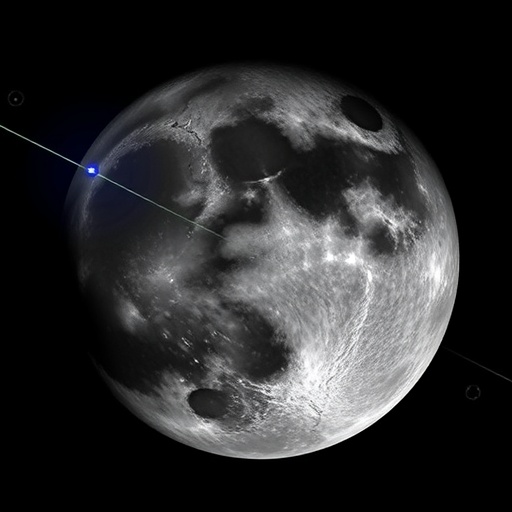
In an exciting leap for lunar science and exploration, researchers at ETH Zurich, in collaboration with international partners including Los Alamos National Laboratory, have unveiled a groundbreaking approach that could revolutionize how we study the Moon’s inner geological landscape. Traditionally, seismic data from the Moon have been scarce and limited since the Apollo missions, which ended seismic measurements in 1977. However, with the advent of cutting-edge fibre-optic Distributed Acoustic Sensing (DAS), the prospect of deploying a dense, lightweight sensor network across the lunar surface is now within reach.
The core innovation lies in leveraging fibre-optic cables as seismic sensors that can be spread out over great distances by lunar rovers. These cables, thinner than a human hair yet incredibly sensitive, use laser pulses to detect subtle vibrations in the surface of the Moon. When these laser pulses encounter tiny imperfections within the cable, they scatter back information about the environment, allowing the detection of seismic waves with remarkable precision. This technology transforms what was once a single sensor into thousands of virtual sensors along the length of the fibre, vastly increasing spatial resolution compared to conventional seismic networks.
This shift from deploying individual seismometers to unrolling kilometres of fibre-optic cable enables a seismic network of unprecedented density and coverage. Not only can such a system pick up moonquake tremors, but it can also register vibrations caused by meteorite impacts, spacecraft landings, and take-offs. The ability to harness these routine lunar events as active seismic sources hints at a novel and dynamic way to image the subsurface structure of the Moon, akin to the principles used in medical ultrasound, revealing hidden aspects of lunar geology previously inaccessible.
ETH Zurich’s team, led by Professor Johan Robertsson and doctoral researcher Simone Probst, focused intensive experimental and simulation efforts on assessing the practical efficacy of these DAS cables under lunar conditions. One revealing experiment involved placing fibre-optic cables in contact with crushed basalt, a terrestrial analog of lunar regolith. Results indicated that thicker fibre-optic cables maintain high-fidelity seismic signal detection even when laid directly atop such granular surfaces without the need for burial, a significant simplification given the tricky lunar terrain.
Perhaps most crucially, the Moon’s unique environment amplifies the advantages of this approach. Unlike Earth, the Moon lacks an atmosphere, so external sources of noise such as wind that disrupt terrestrial seismic measurements are absent. This dramatically enhances the signal-to-noise ratio, permitting fibre-optic cables to be deployed on the surface itself rather than buried underground. This not only reduces mission complexity and deployment time but also opens the door for large-scale, flexible seismic networks that can be reconfigured with ease.
Further computational models developed by the group simulate how fibre-optic cables couple with the lunar surface under the influence of lunar gravity, shedding light on expected vibration sensitivities. These sophisticated simulations are pivotal in understanding the interaction between cables and regolith, anticipating performance under lunar seismic wave propagation, and optimizing design parameters for future deployments. The coupling efficiency directly impacts the sensitivity and accuracy of seismic measurements and ultimately the clarity of the Moon’s interior images.
The implications of establishing such a dense sensor array on the Moon extend beyond pure geophysical curiosity. Detailed seismic maps could illuminate hidden features such as lava tubes, which are potential natural shelters for human habitats and reservoirs for water ice—critical resources for long-term lunar habitation. The technology could also detect tidal stresses induced by Earth’s gravitational pull, enhancing our understanding of lunar internal dynamics and seismic wave characteristics.
Moreover, detecting and monitoring dust displacement during rocket landings would provide practical data crucial for designing safer landing protocols and equipment. Lunar dust is known for its abrasive properties, posing significant risks to both machinery and human health. Real-time vibration sensing might guide future mission planners in managing and mitigating these hazards, heralding a new era of mission safety and efficiency.
This pioneering work also ventures into some of the more speculative but intriguing proposals, such as using the Moon itself as a detector for gravitational waves. The concept proposes that certain wave modes excited within the lunar body could be tracked using distributed sensing cables, opening a novel frontier for astrophysics and gravitational research beyond Earth-based detectors.
The study published in the journal Earth and Space Science represents a foundational step toward transforming the Moon into one of the most instrumented seismic laboratories outside Earth. If operationalized, fibre-optic distributed acoustic sensing networks could span the lunar surface, offering continuous, high-resolution monitoring that dramatically expands scientific knowledge and supports future exploration missions.
By integrating advanced laser optics, computational modeling, and geophysical techniques, this approach highlights a broader trend in planetary science: deploying light-based sensors for remote, large-scale environmental monitoring. It also underscores the growing interdependence between experimental fieldwork, laboratory analogs, and simulation modeling in designing space instrumentation tailored to alien environments.
ETH Zurich’s efforts symbolize the convergence of academic research and practical engineering aimed at unraveling the hidden mysteries of our nearest celestial neighbor. Beyond the technical feats, the broader vision entails building infrastructure for sustained lunar presence and discovery, leveraging innovative technologies that were once the preserve of Earth-bound laboratories and only now are poised to reshape off-world exploration.
As the global space community looks toward renewed lunar exploration, including NASA’s Artemis program and international lunar missions, the development of scalable, cost-efficient, and precise seismic sensing is pivotal. Fibre-optic DAS demonstrates how the next generation of sensing instruments can overcome the logistical and environmental challenges of space, enabling humanity to listen closely to the Moon’s subtle whispers and decode its ancient geological story in unprecedented detail.
News Publication Date: 17-Mar-2026
Web References: http://dx.doi.org/10.1029/2025EA004817
Keywords
Distributed Acoustic Sensing, fibre-optic cables, lunar seismology, Moonquake detection, laser pulse scattering, lunar regolith, seismic networks, lunar interior imaging, space exploration technology, lunar dust monitoring, gravitational wave detection, ETH Zurich
Cite Scienmag News
Grant Pearson. (March 25, 2026). Exploring the Moon’s Interior Using Fiber-Optic Technology. Scienmag. https://scienmag.com/exploring-the-moons-interior-using-fiber-optic-technology/
Grant Pearson. "Exploring the Moon’s Interior Using Fiber-Optic Technology." Scienmag, 25 March 2026, https://scienmag.com/exploring-the-moons-interior-using-fiber-optic-technology/. Accessed 4 September 2026.
Grant Pearson. "Exploring the Moon’s Interior Using Fiber-Optic Technology." Scienmag. March 25, 2026. https://scienmag.com/exploring-the-moons-interior-using-fiber-optic-technology/


