


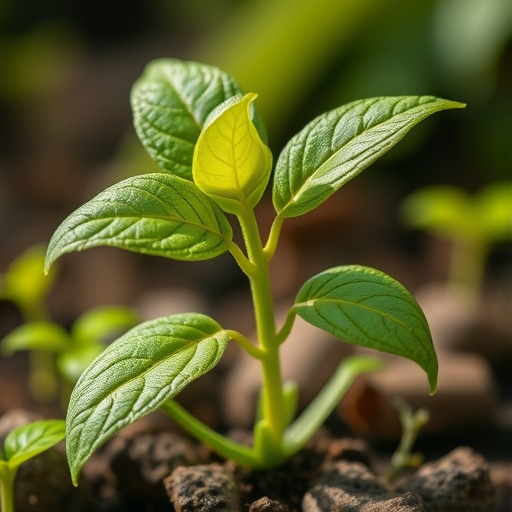
UC Riverside researchers have uncovered a groundbreaking mechanism by which plants rapidly halt growth in response to severe environmental stresses—offering new hope for breeding more resilient crops amid escalating climate challenges. This novel discovery reveals how plants employ a swift, enzyme-level regulatory system to survive extreme conditions such as intense light and heat, challenging prior assumptions about how biosynthetic pathways adjust under stress.
The foundation of this rapid response lies within a highly conserved biosynthetic pathway integral to plant metabolism. This pathway is responsible for generating essential compounds required not only for regular development but also for stress survival. Uniquely, this system is so critical that disruption of even a single enzyme in the sequence proves lethal under standard conditions. However, under acute stress, the plant employs a dynamic regulatory strategy, modulating enzyme activities directly rather than relying on gene expression changes, which typically require longer to manifest.
Conventional biological responses to environmental stress primarily involve changes at the transcriptional level—altering RNA synthesis to adjust protein amounts and subsequently shift metabolic outputs. These processes generally demand extensive time, inadequate for plants suddenly exposed to harmful stimuli such as solar radiation spikes or heat waves. Instead, UC Riverside scientists observed that stressful stimuli instigate immediate biochemical modifications to existing enzymes, allowing plant tissues to curtail growth rapidly and conserve resources without waiting for new gene products to be synthesized.
Professor Katie Dehesh, a distinguished molecular biochemistry expert at UC Riverside, highlighted the evolutionary advantage of such instantaneous regulation. “The plant’s survival hinges on a response that is both immediate and effective. While modifying gene expression involves a cumbersome timescale, enzyme activity can be fine-tuned within seconds, enabling the plant to withstand otherwise lethal environmental surges,” she explained.
At the biochemical level, the response initiates through reactive oxygen species (ROS) generated by stress conditions. These ROS molecules interact directly with specific enzymes in the biosynthetic pathway, attenuating their catalytic activity. Concurrently, the build-up of certain metabolic intermediates serves as a feedback inhibitor, binding upstream enzymes and effectively throttling pathway flux. This dual inhibitory mechanism swiftly downregulates the synthesis of growth-promoting compounds, allowing the plant to enter a protective state that balances survival against developmental progression.
As the stress persists beyond immediate onset, a secondary adaptive phase emerges in which the plant readjusts its metabolic network by altering gene expression and enzyme abundance. This prolonged response secures long-term adaptation but often incurs growth penalties, manifesting in smaller biomass and delayed development. Thus, the newly characterized two-stage regulatory system reconciles acute survival tactics with longer-lasting environmental acclimation.
Previous efforts to bioengineer crops focused on amplifying biosynthetic capabilities or drought tolerance frequently faltered, stymied by incomplete understanding of these dual response phases. By integrating metabolite-mediated enzyme control into their models, the Dehesh lab’s research provides new paradigms for crop improvement strategies. Recognizing the metabolic checkpoints controlling pathway dynamics opens avenues to optimize resource allocation, enhancing productivity under fluctuating environmental pressures.
The meticulous unraveling of this pathway was spearheaded by Mien van de Ven, a retired lab manager whose dedication extended well beyond conventional career timelines. Van de Ven’s painstaking quantitation of ephemeral metabolic intermediates—some present at vanishingly low concentrations—was crucial to elucidating pathway bottlenecks. Her work demanded extraordinary precision and innovation in isolating and assaying both enzymes and metabolites under carefully controlled conditions.
Dehesh commended van de Ven’s commitment, remarking, “Her relentless pursuit of clarity and rigorous experimentation profoundly advanced our insight. It exemplifies how passion and perseverance can transform scientific discovery.” Even as she retired, van de Ven remained a driving force, returning to the bench regularly to complete essential experiments that brought the hypothesis full circle.
The team’s breakthrough originated from an enigmatic mutation affecting a single enzyme that notably impeded plant growth without causing fatality. This observation initiated a cascade of analytical steps tracing metabolite accumulations downstream of the mutation point. Their investigations revealed a critical intermediate that, upon accumulating excessively, interacts with upstream enzymatic machinery to suppress its activity—a classic negative feedback regulatory mechanism previously unknown in this context.
Overcoming technical barriers to verify enzyme-metabolite interactions required recreating intricate intracellular environments in vitro. Proteins proved notoriously unstable outside their native milieu, and isolating pure enzyme preparations free from interfering compounds demanded rigorous optimization. These challenges underscored the complexity of unraveling in vivo regulatory networks through reductionist biochemical approaches.
Beyond plant biology, the findings have broader implications, given the existence of analogous pathways in bacterial organisms. This cross-kingdom similarity suggests a conserved, evolutionarily honed strategy for balancing growth and stress resilience across diverse life forms. It underscores the sophistication of metabolic regulation and adaptive flexibility inherent to living systems.
From an applied perspective, enhancing or mimicking this natural, metabolite-controlled enzyme modulation could transform agricultural biotechnology. Developing crops capable of swiftly downshifting growth pathways in response to sudden environmental extremes promises greater yield stability, improved resource use efficiency, and resilience amid climate volatility. This approach presents a promising alternative to conventional genetic modification strategies that target transcriptional controls alone.
The narrative of discovery is as inspiring as the science itself. Van de Ven’s unwavering determination to see the project through after retirement highlights the human dimension of research excellence. Balancing retirement’s newfound joys with scientific passion, she epitomizes dedication’s power in driving transformative knowledge.
In her own words, van de Ven reflected, “Although it took longer than I anticipated, completing this work was deeply rewarding. It’s fulfilling to contribute lasting insights that could impact future generations of crops and food security.”
This paradigm-shifting research not only advances fundamental molecular understanding of plant stress biology but also charts a practical roadmap for engineering robust, high-performing crops tailored for an uncertain environmental future.
News Publication Date:
4-Feb-2026
Web References:
http://dx.doi.org/10.1073/pnas.2529243123
Cite Scienmag News
Alan Morgan. (March 25, 2026). How Plants Halt Growth to Withstand Stress and Survive. Scienmag. https://scienmag.com/how-plants-halt-growth-to-withstand-stress-and-survive/
Alan Morgan. "How Plants Halt Growth to Withstand Stress and Survive." Scienmag, 25 March 2026, https://scienmag.com/how-plants-halt-growth-to-withstand-stress-and-survive/. Accessed 4 September 2026.
Alan Morgan. "How Plants Halt Growth to Withstand Stress and Survive." Scienmag. March 25, 2026. https://scienmag.com/how-plants-halt-growth-to-withstand-stress-and-survive/


