


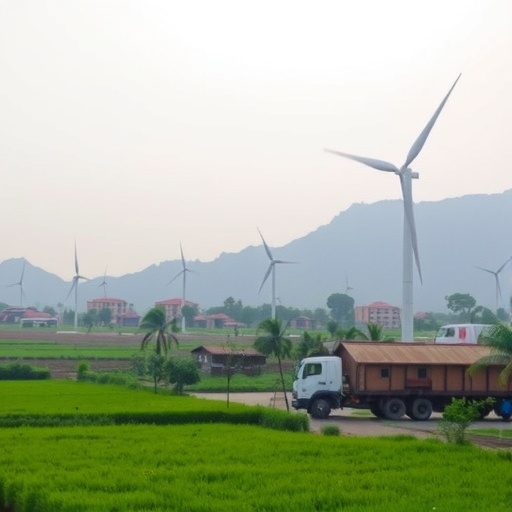
A groundbreaking econometric study offers compelling evidence for a sustainable economic future in South Asia, a region grappling with the dual imperatives of rapid development and environmental preservation. This research, led by Imran Khan of The University of Haripur and China University of Mining and Technology, uses advanced panel econometric techniques to unravel the intricate relationship between globalization, industrial expansion, and carbon emissions across South Asian economies. The findings present a robust analytical framework that not only quantifies these dynamics but also charts actionable pathways toward carbon neutrality, an urgent agenda as these nations continue to accelerate economic growth.
South Asia, defined by the South Asian Association for Regional Cooperation (SAARC), is home to over one-fifth of the global population and represents an ecosystem where economic ambition often clashes with environmental sustainability. Historically, efforts to boost Gross Domestic Product (GDP) through industrialization have led to escalating CO2 emissions, contributing to global climate challenges. This study’s application of Panel Autoregressive Distributed Lag (ARDL) models is pivotal, allowing for dynamic, long-run equilibrium analyses which are essential when assessing the temporally lagged environmental impacts of economic activity.
At the heart of this research lies a paradox: economic globalization, an engine of growth and prosperity, exerts a measurable environmental cost. Empirical evidence from the analysis reveals that a 1% increase in globalization leads to a significant 2.61% rise in GDP but concurrently triggers a 0.278% rise in carbon dioxide emissions. This duality underscores the need for calibrated policy mechanisms that can steer economic integration and growth without degrading the climate system.
Similarly, the study examines industrial structural dynamics, revealing a direct but nuanced impact on emissions. While a 1% expansion in industrial structure correlates with a 0.56% increase in GDP, it comes at the cost of a 0.222% increase in CO2 emissions. These findings articulate the environmental price embedded in traditional industrialization, signaling a critical need for transformative industrial policies that integrate low-carbon technologies and energy-efficient practices.
Perhaps the most consequential insight of this work concerns the role of renewable energy consumption (REC) in modulating environmental outcomes. The data compellingly demonstrates that every incremental 1% increase in REC leads to a 0.316% reduction in long-term CO2 emissions, effectively offsetting the emissions associated with industrial growth. This outcome is a clarion call for policymakers: renewable energy investments can be a game changer, facilitating an economic trajectory that harmonizes industrial advancement with environmental stewardship.
The methodological rigor of the study is noteworthy. Employing cointegration tests alongside ARDL models ensures a robust accounting for the non-stationary yet cointegrated nature of the macroeconomic and environmental time series data. This statistical sophistication strengthens confidence in the causal interpretations derived and sets a new standard for climate-economic analyses in the context of developing economies.
Moreover, the comprehensive cross-country panel approach allows the researchers to capture heterogeneities and shared trends across SAARC countries, forming a nuanced mosaic of the region’s development-environment nexus. By integrating diverse economic profiles and energy portfolios, the research presents versatile policy prescriptions adaptable to various national contexts within South Asia.
This analysis transcends abstract climate narratives by providing actionable insights. It underscores the imperative for SAARC governments to concurrently reimagine industrial policies and aggressively channel resources into renewable energy infrastructure. Enforcing market-based instruments such as carbon pricing could further internalize the environmental cost of emissions, incentivizing cleaner production and consumption patterns.
In practical terms, this study advocates for a paradigm shift wherein economic agendas are not tethered to fossil-fuel-driven growth paradigms but are realigned toward sustainable development pathways. This entails fostering innovation ecosystems around green technologies, deploying smart urban planning to reduce carbon footprints, and enhancing energy efficiency standards across industrial sectors.
The implications extend beyond South Asia, offering a template for other emerging economies confronted with the classic dilemma of balancing growth and environmental integrity. The evidence that economic expansion and decarbonization are not antagonistic but synergistic goals disrupts prevailing pessimism and opens new avenues for green policy experimentation globally.
By illuminating the statistically significant impact of renewable energy consumption as a counterbalance to emissions generated by globalization and industrialization, the study injects optimism into the climate discourse. It confirms that technology-driven transitions, underpinned by rigorous policy frameworks, can reconcile economic and environmental objectives.
As global climate negotiations continue to prioritize emissions reductions, empirical studies such as this one provide the indispensable quantitative foundation required to tailor region-specific climate strategies. South Asia, with its sizeable economic and demographic footprint, stands at a critical juncture where informed policy action based on data-driven insights can yield outsized benefits for local and global climate resilience.
In conclusion, the empirical clarity brought forth by this research fundamentally reshapes our understanding of South Asia’s development-climate equation. It compels a re-envisioning of growth trajectories, urging a wholesale integration of renewable energy expansion and carbon governance within the core of economic planning. Such an integrated vision positions the region as both a critical player and an exemplar in the global pursuit of carbon neutrality.
News Publication Date:
3-Mar-2026
Web References:
http://dx.doi.org/10.1007/s44246-025-00243-3
Cite Scienmag News
Courtney Benton. (March 25, 2026). Fueling South Asia’s Future: The Economic Equation of Achieving Carbon Neutrality. Scienmag. https://scienmag.com/fueling-south-asias-future-the-economic-equation-of-achieving-carbon-neutrality/
Courtney Benton. "Fueling South Asia’s Future: The Economic Equation of Achieving Carbon Neutrality." Scienmag, 25 March 2026, https://scienmag.com/fueling-south-asias-future-the-economic-equation-of-achieving-carbon-neutrality/. Accessed 3 September 2026.
Courtney Benton. "Fueling South Asia’s Future: The Economic Equation of Achieving Carbon Neutrality." Scienmag. March 25, 2026. https://scienmag.com/fueling-south-asias-future-the-economic-equation-of-achieving-carbon-neutrality/


