


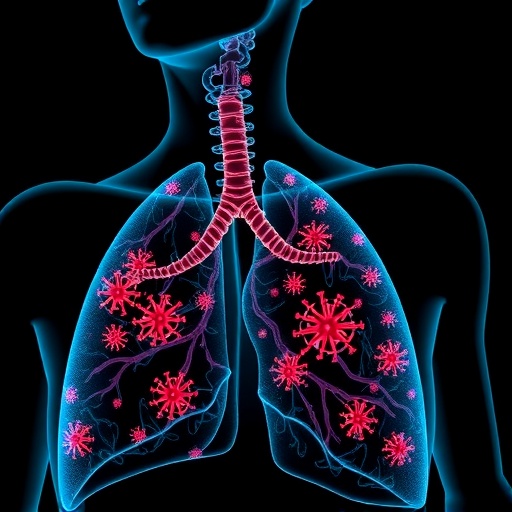
In a groundbreaking study published in the latest issue of Immunity & Inflammation, researchers from the Chinese Academy of Medical Sciences have unveiled a previously unknown mechanism of immune cell trafficking during respiratory viral infections. Led by Professor Xuetao Cao, the team employed state-of-the-art single-cell RNA velocity analysis combined with spatial transcriptomics to decode the origin and migratory path of neutrophils that accumulate in the lungs during severe viral challenges, such as SARS-CoV-2 infection. Their research reveals an orchestrated spleen-to-lung neutrophil axis that is pivotal for the host’s antiviral defense, fundamentally shifting the current understanding of pulmonary immune dynamics.
Neutrophils, known as the first responders of the innate immune system, rapidly infiltrate infected lung tissue during respiratory viral infections, where they exert both protective and potentially damaging effects. Until now, the scientific consensus predominantly held that these cells either proliferated within the lung microenvironment or were mobilized from the bone marrow. However, Prof. Cao’s team systematically analyzed immune cell kinetics in a SARS-CoV-2-infected golden hamster model, discovering that the spleen plays a critical and previously underappreciated role in neutrophil generation and trafficking.
Extensive single-cell RNA velocity profiling revealed a linear developmental trajectory within the lung neutrophil populations post-infection, beginning from proliferative precursors through immature and mature states to fully activated neutrophils. Yet, local proliferation in the lung failed to produce sufficient neutrophils to account for the marked infiltration observed at the infection peak. Intriguingly, a synchronous rise in splenic neutrophil numbers was recorded around days five to seven post-infection, coinciding tightly with the surge seen in the lung, suggesting a causative link.
To further unravel this inter-organ relationship, the researchers compared transcriptomic profiles of neutrophil subsets across the lung and spleen. They noted three conserved major subpopulations — proliferative, non-activated, and activated neutrophils — exhibiting strikingly similar gene expression signatures in both tissues. This powerful insight hinted strongly that splenic neutrophils, proliferating robustly during infection, were primed to migrate to the lung, replenishing its cellular repertoire and supporting immune function.
The team harnessed spatial transcriptomic techniques alongside the Redeconve deconvolution algorithm to map these neutrophils back to precise lung microenvironments. This innovative spatial analysis demonstrated that between days five and seven post-infection, splenic-origin neutrophils constituted a significant fraction of the lung’s neutrophil population — in some cases matching or surpassing that of locally derived cells. Notably, no similar migratory patterns were identified for other immune cells, underscoring the unique role of the spleen regarding neutrophil trafficking.
Temporal dynamics further illuminated the spleen-lung communication axis. Early-stage proliferative neutrophils emigrated from the spleen to the lung by day five, while subsequent influxes predominantly comprised immature and mildly activated neutrophils by day seven. This sequential migration suggests a continuous splenic contribution, supplying neutrophils at different developmental stages tailored for effective antiviral activities within the inflamed pulmonary tissue.
Mechanistically, this directional trafficking adheres to a complex chemokine-receptor signaling code. The lungs at infection peak overexpressed several neutrophil-attracting chemokines, including CXCL5, CXCL12, and CCL11, secreted respectively by epithelial cells, macrophages, and fibroblasts. Correspondingly, splenic neutrophil subsets exhibited distinct receptor profiles — immature neutrophils expressing CXCR4 primarily respond to CXCL12, while mature neutrophils upregulate CXCR2, CCR1, and CCR3, receptors for CXCL5 and CCL11. This ligand-receptor matching provides a biochemical roadmap facilitating precise, stage-specific recruitment from spleen to lung.
This discovery challenges the orthodox paradigm that views the bone marrow as the exclusive reservoir for neutrophil supply during pulmonary infections. Instead, the spleen emerges as an essential extramedullary niche harboring a dynamic pool of neutrophils ready for deployment. These findings have profound implications for understanding immune mobilization and inter-organ coordination in inflammation and infection.
Professor Cao emphasized that this spleen-lung axis elucidates the intricate systemic orchestration of innate immunity, offering novel conceptual frameworks for immunological research. The inter-organ dialogue between spleen and lung shaped by chemokine signals refines the spatial and temporal dimensions of immune responses and raises important questions about similar mechanisms in other infections and inflammatory conditions.
From a clinical perspective, modulation of this neutrophil trafficking axis may pave the way for innovative therapeutic strategies. Excessive neutrophil recruitment is a hallmark of severe viral pneumonias, including COVID-19, where it contributes to lung injury and respiratory failure. Targeting specific chemokine-receptor interactions involved in spleen-to-lung signaling may provide keener control over inflammatory cell influx, balancing protective immunity with tissue preservation.
Equally significant, this research introduces potential diagnostic biomarkers identifying splenic neutrophil activation states or chemokine gradients that could predict disease progression or therapeutic responses. The integration of single-cell and spatial multi-omics represents a powerful technology platform to discern such immune axes across diseases, offering a path toward precision medicine in infectious and inflammatory lung disorders.
In summary, this pioneering study uncovers a critical spleen-to-lung neutrophil axis instrumental in orchestrating antiviral defense during respiratory infection. The convergence of cutting-edge single-cell transcriptomics, spatial mapping, and functional analysis reshapes the understanding of systemic immune cell trafficking, providing exciting opportunities for both fundamental research and clinical translation in pulmonary medicine.
News Publication Date: 11-Mar-2026
References: DOI: 10.1007/s44466-026-00030-8
Keywords
Neutrophil trafficking, spleen-to-lung axis, antiviral immunity, single-cell RNA velocity, spatial transcriptomics, SARS-CoV-2 infection, chemokine signaling, innate immunity, pulmonary inflammation, immune cell migration, extramedullary hematopoiesis, immunotherapy.
Cite Scienmag News
Kristina Jarvis. (March 20, 2026). New Research Uncovers How the Spleen-to-Lung Neutrophil Pathway Drives Antiviral Defense. Scienmag. https://scienmag.com/new-research-uncovers-how-the-spleen-to-lung-neutrophil-pathway-drives-antiviral-defense/
Kristina Jarvis. "New Research Uncovers How the Spleen-to-Lung Neutrophil Pathway Drives Antiviral Defense." Scienmag, 20 March 2026, https://scienmag.com/new-research-uncovers-how-the-spleen-to-lung-neutrophil-pathway-drives-antiviral-defense/. Accessed 4 September 2026.
Kristina Jarvis. "New Research Uncovers How the Spleen-to-Lung Neutrophil Pathway Drives Antiviral Defense." Scienmag. March 20, 2026. https://scienmag.com/new-research-uncovers-how-the-spleen-to-lung-neutrophil-pathway-drives-antiviral-defense/


