


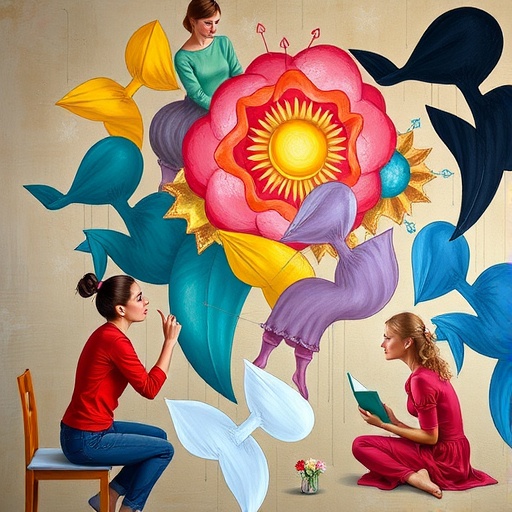
In recent years, a growing body of research has begun to unravel the profound impact that engagement with the arts can have on mental health. From creative arts therapies and community arts initiatives prescribed by healthcare practitioners, to leisure-time arts activities, participation in the arts is now recognized as more than mere recreation. It plays a pivotal role in reducing psychiatric symptoms and enhancing psychological wellbeing across diverse mental health conditions. However, despite robust evidence supporting these benefits, the science behind how and why arts engagement exerts such positive effects on the brain and mind remains largely opaque, a puzzle at the heart of contemporary psychological and neuroscientific inquiry.
A groundbreaking review by Fancourt, Stringaris, and Sacco, published in Nature Reviews Psychology, addresses this very enigma by synthesizing interdisciplinary research to map out the underlying causal mechanisms through which the arts influence mental health. This comprehensive examination reaches beyond surface-level effects to identify the intricate web of processes that link engagement with artistic activities to improvements in mental well-being. By integrating insights from psychology, neuroscience, neurophysiology, psychobiology, social science, and behavioral science, the authors spotlight an impressive array of 50 distinct mechanisms organized into broad, interconnected categories that transcend specific art forms.
Central to this emerging framework is the idea of a transdiagnostic approach—that is, mechanisms common across different psychiatric diagnoses and across the various modalities of art, whether it be music, dance, visual art, or theater. This approach moves the field towards a more nuanced understanding that cuts across diagnostic boundaries, focusing instead on shared pathways by which art can restore or optimize mental functioning. These mechanisms are not isolated; rather, they interlock and amplify each other, producing a cumulative effect greater than the sum of their parts.
One remarkable insight from the review is the concept of the ‘arts exposome,’ a term borrowed and adapted from environmental health sciences to describe the totality and dynamics of an individual’s arts-related behaviors and exposures over time. The arts exposome encapsulates the habitual patterns of engaging with arts in everyday life, highlighting how these patterns interact with biological, psychological, and social mechanisms to shape mental health trajectories. This holistic viewpoint acknowledges that it is not any single art activity but the continuous, multifaceted engagements that together activate a constellation of beneficial mechanisms.
Among the plethora of identified processes are neurobiological mechanisms such as regulation of neurotransmitters and neuroplasticity, which collectively promote brain resilience and recovery. For instance, engagement in music or dance has been shown to modulate dopamine pathways, facilitating reward and motivation circuits that often suffer disruption in depression and anxiety. At the same time, the arts stimulate the release of endorphins and oxytocin, hormones linked to pleasure, social bonding, and stress reduction. These neurochemical changes underpin some of the immediate emotional benefits reported by participants.
Beyond the biochemical realm, the arts evoke profound psychophysiological effects, influencing autonomic nervous system balance and reducing physiological markers of stress such as cortisol levels. This effect on the body’s stress response may help explain the sustained symptom relief experienced by many individuals who regularly participate in arts activities. Likewise, changes in brain connectivity patterns, particularly between regions involved in emotion regulation, executive functioning, and sensory processing, have been documented through neuroimaging studies, further elucidating the pathways through which arts engagement fosters mental health.
Psychological mechanisms are equally compelling. The arts provide immersive frameworks for meaning-making, self-expression, and identity reconstruction—processes that are fundamental to psychological healing and growth. Engagement with arts allows individuals to externalize internal conflicts, manage emotions more effectively, and build self-efficacy. Furthermore, the creative process nurtures problem-solving skills and cognitive flexibility, essential tools for coping with uncertainty and adversity, which are often heightened in those with mental health disorders.
Social dimensions add another critical layer. Arts activities promote social inclusion and connection by creating shared experiences and communities, which counteract the isolation so commonly intertwined with mental illness. Participation in group arts programs fosters empathy, trust, and mutual support—all key ingredients for social reintegration and recovery. These social mechanisms may also help moderate the effects of stigma, enhancing individuals’ sense of belonging and acceptance.
Importantly, Fancourt and colleagues emphasize that these mechanisms do not operate in isolation but are densely interwoven. For example, social connectedness fostered by arts participation can enhance neuroendocrine responses, which in turn improve emotional regulation, forming a positive feedback loop that consolidates mental health benefits. This synergy underscores the necessity of considering the arts as multifaceted interventions rather than simplistic or single-dimensional treatments.
The review also highlights that the impact of the arts on mental health is highly personalized, shaped by factors such as individual art preferences, cultural context, and the psychosocial environment. This individual variability has implications for clinical practice and public health, underscoring the need to tailor arts interventions to activate mechanisms most relevant to each person’s diagnostic and personal profile. Advancing this precision approach will require integration of both quantitative and qualitative methods, including biomarker assessments and phenomenological accounts.
Looking ahead, a key priority identified is the development of more refined theoretical models that map how particular arts modalities, dosage, and engagement styles selectively target diagnostic-specific and transdiagnostic mechanisms. This could lead to the design of bespoke arts-based treatments that complement conventional therapies, offering holistic and patient-centered options for mental healthcare. Additionally, longitudinal studies tracking individuals’ arts exposomes and mental health over time will shed light on causal pathways and the sustainability of arts benefits.
The implications of this review extend beyond clinical settings. As arts policy makers, educators, and community organizers consider how to embed the arts in everyday life as tools for mental health promotion, knowledge of these complex mechanisms will guide program development grounded in scientific evidence. Moreover, by framing arts participation as a behavior with measurable neurobiological and psychosocial impacts, the review opens pathways for collaborations across health, social, and cultural sectors to jointly enhance population well-being.
In sum, Fancourt, Stringaris, and Sacco have provided a landmark synthesis that propels the field forward from anecdote to mechanism-based understanding. Their work clarifies that the mental health benefits of arts engagement arise from a dynamic interplay of neurobiological, physiological, psychological, and social mechanisms aggregated within personalized arts exposomes. As this knowledge base expands, it promises to elevate the arts from complementary activities to cornerstones of holistic and integrative mental health care, reshaping how societies view healing, creativity, and human flourishing.
Cite Scienmag News
Glenn Wilkins. (March 20, 2026). How Arts Engagement Shapes Mental Health Mechanisms. Scienmag. https://scienmag.com/how-arts-engagement-shapes-mental-health-mechanisms/
Glenn Wilkins. "How Arts Engagement Shapes Mental Health Mechanisms." Scienmag, 20 March 2026, https://scienmag.com/how-arts-engagement-shapes-mental-health-mechanisms/. Accessed 4 September 2026.
Glenn Wilkins. "How Arts Engagement Shapes Mental Health Mechanisms." Scienmag. March 20, 2026. https://scienmag.com/how-arts-engagement-shapes-mental-health-mechanisms/


