


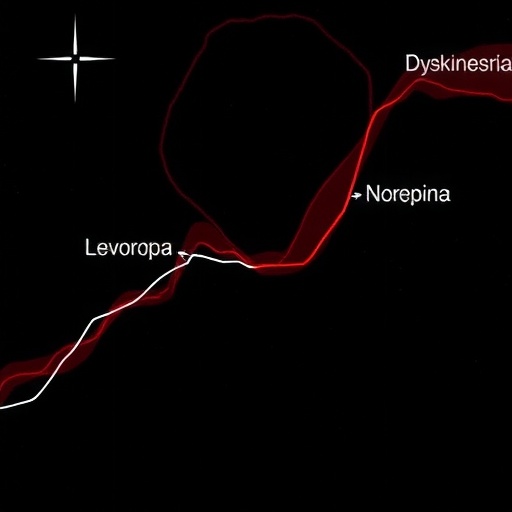
In a groundbreaking study published in npj Parkinson’s Disease, researchers have unveiled a novel neurophysiological hallmark associated with levodopa-induced dyskinesia (LID) in Parkinson’s disease (PD) — altered wakeful theta activity. This discovery sheds new light on the complex neural dynamics underpinning dyskinetic movements, potentially paving the way for innovative diagnostic and therapeutic strategies. As Parkinson’s disease continues to pose significant challenges to millions worldwide, understanding the nuanced interplay between dopaminergic treatments and brain network oscillations is paramount to improving patient outcomes.
Parkinson’s disease is primarily characterized by the degeneration of dopaminergic neurons in the substantia nigra, leading to motor deficits such as bradykinesia, rigidity, and tremor. Levodopa remains the gold standard pharmacological intervention, effectively replenishing dopamine and alleviating motor symptoms. However, a major complication arising after prolonged levodopa administration is the development of involuntary, often debilitating movements known as dyskinesias. These levodopa-induced dyskinesias represent a significant clinical challenge, complicating disease management and diminishing patients’ quality of life.
The study, led by Fiorillo, Lombardi, La Porta, and colleagues, delves deep into the electrophysiological underpinnings of these dyskinetic manifestations by focusing on oscillatory brain rhythms during wakefulness. Theta oscillations, typically ranging between 4 and 8 Hz, are a fundamental neural rhythm implicated in various cognitive and motor functions. Prior research has extensively characterized theta activity during sleep and cognitive tasks, but its modulation in neurodegenerative disorders and drug-induced motor complications has remained elusive.
Utilizing advanced electrophysiological recording techniques, the researchers conducted longitudinal analyses in Parkinson’s patients undergoing chronic levodopa therapy. They detected a consistent and reproducible alteration in the wakeful theta rhythm, distinguishing patients afflicted by LID from those without dyskinesia. This alteration was not merely a quantitative increase or decrease in power but reflected a profound change in the temporal dynamics and coherence of theta oscillations across motor-related cortical and subcortical networks.
Importantly, this altered wakeful theta pattern appears to index the pathological neural plasticity engendered by fluctuating dopaminergic stimulation. The researchers posit that excessive or aberrant synchrony within theta frequency channels could facilitate maladaptive motor patterns, culminating in the involuntary movements characteristic of dyskinesia. This mechanistic insight challenges traditional models focused solely on dopamine receptor sensitivity or basal ganglia circuitry dysfunction, promoting a network-based paradigm highlighting oscillatory dysregulation.
The implications of identifying altered theta activity as a biomarker for dyskinesia are multifold. From a diagnostic standpoint, non-invasive electroencephalography (EEG) or magnetoencephalography (MEG) could be harnessed to monitor disease progression and dyskinesia risk in real time. Moreover, therapeutic interventions might be tailored to modulate specific oscillatory activity, either pharmacologically or through emerging neuromodulation techniques such as transcranial alternating current stimulation (tACS) or deep brain stimulation (DBS) with frequency-specific parameters.
Additionally, the study delineates how theta alterations correlate with clinical severity and duration of dyskinesias. Patients with more pronounced dyskinetic episodes exhibit greater deviations in theta power and phase synchrony, suggesting a dose-dependent relationship between dysregulated oscillations and motor dysfunction. This correlation reinforces the potential utility of theta metrics as objective endpoints in clinical trials seeking to evaluate novel anti-dyskinetic compounds or neuromodulatory regimens.
Further, the investigation highlights the role of corticostriatal pathways in mediating these oscillatory changes. The interaction between the motor cortex and striatum, both of which are critically involved in movement initiation and control, appears to underlie the pathological theta synchrony observed. Disruptions in normal communication patterns across these regions may exacerbate aberrant motor outputs, emphasizing the need to consider distributed network dysfunction rather than isolated neuronal deficits.
The study’s methodological rigor is also noteworthy. Employing high-density EEG arrays coupled with sophisticated signal processing algorithms enabled a fine-grained temporal and spatial resolution of brain rhythms. The researchers mitigated confounding factors such as medication state, disease duration, and comorbid conditions, enhancing the robustness of their findings. Furthermore, cross-validation with animal models of Parkinson’s disease enriched the translational relevance of the results.
Interestingly, the altered theta activity is evident predominantly in the wakeful resting state rather than during task performance, suggesting that spontaneous neural activity disturbances may predispose patients to dyskinesia even before overt motor signs emerge. This finding challenges prior assumptions that dyskinesias result solely from aberrancies during movement execution, implying that baseline neural network instability is a predisposing factor.
The study also explores the potential interaction between theta oscillations and other frequency bands such as beta (13-30 Hz) and gamma (>30 Hz). While beta rhythm suppression has been long associated with movement facilitation in PD, the coexistence of aberrant theta patterns could reflect complex cross-frequency coupling abnormalities that disrupt normal motor control. This nuanced comprehension of multi-band oscillatory interactions opens avenues to target composite neural signatures rather than isolated frequency bands.
Moreover, the findings may inspire re-evaluation of levodopa dosing regimens and adjunctive therapies. By elucidating the temporal dynamics of dyskinesia-related oscillations, clinicians might optimize treatment schedules to minimize pathological theta enhancements, potentially prolonging therapeutic windows and mitigating adverse effects. Personalized medicine approaches integrating electrophysiological profiling could become a future cornerstone of Parkinsonian care.
Beyond therapeutic implications, this research reveals important conceptual insights into how chronic pharmacological modulation reshapes brain network activity. The manifestation of dyskinesia as a rhythmopathy underscores the brain’s susceptibility to induced maladaptive oscillatory states, a principle that may extend to other movement disorders or neuropsychiatric conditions characterized by rhythmic dysregulation.
In sum, the identification of altered wakeful theta activity as a distinctive neural signature of levodopa-induced dyskinesia represents a significant advance in our understanding of Parkinson’s disease pathophysiology. This work not only enriches the scientific community’s knowledge of brain oscillations in health and disease but also holds tangible promise for the development of innovative diagnostic tools and targeted therapies. As the field advances, integrating electrophysiological biomarkers with clinical phenotyping will be vital to transform these insights into meaningful patient benefits.
The study by Fiorillo, Lombardi, La Porta, and collaborators stands as a testament to the power of interdisciplinary neuroscience, bridging clinical neurology, electrophysiology, and computational analysis. Future investigations expanding upon these findings will undoubtedly continue to unravel the intricate dynamics of Parkinson’s disease and refine strategies to combat its most disabling complications.
Cite Scienmag News
Cassandra Pierce. (March 20, 2026). Altered Theta Activity Marks Levodopa Dyskinesia. Scienmag. https://scienmag.com/altered-theta-activity-marks-levodopa-dyskinesia/
Cassandra Pierce. "Altered Theta Activity Marks Levodopa Dyskinesia." Scienmag, 20 March 2026, https://scienmag.com/altered-theta-activity-marks-levodopa-dyskinesia/. Accessed 3 September 2026.
Cassandra Pierce. "Altered Theta Activity Marks Levodopa Dyskinesia." Scienmag. March 20, 2026. https://scienmag.com/altered-theta-activity-marks-levodopa-dyskinesia/


