


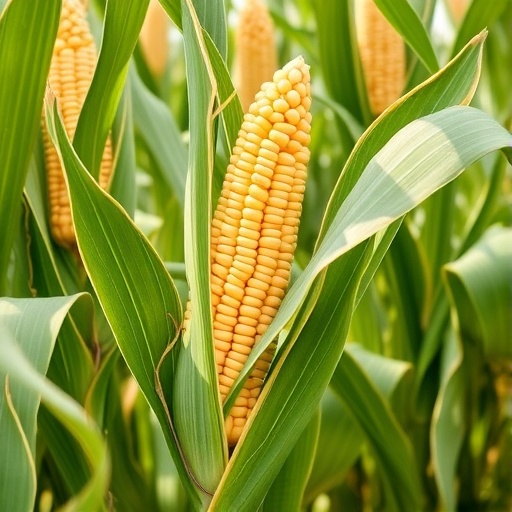
In a groundbreaking development that promises to reshape the future of global agriculture, researchers have unveiled the critical role of the ZmMYB127 gene in maize (Zea mays) endosperm development, with far-reaching implications for both grain yield and nutritional quality. Published in Nature Plants, this study meticulously dissects the molecular mechanisms underlying maize endosperm filling, spotlighting a dual-transcriptional regulatory system that can be harnessed to enhance grain productivity. The findings emerge at a pivotal moment as the world grapples with feeding a rapidly expanding population under the escalating pressures of climate change.
Central to this pioneering research is the discovery that ZmMYB127 functions as a master regulator during the maize grain-filling phase, markedly influencing the biosynthesis and accumulation of nutrients within the endosperm—the tissue responsible for storing energy reserves critical to seed germination and human consumption. The researchers employed a series of sophisticated molecular biology techniques, including transcriptomic analysis, chromatin immunoprecipitation, and promoter activity assays, to demonstrate how ZmMYB127 orchestrates gene networks involved in starch and protein synthesis.
What sets ZmMYB127 apart is its unique capacity to execute dual-transcriptional regulation—a mechanism by which it simultaneously activates and represses distinct target genes, fine-tuning the balance of storage compounds within the developing seed. This nuanced regulatory capacity underscores a level of genetic control previously unappreciated in cereal endosperm development. By mapping the intricate interactions ZmMYB127 establishes with other transcription factors and cis-regulatory elements, the study offers a comprehensive model of gene expression modulation pivotal for endosperm filling.
Beyond the molecular insights, the authors put the gene’s functional potential to the test through carefully designed genetic manipulations in transgenic maize lines. Overexpression of ZmMYB127 resulted in a significant increase in kernel weight and starch content, while simultaneously enhancing the protein composition, effectively elevating the nutritional profile of the grains. Conversely, knockout mutants displayed reduced endosperm development, underscoring the gene’s indispensable role in kernel formation.
This dual impact on yield and quality denotes a remarkable breakthrough. Historically, breeding programs faced a trade-off between boosting grain yield and maintaining nutritional value, often improving one at the expense of the other. ZmMYB127’s dual-function regulation disrupts this dichotomy, providing a promising molecular target to surpass existing agronomic limitations. Such balance is not only vital for crop productivity but also paramount for addressing “hidden hunger”—micronutrient deficiencies afflicting millions worldwide.
Notably, the study also highlights the evolutionary conservation of MYB transcription factors while illuminating maize-specific adaptations that optimize endosperm development. Comparative analysis with orthologous genes in other cereal crops, such as rice and wheat, reveals evolutionary divergence in the regulatory motifs governing nutrient storage. This context strengthens the argument that leveraging ZmMYB127’s unique properties could inspire cross-crop biotechnological strategies tailored to diverse agronomic species.
While the promise is immense, translating these findings into field-ready innovations presents several challenges. The intricate balance maintained by ZmMYB127 suggests that perturbing its activity must be meticulously calibrated to avoid unintended consequences like altered kernel morphology or compromised plant fitness. The researchers emphasize the necessity of employing precision gene editing techniques, such as CRISPR/Cas9 with tissue-specific promoters, to confine gene modulation to the maize endosperm, thereby minimizing off-target effects.
Integrating this gene-editing strategy into conventional breeding pipelines could accelerate the development of next-generation maize varieties with superior yield and enhanced nutritional quality. Field trials under variable environmental conditions remain critical to evaluate the stability of these traits and their interaction with abiotic stress factors, such as drought or heat, which are increasingly undermining crop productivity worldwide.
The implications of this discovery extend beyond maize biology. Understanding the molecular nexus by which ZmMYB127 governs carbohydrate and protein partitioning in seeds offers a blueprint for the genetic enhancement of other staple crops. Given maize’s role as a global staple feedstock and bioenergy source, improving its seed composition transcends food security, impacting economic and ecological sectors by optimizing resource use efficiency.
From a broader scientific perspective, this study exemplifies the power of integrating multi-omics approaches—combining genomics, transcriptomics, and metabolomics—to unravel complex plant developmental processes. It further reinforces the centrality of transcriptional regulation in orchestrating plant phenotypes, paving the way for more refined control over crop traits through molecular breeding.
Ethical considerations surface as researchers and policymakers contemplate deploying genetically modified organisms (GMOs) in different geopolitical contexts. Public acceptance of genome-edited crops hinges on transparent communication of benefits and risks. The precise modulation achieved with ZmMYB127 provides an advantage by enabling subtle trait enhancements that mirror natural genetic variation, potentially easing regulatory hurdles and fostering consumer trust.
Moreover, the economic benefits envisioned through enhanced maize varieties are substantial. Increased kernel weight coupled with enriched nutritional content implies higher market value and reduced need for dietary supplementation, particularly in developing regions where maize constitutes a dietary staple. Such advances can contribute decisively to Sustainable Development Goals centered around zero hunger and good health and well-being.
Future research directions emerging from this work are multifaceted. They include dissecting the interactions between ZmMYB127 and epigenetic regulators that modulate chromatin state dynamics during seed development. Additionally, exploring how environmental cues integrate with ZmMYB127-mediated transcriptional networks could yield insights into resilience mechanisms under climate perturbations.
In sum, the identification and functional characterization of ZmMYB127 marks a transformative step in cereal crop biotechnology. This gene’s dual-transcriptional regulation mechanism offers a sophisticated lever to enhance maize grain yield and quality simultaneously, defying traditional trade-offs. With strategic deployment in breeding programs complemented by rigorous field validation, ZmMYB127 has the potential to underwrite more productive, nutritious, and sustainable maize cultivation worldwide, heralding a new era in agricultural innovation.
Cite Scienmag News
Alan Morgan. (March 20, 2026). ZmMYB127 Boosts Maize Yield and Grain Quality. Scienmag. https://scienmag.com/zmmyb127-boosts-maize-yield-and-grain-quality/
Alan Morgan. "ZmMYB127 Boosts Maize Yield and Grain Quality." Scienmag, 20 March 2026, https://scienmag.com/zmmyb127-boosts-maize-yield-and-grain-quality/. Accessed 4 September 2026.
Alan Morgan. "ZmMYB127 Boosts Maize Yield and Grain Quality." Scienmag. March 20, 2026. https://scienmag.com/zmmyb127-boosts-maize-yield-and-grain-quality/


