


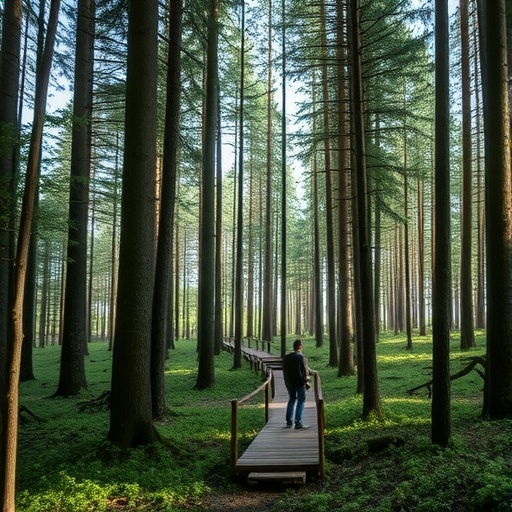
In recent years, boreal forests have received growing scientific attention for their critical role in global carbon cycling and climate regulation. Stretching across northern latitudes, boreal forests represent the planet’s largest terrestrial biome, enveloping vast swaths of cold temperate regions in North America, Europe, and Asia. These primary forests—forests left undisturbed by human activity—function as massive carbon reservoirs, sequestering atmospheric carbon dioxide (CO₂) through complex biophysical and biochemical processes. A groundbreaking new study investigating the carbon storage capacity of boreal forests in Sweden illuminates just how much more carbon undisturbed, or primary, forests hold compared to their managed counterparts, offering essential insights for climate change mitigation strategies.
Sweden’s boreal forests are a paradigmatic example of the balance between conservation and resource management. For decades, economic pressures have driven the development of managed secondary forests, subjected to a suite of silvicultural practices such as clear-cutting, thinning, tree species selection, fertilization, soil drainage, and preparation to optimize timber production. While these actions bolster wood yield and bioenergy resources, they simultaneously affect ecological functions critical to carbon sequestration. Until now, the exact magnitude of carbon loss attributable to converting primary forests into managed secondary forests remained ambiguous, limited by sparse empirical data from intact forests and modeling uncertainties.
The new investigation, spearheaded by Didac Pascual and colleagues, bridges this scientific gap by integrating robust datasets from the Swedish National Forest Inventory (NFI) and the Swedish National Forest Soil Inventory with focused fieldwork in pristine boreal forest plots. This comprehensive approach enabled precise quantification of carbon pools across multiple forest ecosystem components—living vegetation biomass, dead organic matter, soil organic carbon, and harvested wood products—combining to encapsulate total forest carbon storage. Employing a suite of complementary analytical methods strengthened the validity of their carbon stock estimates, providing a refined baseline for future carbon budgeting.
Findings from Pascual et al. unequivocally demonstrate that primary boreal forests store approximately 72% more carbon overall than managed secondary forests in Sweden. This startling figure emphasizes the profound carbon retention advantage inherent in undisturbed boreal systems. Importantly, soil carbon stocks accounted for the bulk of this difference, highlighting the pivotal role of soil organic matter stability under natural forest regimes. The study reveals that soils in primary forests harbor significantly greater carbon reserves than those altered by forestry operations, which disrupt organic horizons and accelerate carbon release.
To contextualize these results, the researchers report that across Sweden’s boreal landscapes, primary forests hold on average 9.9 kilograms more carbon per square meter than managed secondary forests. This carbon differential surpasses previous estimates by factors ranging from nearly three to eight times, underscoring an underappreciated climate impact of forest management practices. Such discrepancies between empirical observations and prior assumptions indicate that forest industry policies may inadvertently amplify atmospheric CO₂ concentrations by relinquishing carbon sinks that primary forests naturally provide.
The climatic implications of these findings are profound. Boreal forests collectively absorb approximately 30% of airborne CO₂ emissions generated by human activities. Thus, any degradation or conversion of these forests could significantly undermine global efforts to curb greenhouse gas build-up. The study’s refined carbon storage metrics offer crucial evidence in support of increased protection and restoration of primary boreal forests, which could bolster natural carbon sequestration and enhance ecosystem resilience under changing climate scenarios.
Moreover, this research arrives at a critical juncture as global reliance on bioenergy expands and northern forest landscapes face intensified exploitation pressures. Bioenergy strategies, while intended to replace fossil fuels, may paradoxically exacerbate carbon emissions if based on unsustainable harvesting or conversion of primary forests. Understanding the nuanced carbon dynamics of boreal forest management is therefore indispensable to developing bioenergy policies aligned with long-term climate stabilization goals.
The study also underscores methodological advancements in forest carbon accounting. Integrating diverse data sources—from national inventories to detailed soil surveys and targeted field plots—combined with advanced modeling approaches, sets a new standard for accurate forest carbon estimation. Such rigor is vital for cross-border climate agreements and carbon offsetting initiatives reliant on trustworthy carbon stock data.
Furthermore, the recognition of soil carbon’s primacy in total forest carbon balance calls for greater emphasis on soil conservation within forestry practices. Traditional forest management often overlooks the longevity and vulnerability of soil carbon pools, yet protecting these belowground stocks could offer the most enduring climate benefits. Future research directions will likely explore soil microbial dynamics, organic matter stabilization, and disturbance impacts in boreal soils to inform sustainable forestry guidelines.
In summary, the elucidation of carbon storage disparities between primary and managed boreal forests in Sweden provides compelling evidence for reevaluating forest management policies and conservation priorities. By revealing the substantial carbon retention benefits of primary forests—particularly through soil carbon reservoirs—this study informs not only national forestry strategies but also broader climate mitigation frameworks seeking to harness natural ecosystems in the fight against global warming.
As nations continue to map pathways toward net-zero emissions, preserving the integrity of boreal primary forests emerges as a non-negotiable strategy. The extensive carbon pools safeguarded within these ancient forest systems represent a vital natural capital that, if wisely managed, can underpin a more sustainable and climate-resilient future. This research serves as a clarion call to integrate ecological science deeply into forest governance, ensuring that economic development harmonizes with planetary health imperatives.
News Publication Date: 19-Mar-2026
Web References: 10.1126/science.adz8554
Cite Scienmag News
Violet Maxwell. (March 19, 2026). Ancient Forests in Sweden Found to Store Significantly More Carbon, New Study Reveals. Scienmag. https://scienmag.com/ancient-forests-in-sweden-found-to-store-significantly-more-carbon-new-study-reveals/
Violet Maxwell. "Ancient Forests in Sweden Found to Store Significantly More Carbon, New Study Reveals." Scienmag, 19 March 2026, https://scienmag.com/ancient-forests-in-sweden-found-to-store-significantly-more-carbon-new-study-reveals/. Accessed 3 September 2026.
Violet Maxwell. "Ancient Forests in Sweden Found to Store Significantly More Carbon, New Study Reveals." Scienmag. March 19, 2026. https://scienmag.com/ancient-forests-in-sweden-found-to-store-significantly-more-carbon-new-study-reveals/


