


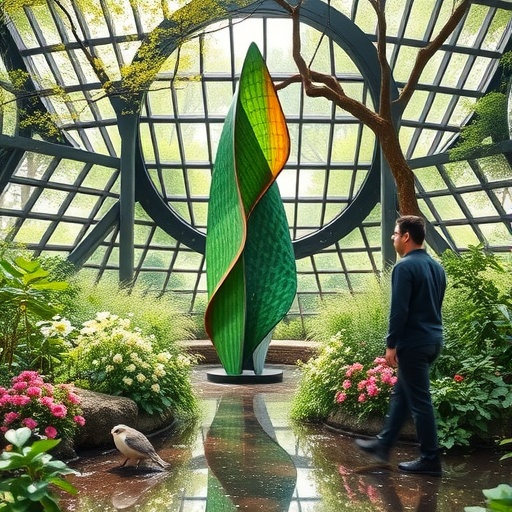
Nestled in the pivotal climatic transition zone between subtropical and temperate regions, Hefei Botanical Garden has skyrocketed to prominence as a leading botanical institution in East China. Renowned for its exemplary integration of scientific innovation and ecological stewardship, this garden not only serves as a sanctuary for plant biodiversity but also stands at the forefront of sustainable resource utilization and immersive ecological education. Its multifaceted approach has been recently spotlighted in the esteemed journal Biological Diversity, revealing new paradigms in plant conservation and urban ecological revitalization.
Covering an impressive collection of over 5,000 plant species, Hefei Botanical Garden houses an extensive reservoir of botanical diversity. Among this rich assembly, approximately 200 species are classified as rare or endangered, underscoring the garden’s critical role in ex situ conservation. By harmonizing traditional botanical practices with cutting-edge scientific methodologies, the garden has crafted a comprehensive framework for the protection and sustainable management of regional flora, ultimately supporting the broader goals of urban ecological balance and resilience.
In recent years, the garden’s conservation efforts have transcended mere preservation. As of 2024, it boasts a meticulously maintained repository of 4,012 plant species, spanning 187 families and 815 genera. This collection is bolstered by specialized garden systems dedicated to emblematic species such as Armeniaca mume and Nelumbo nucifera, which have been cultivated with a focus on genetic stability and phenotypic resilience. Notably, the garden excels in the ex situ propagation of 73 nationally protected tree species, exemplified by the over 1,000 successfully propagated individuals of the second-class protected Sinojackia xylocarpa.
An extraordinary ecological restoration initiative further highlights the garden’s commitment to environmental rehabilitation. Over 200 hectares of previously degraded wetlands adjacent to Chaohu Lake have been revitalized, restoring vital ecosystem functions and biodiversity. In tandem, the southern zone of the garden—encompassing 33 hectares—has undergone comprehensive ecological upgrades, resulting in a marked improvement in water quality standards from the inadequate Class V status to a significantly cleaner Class II–III level. This watershed restoration not only benefits local biodiversity but also enhances community well-being and adaptive capacity against climate perturbations.
Integral to its mission, Hefei Botanical Garden has embraced sustainable resource utilization strategies that directly foster rural development and ecological harmony. Since 2019, the institution has operated a “Botanical Garden + Agriculture” model through its research base in Changzhuang Village. Here, the garden cultivates medicinal and ornamental plants such as Nymphaea rubra, optimized for natural overwintering and ecological compatibility. This innovative agroecological approach promotes biodiversity-friendly agricultural practices, amplifies rural tourism potential, and elevates local farmers’ incomes, forming a symbiotic relationship between conservation priorities and socioeconomic revitalization.
The garden’s contribution to cultural and public education enriches its conservation ethos with societal dimensions. As a designated national-level science education base, it houses a state-of-the-art Science Museum equipped with augmented reality (AR) interactive systems that revolutionize visitor engagement and environmental literacy. The Nature Education Center extends learning opportunities by training nearly 1,000 environmental volunteers annually and hosting educational activities for over 10,000 participants. Celebrated as a National Key Flower Culture Base, the garden conducts prestigious floral exhibitions that draw more than one million visitors each year, further embedding conservation consciousness in popular culture.
Public involvement in biodiversity conservation is markedly encouraged through innovative participatory projects such as Plant Adoption. This initiative mobilizes over 5,000 individuals in hands-on stewardship activities, nurturing a collective sense of responsibility and fostering community-driven ecological action. By intertwining scientific rigor with cultural resonance, these educational endeavors underscore the garden’s role as a bridge between academic research and public engagement.
Recognizing the global stakes of biodiversity loss, Hefei Botanical Garden actively contributes to international conservation networks including Botanic Gardens Conservation International (BGCI). It maintains collaborative partnerships with notable institutions both domestically and abroad, such as Japan’s Makino Botanical Garden. These alliances enhance knowledge exchange, facilitate germplasm sharing, and catalyze joint research projects aimed at tackling the multifaceted challenges of environmental change.
Looking forward, the garden acknowledges existing gaps in germplasm coverage and research outputs. To address these challenges, strategic plans emphasize the development of systematic germplasm conservation programs augmented by molecular breeding techniques. Cutting-edge technologies including artificial intelligence (AI) and big data analytics are slated to be integrated into garden management, transforming it into a “smart garden” conducive to efficient monitoring and adaptive decision-making.
Furthermore, deep integration of biodiversity conservation with rural revitalization remains a central objective. By uniting ecological preservation with community empowerment and sustainable livelihoods, Hefei Botanical Garden aspires to set the national standard for comprehensive urban ecological gardens. This institutional model not only safeguards botanical heritage but also functions as a dynamic platform for ecological innovation and societal well-being in China’s rapidly urbanizing landscapes.
The story of Hefei Botanical Garden is a compelling testament to how multifaceted approaches—inclusive of rigorous scientific research, sustainable economic models, and immersive public education—can collectively galvanize biodiversity conservation. As global biodiversity crises intensify, such pioneering institutions offer critical pathways to safeguarding natural heritage and fostering resilient, sustainable futures.
News Publication Date:
March 19, 2026
Web References:
http://dx.doi.org/10.1002/bod2.70014
References:
Zhang, Jimei, Xu Li, Yuhua Ma, Fasih U. Haider, and Yunfeng Zhou. 2026. “Exploration and Practice of Hefei Botanical Garden in Biodiversity Conservation, Resource Utilization, and Public Education,” Biological Diversity: 1-6.
Cite Scienmag News
Margaret Porter. (March 19, 2026). Hefei Botanical Garden: Leading the Way in Urban Biodiversity Conservation, Resource Management, and Public Education. Scienmag. https://scienmag.com/hefei-botanical-garden-leading-the-way-in-urban-biodiversity-conservation-resource-management-and-public-education/
Margaret Porter. "Hefei Botanical Garden: Leading the Way in Urban Biodiversity Conservation, Resource Management, and Public Education." Scienmag, 19 March 2026, https://scienmag.com/hefei-botanical-garden-leading-the-way-in-urban-biodiversity-conservation-resource-management-and-public-education/. Accessed 4 September 2026.
Margaret Porter. "Hefei Botanical Garden: Leading the Way in Urban Biodiversity Conservation, Resource Management, and Public Education." Scienmag. March 19, 2026. https://scienmag.com/hefei-botanical-garden-leading-the-way-in-urban-biodiversity-conservation-resource-management-and-public-education/


