


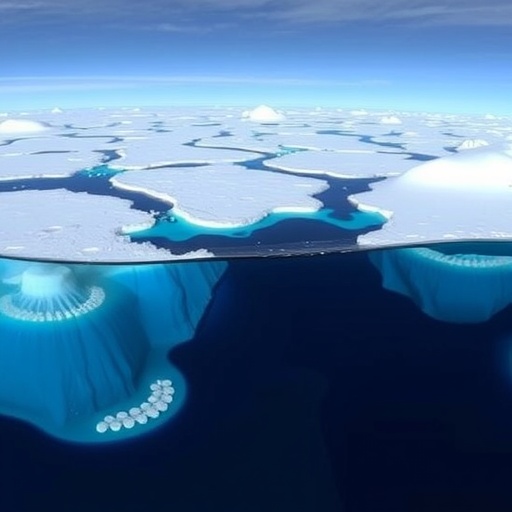
In a groundbreaking study probing the depths of the Southern Ocean, researchers have unveiled critical insights into the evolving dynamics of Antarctic Winter Water (WW), a key indicator and regulator of polar climate and sea-ice processes. By harnessing an unprecedented dataset of nearly 590,000 hydrographic profiles spanning from 2005 to 2022, scientists have meticulously dissected changes within the upper 300 meters of the circumpolar Southern Ocean. This ambitious analysis sheds new light on how variations in water column structure and wind-driven mixing interplay to influence Antarctic sea-ice retreat.
The study employed a rigorous definition of Winter Water based on temperature and density characteristics, navigating the complex stratification of polar waters. Winter Water was identified through a combination of maximum temperature thresholds capped at 2°C to delineate the northern boundary near the polar front, while simultaneously excluding warmer sub-Antarctic mode waters. This precise identification was augmented by examining the depth of temperature minima and gradients, capturing both mixed layer-bound Winter Water and subsurface equivalents beneath the mixed layer where temperature inversions occur. Collectively, these refined hydrographic criteria enabled a comprehensive quantification of WW occurrence, which was found in over 92% of the analyzed profiles within vast open-ocean domains deeper than 2,000 meters, purposefully excluding shelf regions to focus on consistent oceanic processes.
Monthly climatologies and anomalies were computed by gridding hydrographic data onto a one-degree spatial resolution, allowing researchers to detect subtle but significant trends across the seasonal and interannual timescales. The study distinguished between high sea-ice area (SIA) periods (2005 to mid-2015) and subsequent low SIA phases (2015 to 2021), revealing contrasting hydrographic shifts. During the era of extensive sea ice, the upper ocean exhibited cooling in the summertime mixed layer at a rate of approximately -0.004°C per year, whereas the Winter Water layer paradoxically warmed at a similar rate. Concurrently, Circumpolar Deep Water (CDW), representing the subsurface warm reservoir, displayed accelerated warming trends up to 0.012°C annually. These complex thermal patterns were paired with salinity changes, where the ocean surface and WW freshened, and the CDW increasingly salinified, indicating a nuanced reorganization of water masses under distinct sea ice regimes.
Intriguingly, the transition to reduced sea ice after 2015 coincided with a pervasive warming of the entire upper-ocean column and a freshening trend in salinity, highlighting a shift in the ocean’s response to evolving climatic and atmospheric conditions. Statistical analyses confirmed the robustness of many of these temperature and salinity trends, with p-values underscoring significant changes especially concerning Winter Water temperatures during the low sea-ice interval. This oceanographic transformation suggests a possible feedback mechanism amplifying sea-ice loss through enhanced subsurface heat exposure and altered stratification within the upper water layers.
To probe the mechanisms responsible for these hydrographic transitions, the research delved into wind-driven processes modulating upper ocean turbulence and heat exchange. By leveraging the relationship between kinematic wind stress and turbulent dissipation rates established in prior Southern Ocean studies, turbulent mixing was approximated seasonally using friction velocity and the depth of the ocean’s mixed layer. These turbulent dissipation estimates, derived through the well-known law of the wall, were further translated into diapycnal diffusivity—a metric quantifying vertical mixing efficiency across density gradients just below the mixed layer.
A pivotal outcome of these calculations was the estimation of the turbulent heat flux imparted upwards from the subsurface ocean, illuminating how wind-induced mixing can awaken the latent heat stored in deeper waters. The quantification of this flux utilized established seawater physical properties including density and specific heat capacity, combined with measured temperature differentials and mixing rates. The upward heat flux thus provides a critical lens for understanding how enhanced turbulence can erode sea ice from below, a process quantified by translating heat flux into potential reductions in sea ice thickness using the latent heat of fusion.
Recognizing that sea ice presence attenuates momentum transfer between atmosphere and ocean, the study innovatively adjusted the wind stress estimates in ice-covered regions by integrating sea ice concentration and velocity data. This hybrid approach combined the “rule of thumb” reduction in ocean-atmosphere stress due to ice cover with dynamic assessments of momentum exchange considering varying ice conditions. This nuanced treatment acknowledges the spatial heterogeneity in oceanic forcing effects under differing sea-ice scenarios and underscores the central role of sea ice in modulating upper ocean turbulence.
The validity of assuming wind as the prime driver of mixed layer turbulence was critically examined through computations of the Monin–Obukhov length, a fundamental parameter describing the balance between mechanical and buoyancy forcing. Close correspondence between mixed layer depth and this turbulent scale length across seasons supports the dominance of wind-induced mechanical mixing processes in the surface ocean, reinforcing the mechanistic framework underpinning the study’s turbulence and heat flux estimates.
Supporting datasets were meticulously incorporated, with the Antarctic Circumpolar Front—a key oceanographic boundary—defined via absolute dynamic topography from satellite altimetry. High-resolution bathymetry and sea ice concentration data provided robust spatial context, enabling the focus on seasonally ice-covered zones and excluding continental shelves where distinct hydrographic dynamics prevail. Atmospheric forcing components including net radiation fluxes, precipitation, evaporation, and turbulent wind stresses were sourced from the ERA5 reanalysis to ensure consistent and comprehensive surface forcing characterization.
This synthesis of hydrographic observations, atmospheric reanalysis, and physical oceanographic theory culminates in a compelling narrative illustrating how thinning Winter Water layers have preconditioned Antarctic sea ice for accelerated decline, particularly through enhanced wind-driven turbulent heat fluxes. The discerned subsurface warming within the Winter Water and CDW layers directly impacts ice formation thresholds, effectively setting the stage for amplifying ice melt under prevailing climatic trends. These findings hold profound implications for predicting future changes in Antarctic sea ice extent, regional ocean circulation, and global climate feedbacks.
Beyond illuminating detailed physical processes, the study’s methodology sets a new benchmark for integrating massive hydrographic datasets with cutting-edge turbulent mixing frameworks across demanding polar environments. By blending rigorous observational analysis with dynamical computations of air-sea-ice interactions, this work advances the ability to anticipate critical tipping points in the Southern Ocean system. The approach emphasizes the complexity of winter water dynamics, their susceptibility to atmospheric forcing, and their decisive role in modulating polar sea-ice responses amid a warming climate.
As the Southern Ocean continues to evolve rapidly under anthropogenic influence, continued monitoring and expanded observational campaigns will be crucial for refining these insights and constraining model projections. The interplay unveiled here between thinning Winter Water, wind-driven turbulence, and sea-ice retreat captures a pivotal aspect of polar climate change and underscores the urgency of incorporating such nuanced oceanic processes into next-generation Earth system models. This enhanced understanding is indispensable for robust forecasting of Antarctic cryospheric stability and its far-reaching impacts on ocean circulation and global climate.
In conclusion, this transformative research presents compelling evidence that wind-driven turbulent mixing, modulated by concurrent changes in Winter Water properties, plays an instrumental role in preconditioning the Antarctic sea-ice decline observed in recent decades. The work not only deepens scientific comprehension of Southern Ocean hydrographic changes but also frames a crucial narrative on the vulnerabilities of polar ice to coupled ocean-atmosphere feedbacks. As polar regions emerge as climate change hotspots, elucidating these connections affords critical foresight for anticipating and potentially mitigating future ice loss trajectories and their global repercussions.
Cite Scienmag News
Sloane Callahan. (March 18, 2026). Winds Drive Antarctic Sea-Ice Decline via Thinning Water. Scienmag. https://scienmag.com/winds-drive-antarctic-sea-ice-decline-via-thinning-water/
Sloane Callahan. "Winds Drive Antarctic Sea-Ice Decline via Thinning Water." Scienmag, 18 March 2026, https://scienmag.com/winds-drive-antarctic-sea-ice-decline-via-thinning-water/. Accessed 4 September 2026.
Sloane Callahan. "Winds Drive Antarctic Sea-Ice Decline via Thinning Water." Scienmag. March 18, 2026. https://scienmag.com/winds-drive-antarctic-sea-ice-decline-via-thinning-water/


