


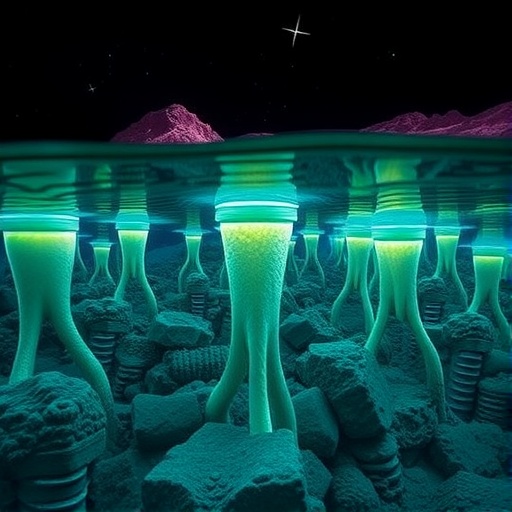
The Atacama Trench, an enigmatic abyss hidden beneath the vast Pacific Ocean, has long intrigued oceanographers and microbiologists alike. Stretching over 7,000 meters deep, this subduction zone represents one of Earth’s most extreme and unexplored marine environments. Recent groundbreaking research has spotlighted the unique microbial life forms inhabiting these crushing depths, revealing that the cycling of carbon, nitrogen, and sulfur within these microbial communities uncovers previously unknown ecological niches. These findings not only transform our understanding of deep-sea biogeochemical processes but also offer vital insights into the resilience and adaptability of life under extreme conditions.
Microbial communities dwelling in the Atacama Trench endure conditions that challenge the very basics of life: near-freezing temperatures, staggering hydrostatic pressure exceeding 700 atmospheres, and complete darkness. Despite these seemingly inhospitable surroundings, the trench hosts a complex web of microbial ecosystems that engage intricately in elemental cycles essential for sustaining deep-ocean life. By examining the nuances of carbon, nitrogen, and sulfur transformation pathways in these microbes, the study illuminates the biochemical frameworks enabling survival in such energy-starved habitats.
Central to deep-sea ecology is the carbon cycle, which governs organic matter turnover and energy flow through microbial metabolic activities. In the Atacama Trench, organic carbon is primarily derived from the continuous fall of marine snow—particles composed of dead plankton, fecal matter, and other organic debris from surface waters. These detrital aggregates serve as a critical food source for trench microorganisms. However, the efficiency and pathways through which microbes process this particulate organic carbon have remained poorly understood until now. Researchers employed metagenomic and metatranscriptomic approaches to decode the enzymes and metabolic modules responsible for carbon fixation and degradation, revealing that the microbial communities harbor diverse autotrophic and heterotrophic strategies to exploit carbon substrates in this ultra-oligotrophic environment.
Equally pivotal to biogeochemical equilibrium is nitrogen cycling, a complex network of microbial transformations underpinning nutrient regeneration in marine sediments. Nitrogen enters the deep-sea ecosystem primarily as organic nitrogen from sinking particulate matter, atmospheric deposition, or nitrogen fixation by specific microbes. In the Atacama Trench, however, the nitrogen cycle exhibits uniquely stratified niches where distinct microbial guilds orchestrate processes such as nitrification, denitrification, and anaerobic ammonium oxidation (anammox). The discovery of novel nitrogen-transforming gene clusters indicates specialized adaptations of these microbial consortia to the trench’s physicochemical gradients. These adaptations ensure efficient recycling of biologically available nitrogen, sustaining productivity despite minimal external nutrient inputs.
Furthermore, the sulfur cycle was revealed to be extraordinarily dynamic within the trench sediments and water column. Sulfur compounds, ranging from sulfate to sulfide species, act as electron donors or acceptors in numerous microbial metabolic pathways. The researchers detected a plethora of genes related to sulfur oxidation and reduction, pointing to a finely tuned sulfur-driven energy economy. Sulfur-oxidizing bacteria appear to dominate microenvironments enriched in reduced sulfur compounds, while sulfate-reducing microbes thrive in anoxic niches. This metabolic interplay establishes a complex redox landscape in which microbial communities exploit sulfur chemistry to generate energy—facilitating elemental exchange and maintaining ecosystem stability under the trench’s extreme conditions.
One of the most compelling revelations of the study is the identification of previously uncharacterized microbial taxa forming distinct niches along vertical and horizontal gradients within the trench. These taxa exhibit specialized enzymatic machinery tailored to the trench’s unique geochemical context. The discovery of such microbial specialists underscores the role of subtle environmental heterogeneity in structuring microbial populations, guiding their metabolic functions, and promoting biodiversity even in one of Earth’s most remote realms. This niche partitioning indicates an evolutionary fine-tuning that enables microbial survival across microhabitats defined by variations in oxygen availability, organic matter flux, and redox potential.
Metagenomic reconstructions delineated metabolic pathways associated with carbon fixation via the Calvin-Benson-Bassham cycle and the reverse tricarboxylic acid (rTCA) cycle, suggesting the coexistence of chemoautotrophic strategies that utilize reduced inorganic compounds for biosynthesis. Similarly, pathways for nitrogen transformations—including ammonia oxidation by novel archaeal and bacterial lineages—highlight adaptive mechanisms optimized for low-energy environments. The presence of key sulfur cycling genes points towards intricate symbiotic relationships, potentially involving syntrophic interactions that bolster energy efficiency within the trench’s microbial consortia.
The study’s integrative approach combining high-throughput sequencing, geochemical profiling, and in situ experimental incubations permitted unprecedented resolution in mapping elemental fluxes and microbial ecological roles. By correlating gene expression patterns with precise chemical gradients measured in sediment cores and water samples, the researchers established causative links between microbial community structure and functional activity. This holistic methodology uncovered how the Atacama Trench’s microbial ecosystem functions as a tightly coupled network, facilitating elemental cycling that sustains life far removed from sunlight and conventional nutrient inputs.
Beyond its implications for understanding deep-sea microbial ecology, the research challenges existing paradigms about the limits of life and the adaptability of microbial metabolisms. The ability of microbes to maintain complex elemental cycles under extreme pressure, low temperatures, and scarce energy resources attests to their remarkable physiological plasticity. This plasticity opens avenues for exploring biotechnological applications, such as bioremediation under high-pressure conditions and bioenergy production via novel metabolic pathways. Additionally, insights gleaned from this trench environment may inform astrobiological inquiries, as analogous conditions to deep-ocean hadal zones are hypothesized to exist on icy moons and subsurface extraterrestrial oceans.
The presence of tightly integrated carbon, nitrogen, and sulfur cycles also suggests that microbial metabolism in deep-sea trenches contributes significantly to global biogeochemical balances. Deep-sea sediments act as vast reservoirs for organic carbon burial and nutrient recycling, influencing ocean chemistry on geological timescales. By illustrating the functional capabilities and ecological strategies of microbial communities in the Atacama Trench, this research provides valuable data for refining biogeochemical models that account for deep-ocean processes in Earth system science.
Intriguingly, the findings indicate that trench microbial communities might be sensitive sentinels of environmental change. Given the trench’s connectivity to surface processes through the downward flux of organic matter, disruptions such as climate-induced shifts in ocean productivity or acidification could cascade into deep-sea ecosystems. Monitoring microbial community responses could thus serve as an early warning system for perturbations in deep ocean health, aiding conservation strategies for these fragile habitats.
Moreover, the study emphasizes the importance of continuous exploration of Earth’s least accessible habitats. The utilization of advanced molecular techniques combined with novel sampling technologies exemplifies how modern science can penetrate formerly unreachable frontiers. As researchers expand such efforts to other hadal trenches and abyssal plains, a more comprehensive picture of marine microbial diversity, ecosystem function, and evolutionary innovation will undoubtedly emerge.
In conclusion, the meticulous investigation into carbon, nitrogen, and sulfur cycling within the Atacama Trench has unveiled a mosaic of deep-sea microbial niches characterized by metabolic robustness and ecological intricacy. The reported findings fundamentally recalibrate our knowledge of biogeochemical cycling under extreme pressures and environmental constraints, highlighting the versatility of life forms thriving in the planet’s most remote frontier. This profound new understanding not only elevates the Atacama Trench from a geological curiosity to a pivotal node in Earth’s biosphere but also fuels curiosity about life’s potential beyond our own world.
Cite Scienmag News
Violet Maxwell. (March 18, 2026). Deep-Sea Microbes Reveal Atacama Trench Cycles. Scienmag. https://scienmag.com/deep-sea-microbes-reveal-atacama-trench-cycles/
Violet Maxwell. "Deep-Sea Microbes Reveal Atacama Trench Cycles." Scienmag, 18 March 2026, https://scienmag.com/deep-sea-microbes-reveal-atacama-trench-cycles/. Accessed 4 September 2026.
Violet Maxwell. "Deep-Sea Microbes Reveal Atacama Trench Cycles." Scienmag. March 18, 2026. https://scienmag.com/deep-sea-microbes-reveal-atacama-trench-cycles/


