


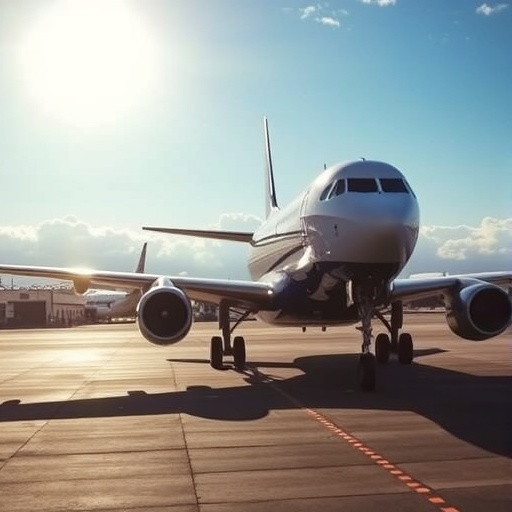
Recent groundbreaking research from the University of Cambridge offers a promising strategy to significantly curb aviation’s contribution to global warming, by targeting the formation of condensation trails, or contrails. These contrails, those striking white streaks trailing behind high-altitude aircraft, are not only a visible byproduct of flight but are also potent contributors to atmospheric warming. The study suggests that subtle modifications to an aircraft’s cruising altitude—either ascending or descending a few thousand feet—could dramatically reduce contrail formation, effectively halving aviation’s warming impact with immediate effects.
Contrails form under specific atmospheric conditions when the hot exhaust gases emitted from aircraft engines mix with the frigid, moist air high above the Earth. In this environment, water vapor quickly freezes into minute ice crystals, resembling thin cloud formations that can linger for hours. These persistent contrails trap infrared radiation emitted from the Earth’s surface, thereby exerting a warming effect comparable to or even exceeding the direct carbon dioxide emissions from aviation. Currently, aviation accounts for about 2 to 3 percent of global CO₂ emissions, but including contrails and other non-CO₂ effects reveals a far more pronounced climate footprint.
The Cambridge-led team utilized state-of-the-art climate modeling to demonstrate how modest altitude adjustments could mitigate contrail formation. These models, running over 10,000 simulated scenarios, indicate that initiating contrail avoidance between 2035 and 2045 could claw back roughly 9 percent of the remaining global temperature budget before breaching the critical 2°C threshold stipulated by the Paris Agreement. Such findings highlight contrail avoidance not just as an incremental improvement but as a potentially substantial lever in aviation’s climate mitigation arsenal.
One notable revelation from the study is the extraordinary speed with which these temperature reductions could be realized. Unlike many climate interventions that require decades to affect measurable change, contrail avoidance could yield significant warming reductions in just ten years after implementation. The research team emphasizes that earlier action compounds the benefits, noting that delaying the onset of contrail avoidance policies by a decade weakens their effectiveness by nearly 80 percent.
Concerns about the operational feasibility of contrail avoidance have been addressed by the researchers, who point out that modern flight protocols already involve frequent adjustments to altitude and routing to avoid adverse weather such as turbulence. This operational precedent reduces the barriers to introducing contrail avoidance strategies. Changes would primarily require coordinated efforts among pilots, air traffic controllers, and meteorologists to dynamically modify flight paths in real time according to atmospheric conditions conducive to contrail formation.
While there is some increase in fuel consumption associated with re-routing or altitude changes, the study finds that the net climate effect remains positive. The resultant reduction in contrail-related warming more than compensates for the slightly higher CO₂ emissions from minor increases in jet fuel usage. This finding challenges conventional perceptions that reducing contrails could lead to inefficient fuel burn, demonstrating instead that the integrated climate impact favors contrail avoidance.
Contrail avoidance stands out in comparison to other emission reduction strategies such as sustainable aviation fuels or new propulsion technologies, which face complex logistical, infrastructure, and economic challenges. Contrail avoidance is an operational change rather than a technological one, leveraging existing aircraft capabilities and current airline infrastructure. This simplicity enhances its appeal as a near-term intervention to complement longer-term decarbonization efforts.
Developing reliable, location-specific forecasts for contrail formation remains a scientific priority. Improved atmospheric modeling and data collection could refine contrail avoidance tactics and boost their effectiveness beyond the study’s conservative estimates. Notably, partial implementation at even 25 percent effectiveness can yield meaningful climate benefits, underlining that perfect system performance is not a prerequisite for action.
The study also underscores the importance of industry and policy cooperation. Implementing contrail avoidance at scale demands synchrony between multiple stakeholders—from regulatory authorities setting policy frameworks, to air traffic management organizations adapting control systems, and flight operators incorporating contrail forecasts into their operational decisions. Early demonstration projects, perhaps on busy transcontinental or transatlantic routes, could pave the way for widespread adoption.
Contrails are a unique facet of aviation’s climate impact, often overlooked compared to direct fuel emissions. This research elevates contrail avoidance as a critical, scientifically grounded approach in the global climate strategy for aviation. Although not a panacea, the approach offers one of the fastest and most cost-effective avenues to mitigate aviation’s warming contribution.
Lead author Dr. Jessie Smith from Cambridge’s Department of Engineering emphasizes that the window for impactful contrail avoidance is narrowing. “Every year of delay diminishes the potential climate benefits dramatically,” she explains. The study thus advocates for setting in motion policy and operational changes now, to capitalize on the early phase of contrail avoidance’s climate potential and ensure the aviation sector remains aligned with global climate goals.
In summary, this pioneering study reveals a compelling, actionable pathway to reduce aviation-induced warming by optimizing flight altitudes to avoid contrail formation. By harnessing current air traffic control capabilities and enhancing atmospheric forecasting, the aviation industry could quickly adopt a dynamic contrail avoidance system, producing rapid climate benefits and complementing long-term decarbonization efforts. This research marks a significant advancement in understanding and mitigating the multifaceted drivers of aviation’s climate footprint.
News Publication Date: 2-Mar-2026
Web References:
https://www.nature.com/articles/s41467-026-68784-8
References:
Jessie R. Smith et al. ‘The climate opportunities and risks of contrail avoidance.’ Nature Communications (2026). DOI: 10.1038/s41467-026-68784-8
Cite Scienmag News
Russell Cooper. (March 17, 2026). Rerouting Flights Could Dramatically Reduce Aviation’s Climate Footprint, Study Finds. Scienmag. https://scienmag.com/rerouting-flights-could-dramatically-reduce-aviations-climate-footprint-study-finds/
Russell Cooper. "Rerouting Flights Could Dramatically Reduce Aviation’s Climate Footprint, Study Finds." Scienmag, 17 March 2026, https://scienmag.com/rerouting-flights-could-dramatically-reduce-aviations-climate-footprint-study-finds/. Accessed 4 September 2026.
Russell Cooper. "Rerouting Flights Could Dramatically Reduce Aviation’s Climate Footprint, Study Finds." Scienmag. March 17, 2026. https://scienmag.com/rerouting-flights-could-dramatically-reduce-aviations-climate-footprint-study-finds/


