


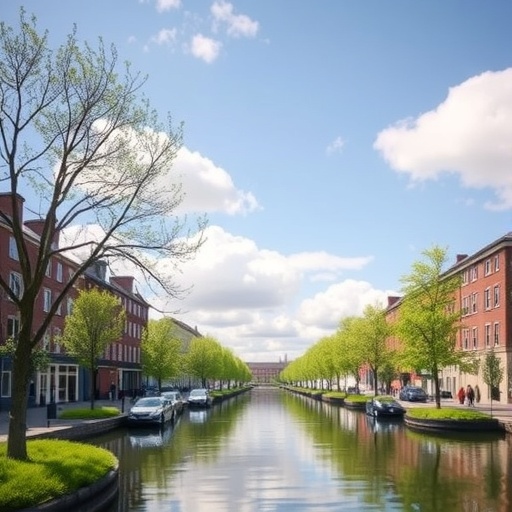
In today’s rapidly urbanizing world, the interplay between natural landscapes and urban development has become a focal point of scientific and social inquiry. A pioneering study set within the context of Great Britain offers a comprehensive analysis of urban blue and green spaces, their distribution across cities, social equity considerations, and profound ecological implications. With urban populations swelling and the environment increasingly compromised, this research sheds light on how these vital natural areas can be preserved, enhanced, and equitably distributed to serve both human well-being and environmental sustainability.
Urban blue spaces, defined broadly as bodies of water including rivers, lakes, ponds, canals, and coastal areas, coexist symbiotically with green spaces—parks, urban woodlands, gardens, and green corridors. These blue and green areas form the lungs of urban centers, playing crucial roles in air quality regulation, temperature mitigation, biodiversity conservation, and recreational opportunities. The study meticulously maps out the spatial distribution of these features using advanced geospatial technologies, unveiling stark disparities in their availability relative to socio-economic strata and geographic locations within British cities.
The evolutionary pressures exerted by urbanization on blue and green spaces are multifaceted. On one hand, intense development and land-use change have led to fragmentation and depletion of these natural habitats. On the other hand, a growing understanding of their ecosystem services has initiated strategic efforts to integrate them more rigorously into urban planning. This research highlights a paradox where the neighborhoods most in need of environmental benefits—those often marginalized or economically disadvantaged—frequently suffer the poorest access to green and blue amenities.
Environmental justice emerges as a critical lens through which to interpret the findings. The systematic inequities in green and blue space distribution are not random but are intertwined with historical, economic, and political factors that perpetuate inequitable urban landscapes. Residents from lower-income households or ethnically diverse communities face reduced access to these vital natural refuges, increasing their vulnerability to heat stress, air pollution, and reduced mental well-being. Such nature-deficit dynamics have ramifications that extend far beyond aesthetics, affecting public health, social cohesion, and overall quality of life.
The ecological consequences of uneven access are similarly profound. Blue and green urban environments act as critical habitats for native flora and fauna, delivering essential ecosystem services such as pollination, water filtration, and carbon sequestration. When these spaces are diminished or fragmented, urban biodiversity suffers, leading to ecosystem instability and decreased resilience against environmental disruptions. The study’s ecological models reveal how enhancements in connectedness and area of green and blue spaces could bolster urban biodiversity and mitigate climate change impacts.
Technological progress has played a pivotal role in this research. Employing high-resolution satellite imagery, LiDAR data, and sophisticated GIS (Geographic Information System) tools, researchers have established a granular understanding of urban green and blue space patterns. These digital landscapes allow for temporal analyses, capturing changes over time and identifying trends of loss or gain in natural areas. Moreover, machine learning algorithms have aided in predicting future scenarios under different urban growth and environmental policy frameworks, offering planners actionable insights.
Intriguingly, the study delves into the socio-political mechanisms that influence the stewardship and governance of blue and green spaces. Urban green infrastructure is often entangled in complex jurisdictional arrangements, funding matrices, and competing land-use priorities. The authors argue for multi-level governance models that prioritize community engagement, inclusiveness, and equitable resource allocation. Enabling local communities to participate in decision-making can foster a sense of ownership and ensure that redevelopment plans honor both cultural heritage and ecological integrity.
One significant finding underscores the benefits of integrated blue-green infrastructure rather than isolated green patches. Networks that combine waterways, wetlands, parks, and street trees create synergistic effects that amplify ecological and social benefits. These integrated systems improve stormwater management, reduce urban heat islands, and create continuous habitats that support wildlife movement. The paper highlights successful case studies where retrofit projects have transformed neglected urban spaces into vibrant blue-green corridors, reconnecting fragmented habitats and enhancing public accessibility.
The mental health implications of urban nature exposure are another critical dimension explored. Psychological studies have demonstrated that access to natural environments reduces stress, enhances mood, and promotes physical activity. This study quantitatively correlates the uneven distribution of green and blue spaces with public health data, emphasizing disparities in stress-related illnesses, cardiovascular health, and child development outcomes in relation to access inequalities. These findings call for urgent policy interventions that recognize urban nature as a public health imperative.
The research also engages with climate adaptation strategies, positioning urban blue and green spaces as frontline defenses against anthropogenic climate threats. Green roofs, rain gardens, urban forests, and permeable surfaces help cities manage flood risks, moderate temperature extremes, and store carbon. In a warming world, the strategic expansion and maintenance of these natural elements become essential for climate resilience. The study outlines a blueprint for integrating blue-green infrastructure into city planning as a nature-based solution for mitigating and adapting to climate change.
One of the most compelling aspects of this work is its emphasis on cross-sector collaboration. Addressing the myriad challenges of urban sustainability requires partnerships among government agencies, private sectors, NGOs, academia, and local communities. The authors advocate for an interdisciplinary approach that bridges ecological science, urban design, social justice, and policy-making. Through collaborative frameworks, it is possible to align environmental goals with economic development and social equity.
The dataset generated from this investigation is an invaluable resource for urban planners and environmental scientists globally. By making the spatial and analytical data publicly accessible, the study encourages replication and adaptation in other metropolitan contexts, fostering a global conversation on urban nature equity. Furthermore, the integration of citizen science initiatives enriches this body of knowledge by incorporating community observations and experiences, democratizing science and enhancing data robustness.
In synthesis, this investigation reframes urban blue and green spaces not merely as environmental assets but as vital social infrastructure underpinning health, equity, and ecological stability. Its findings challenge planners and policy-makers to confront uncomfortable truths about privilege and access while offering a scientifically grounded roadmap for creating healthier, more just, and resilient cities. The implications transcend Great Britain, resonating with worldwide urban centers grappling with similar tensions between growth and nature conservation.
As urban centers continue to expand, research such as this serves as a clarion call to prioritize equitable distribution of natural spaces to sustain both human and planetary health. The interplay of technology, governance, and community action highlighted in this study points toward a hopeful future where cities can harmonize development with nature, serving as exemplars of sustainable urban living in the 21st century and beyond. The ecological, social, and economic dividends of such integrated approaches promise to underpin thriving urban populations for generations.
Ultimately, this cutting-edge research underscores that urban blue and green spaces are linchpins in the quest for sustainable cityscapes, intertwining environmental stewardship with social responsibility. It provides a rigorous, data-driven framework for reimagining our urban futures—where access to nature is a universal right, ecological systems flourish, and cities become resilient havens of health and well-being. The pursuit of these ambitions is not just desirable but imperative, bearing consequences for the future of urban life across countries and continents alike.
Cite Scienmag News
Gavin Prescott. (March 17, 2026). Urban Green and Blue Spaces: Equity and Ecology in Britain. Scienmag. https://scienmag.com/urban-green-and-blue-spaces-equity-and-ecology-in-britain/
Gavin Prescott. "Urban Green and Blue Spaces: Equity and Ecology in Britain." Scienmag, 17 March 2026, https://scienmag.com/urban-green-and-blue-spaces-equity-and-ecology-in-britain/. Accessed 1 September 2026.
Gavin Prescott. "Urban Green and Blue Spaces: Equity and Ecology in Britain." Scienmag. March 17, 2026. https://scienmag.com/urban-green-and-blue-spaces-equity-and-ecology-in-britain/


