


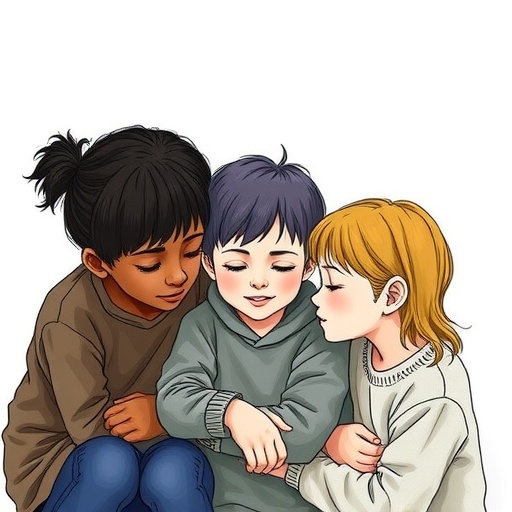
Children exposed to domestic violence often endure psychological scars that profoundly shape their perceptions of trust and safety, particularly within their immediate social circles. While conventional wisdom advocates open dialogue as a therapeutic tool for trauma recovery, recent research reveals that this approach may not hold the same efficacy for all young survivors. A qualitative study published in the Journal of Child & Adolescent Trauma highlights the intricate and often fraught social networks of children aged eight to twelve who exhibit symptoms of posttraumatic stress disorder (PTSD) stemming from familial trauma. The findings underscore the urgent need to rethink assumptions about support systems for these vulnerable children.
The research, led by developmental psychologist Mèlanie Sloover from Radboud University, employed a methodology centred on social network mapping. This innovative approach allowed the team to analyze not only who the children regarded as part of their networks but also the nature of these relationships and the degree to which trauma was discussed within them. The children reported approximately 40 percent of their connections as negative or ambivalent, revealing a landscape where trust and mutual support are tenuous at best. These findings suggest that the social ecosystems surrounding traumatized children may inadvertently contribute to their sense of isolation.
One of the most striking revelations of the study pertains to the children’s interactions with their parents, a group typically positioned as primary sources of emotional support. The research illustrates a profound complexity, as half of the children identified their fathers as part of their social network despite the fathers being perpetrators of abuse. These relationships were characterized predominantly by negativity, further compounding the children’s psychological distress. This paradoxical inclusion signals how deeply intertwined familial bonds can persist even amidst traumatic circumstances, complicating pathways to recovery.
Conversely, the children’s relationships with their mothers appeared more amicable on the surface, yet these connections did not necessarily translate into effective emotional support concerning trauma conversations. Many mothers themselves bear the psychological burden of trauma, often exhibiting symptoms of PTSD, which impairs their capacity to engage empathetically or offer the sensitive responses that children require. This dual trauma within the family system poses a significant hurdle, as conversations about the traumatic events can become fraught or avoidant, leaving children feeling unheard or misunderstood.
Friendships outside the family unit, traditionally regarded as vital for emotional resilience in childhood, present additional layers of difficulty for these young survivors. While children conceptualized friendship in terms of altruism, kindness, and trust, their lived experiences diverged sharply. Many expressed uncertainty about the authenticity of their peer relationships, some facing bullying or a pervasive lack of safety in these interactions. Crucially, the children rarely disclosed traumatic experiences to their friends, suggesting that these external relationships either lacked the depth or the stability required for such profound disclosures.
Yet, a glimmer of hope emerges from the realm of peer support groups designed specifically for children who have endured similar traumas. Within these safe spaces, children found a unique sense of validation and understanding that was not readily available in their broader social networks. The study emphasizes the therapeutic potential of recognition between peers who share analogous histories, as this commonality reduces the need for extensive explanation and accelerates feelings of being understood. Such environments appear to create essential nurturing conditions that facilitate emotional expression and healing.
The implications of these insights necessitate a systemic approach to trauma care. Traditional therapeutic models focusing solely on the individual child may overlook the relational dynamics that sustain or hinder recovery. Notably, attention must be afforded to the broader network, including parents who may themselves be silently struggling with trauma-related disorders. Sloover advocates for interventions aimed at bolstering safe relationships and equipping caregivers with tools to foster supportive dialogues, thereby addressing both the child’s environment and internal psychological state.
Understanding why children avoid discussing their trauma is a complex endeavor. Such avoidance can be symptomatic of PTSD, manifesting as emotional numbness or fear of exposure. However, avoidance may also reflect negative experiences in prior attempts at disclosure, where conversations were met with dismissal, discomfort, or retraumatization. Recognizing the multifactorial reasons behind this silence is critical for clinicians, educators, and caregivers seeking to craft supportive environments that encourage rather than inhibit open communication about traumatic experiences.
Methodologically, this qualitative study stands out for accentuating the subjective interpretation of social bonds by children with PTSD. It reveals how trauma not only alters internal emotional landscapes but also transforms external social maps in ways that challenge conventional support structures. By centering the children’s perspectives, the research expands our comprehension of PTSD beyond symptomatology and into the realm of social relational dynamics, underscoring the importance of context-sensitive interventions.
These findings invite a reevaluation of how trauma-informed care is delivered in educational and therapeutic settings. For instance, schools could integrate peer support models, recognizing their potential as safe havens for children who struggle with external friendships or familial support. Meanwhile, therapeutic programs may need to adopt more holistic frameworks that incorporate family therapy, parental mental health support, and community engagement to create the scaffolding essential for sustainable recovery.
Moreover, the research contributes crucial data that challenges simplistic narratives about resilience. While the capacity to overcome adversity is often praised, the nuanced realities of children living with PTSD illustrate that resilience is contingent upon the quality of their support networks. The prevalence of ambivalence and negativity in these networks calls for targeted strategies that address relational healing as much as individual symptom treatment.
In summary, the study illuminates the nuanced, often painful social realities of children grappling with posttraumatic stress disorder within domestic violence contexts. By mapping their social worlds and analyzing communication patterns, it reveals a profound scarcity of safe and supportive spaces for trauma disclosure. However, it also spotlights the empowering role of peer support groups where shared experiences foster empathy and mutual understanding. Taken together, these insights compel stakeholders to adopt more sophisticated, systemic trauma care approaches that attend not only to the child’s internal distress but also the relational networks that shape their recovery journey.
News Publication Date: 29-Apr-2026
Web References: http://dx.doi.org/10.1007/s40653-026-00896-1
Cite Scienmag News
Courtney Benton. (May 1, 2026). New study reveals limited social support for traumatized children within their own circles. Scienmag. https://scienmag.com/new-study-reveals-limited-social-support-for-traumatized-children-within-their-own-circles/
Courtney Benton. "New study reveals limited social support for traumatized children within their own circles." Scienmag, 1 May 2026, https://scienmag.com/new-study-reveals-limited-social-support-for-traumatized-children-within-their-own-circles/. Accessed 4 September 2026.
Courtney Benton. "New study reveals limited social support for traumatized children within their own circles." Scienmag. May 1, 2026. https://scienmag.com/new-study-reveals-limited-social-support-for-traumatized-children-within-their-own-circles/


