


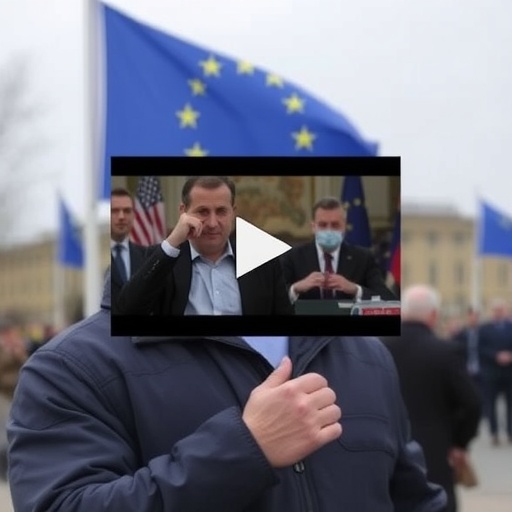
In an era increasingly fraught with misinformation and the rapid spread of false narratives, especially surrounding elections and democratic processes, a groundbreaking study has emerged that offers a hopeful strategy to protect voters across the European Union. Published in 2026 in Communications Psychology, the research led by Biddlestone, Goldberg, Basol, and colleagues proposes a novel use of video inoculation techniques to shield electorates against the pernicious effects of election misinformation. This extensive multinational study involved participants from twelve EU nations, creating a robust, cross-cultural dataset to understand how brief, targeted video interventions can fortify individuals’ resistance to deceptive political content.
The central concern addressed by the research is the vulnerability of democratic systems to manipulation through strategically crafted misinformation campaigns. These campaigns often involve the dissemination of false or misleading information designed to sway voter opinions, destabilize trust in electoral systems, or amplify social divisiveness during critical election periods. Traditional fact-checking efforts, while vital, often lag behind the speed at which falsehoods propagate online. Hence, the need arises for a proactive defense mechanism that inoculates rather than merely reacts to misinformation after exposure.
Drawing on principles from the cognitive science of persuasion and immunology, the researchers conceptualize misinformation resistance akin to a biological immune response—where a weakened form of misinformation is presented ahead of time to “vaccinate” the mind. Prior studies had shown that exposure to carefully constructed counterarguments or explanations can enable people to recognize and dismiss false claims more effectively later. However, these preliminary methods rarely tested in real-world, large-scale, and diverse populations. The current study fills this knowledge gap by deploying short, engaging videos across several countries to evaluate their efficacy at scale.
The experimental design involved creating videos that explain common election misinformation tactics such as emotional appeal manipulation, misleading statistics, and out-of-context visuals. Each video exemplified typical false claims seen during electoral periods, followed by a scientific breakdown that exposed the underlying deceptive techniques. Importantly, these materials were culturally adapted and translated to maintain relevance and resonance with various European audiences, a critical factor often overlooked in misinformation interventions. The researchers hypothesized that viewers would learn to identify the tactics rather than merely debunk specific falsehoods, enabling broader application of this critical thinking skill.
Participants were recruited from 12 EU member states, encompassing diverse linguistic, political, and cultural backgrounds. After initial baseline surveys gauging their susceptibility to misinformation and political attitudes, they viewed the video inoculations. Follow-up assessments measured changes in their ability to critically evaluate election-related claims, both immediately after exposure and at intervals of up to several weeks. Notably, the multination framework allowed the team to detect whether video inoculation effects were consistent or varied by national context, political polarization, media literacy, or trust in institutions.
Quantitative results demonstrated significant increases in misinformation rejection across all participant nations, with improvements ranging from moderate to substantial depending on prior beliefs and media environment. Viewers reported enhanced skepticism toward emotionally charged and simplistic election claims, and showed a marked ability to identify logical fallacies and deceptive framing. Moreover, these cognitive defenses displayed durability over time, suggesting that a single intervention can have lasting protective effects. The videos also appeared to boost participants’ confidence in navigating complex political information landscapes, a key psychological buffer against misinformation.
Beyond behavioral outcomes, the study employed neurocognitive measures to explore how video inoculation impacts information processing at the brain level. Using functional MRI scans of a subset of participants, researchers observed increased activity in the prefrontal cortex regions associated with analytical reasoning and impulse control when individuals evaluated political content post-intervention. This finding supports the theory that inoculation fosters reflective rather than reactive thinking, breaking automatic acceptance of misleading narratives. The neurobiological evidence offers exciting insights into the mechanisms underpinning the cognitive resilience fostered by educational media.
The implications of this research extend far beyond academic interest, suggesting scalable, cost-effective strategies for governments, NGOs, social media platforms, and educators fighting against election misinformation globally. Unlike reactive fact-checking, video inoculation can be strategically disseminated ahead of elections, creating a vaccinated electorate more resistant to manipulation. This proactive approach could reduce vaccine-like societal fatigue related to misinformation overload by strengthening individuals’ own mental defenses, thereby sustaining democratic integrity in an increasingly complex information ecosystem.
However, the study also highlights challenges that demand further inquiry. For instance, inoculation must be carefully tailored to avoid complacency whereby individuals dismiss true information that conflicts with their prior beliefs. The balance between fostering healthy skepticism and preventing cynicism or distrust in legitimate sources remains delicate. Furthermore, cultural sensitivities require continuous adaptation of inoculation materials to prevent alienation or unintended biases. As misinformation tactics evolve rapidly, ongoing updates to inoculation content and techniques will be paramount to maintaining efficacy.
The research team advocates for integrating video inoculation modules into formal voter education programs, social media literacy campaigns, and public broadcasting initiatives. By embedding scientifically grounded inoculation messaging within these networks, societies can build a more resilient civic culture and empower individuals to actively safeguard their democratic participation. Partnerships with tech companies could facilitate algorithmic promotion of such content during pivotal political moments, counterbalancing viral misinformation with equally compelling and accessible protective narratives.
In summary, Biddlestone and colleagues’ landmark study firmly establishes video inoculation as a powerful tool in the modern arsenal against election misinformation. It marks a paradigm shift from reactive correction towards preemptive mental immunization through engaging, culturally relevant educational media. As democracy faces increasing threats from the weaponization of information, scalable behavioral science solutions such as this offer a beacon of hope. Future work will undoubtedly expand on these insights, refining techniques to protect societies worldwide while preserving the open, deliberative nature of democratic discourse.
This work exemplifies how interdisciplinary approaches—merging psychology, neuroscience, communication, and political science—can innovate solutions to urgent contemporary challenges. As we confront an era where misinformation undermines the very foundations of free elections, fostering cognitive resilience through inoculative videos may be one of the most impactful interventions of our time. The study’s rigorous evidence base and wide-reaching impact herald a critical advance not only for Europe but for democracies globally grappling with the digital information age.
Cite Scienmag News
Glenn Wilkins. (March 17, 2026). Video Inoculation Fights Election Misinformation in EU. Scienmag. https://scienmag.com/video-inoculation-fights-election-misinformation-in-eu/
Glenn Wilkins. "Video Inoculation Fights Election Misinformation in EU." Scienmag, 17 March 2026, https://scienmag.com/video-inoculation-fights-election-misinformation-in-eu/. Accessed 4 September 2026.
Glenn Wilkins. "Video Inoculation Fights Election Misinformation in EU." Scienmag. March 17, 2026. https://scienmag.com/video-inoculation-fights-election-misinformation-in-eu/


