


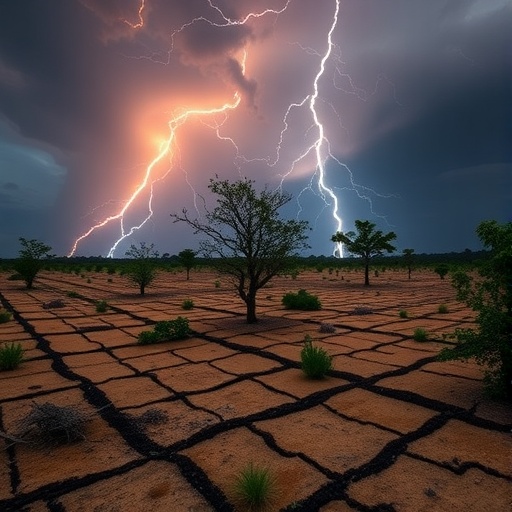
In recent years, the phenomenon of flash droughts has emerged as a critical challenge for the global environment, drawing increased attention from scientists and policymakers alike. Flash droughts, characterized by their rapid onset and intensification over a brief period, disrupt the hydrological cycle in a manner distinct from traditional droughts, posing immediate and severe threats to vegetation productivity across diverse ecosystems. A groundbreaking study published in Nature Communications by Guo, Wu, Wang, and colleagues (2026) provides a comprehensive analysis of the expanding incidence and severity of these fast-developing drought events on a planetary scale. Their findings signal alarming implications for the resilience of vegetation systems, highlighting a pressing need to reassess ecological vulnerability in the face of escalating climate extremes.
At its core, the research delves into the mechanisms underpinning flash drought formation and propagation, unraveling intricate feedback loops among atmospheric conditions, soil moisture dynamics, and vegetation responses. Unlike classical droughts, which evolve gradually over months or years, flash droughts arise within weeks or even days, primarily driven by sudden atmospheric anomalies such as heatwaves combined with sharp declines in soil moisture retention. This brief yet intense temporal scale exacerbates stress on plants, particularly in arid and semi-arid regions, where water availability is already marginal. The study employs high-resolution satellite datasets, coupled with advanced climate and land surface models, to quantify temporal trends and spatial patterns of flash drought occurrences globally, offering unprecedented insights into their frequency, intensity, and geographic distribution.
One of the pivotal revelations of Guo et al.’s investigation is the marked increase in the spatial footprint of flash droughts over the past two decades. Their analysis reveals that regions previously considered relatively stable in terms of drought risk have experienced emerging vulnerabilities, suggesting a shift in baseline climatic conditions. This expansion is tied closely to escalating global temperatures and alterations in precipitation regimes driven by anthropogenic climate change. The acceleration of land-atmosphere feedback cycles perpetuates rapid soil moisture depletion, fostering conditions ripe for flash drought emergence across diverse biomes, ranging from temperate forests to tropical savannas. Such changes undermine longstanding assumptions about ecosystem resilience and the predictability of drought occurrences.
In addition to mapping distribution and intensity, the study offers a detailed examination of the cascading consequences that flash droughts impose on vegetation productivity. Using vegetation indices derived from remote sensing technologies, the authors demonstrate substantial degradation in photosynthetic capacity and biomass accumulation during and following these events. The abrupt water deficits limit plants’ ability to sustain normal physiological processes, triggering premature senescence and reducing carbon sequestration potential. This, in turn, compromises key ecosystem services such as soil stabilization, habitat provision, and carbon cycling, with wider implications for biodiversity conservation and climate regulation.
The resilience of vegetation—its capacity to recover post-drought—is also a central focus of the research. Traditional droughts allow for slower onset and gradual acclimation, giving plants time to deploy adaptive mechanisms such as osmotic adjustments and root growth modulation. However, the rapid progression of flash droughts curtails these opportunities, leaving plants more vulnerable to irreversible damage. This diminished resilience manifests in prolonged recovery periods and, in some cases, permanent shifts in species composition. Consequently, ecosystems may transition toward simplified communities dominated by drought-tolerant species, reducing overall biodiversity and altering functional dynamics critical for ecological stability.
Furthermore, Guo and colleagues emphasize the synergistic effects of flash droughts with other climatic stressors, notably heatwaves. While previous studies have recognized the detrimental role of elevated temperatures during droughts, this research quantifies how the concurrence of extreme heat and soil moisture deficits amplifies vegetation stress exponentially. Heat exacerbates evapotranspiration rates, accelerating soil water loss and intensifying plant dehydration. The coupling of these stressors is particularly pernicious in mid-latitude regions where agricultural productivity heavily depends on stable moisture availability. The findings pose grave concerns for global food security under shifting climate regimes.
The methodological approach underpinning this study merits attention for its integration of multi-source observational data and process-based modeling frameworks. By harmonizing satellite-derived soil moisture measurements from instruments such as SMOS and SMAP with ground-based climatic records, the team achieves robust temporal coverage critical for detecting flash drought onset with high fidelity. Advanced land surface models incorporate dynamic vegetation modules accounting for physiological feedbacks to drought, permitting simulations that reflect realistic biotic responses. This fusion of empirical and theoretical tools sets a new standard for drought monitoring and prognosis, facilitating real-time risk assessments.
Intriguingly, the study also investigates the role of human land use and management practices in modulating flash drought vulnerability. Urbanization, deforestation, and intensive agriculture alter surface energy balances and hydrological pathways, potentially exacerbating or mitigating drought propagation. The authors highlight that anthropogenic changes in land cover, coupled with soil degradation, can impair natural moisture recycling, contributing to faster soil drying rates. Meanwhile, adaptive management strategies such as soil moisture conservation, irrigation scheduling, and reforestation emerge as vital countermeasures to enhance resilience. The research underscores the importance of integrating socio-ecological systems perspectives in addressing flash drought impacts.
From a policy and environmental management standpoint, the implications of expanding flash droughts are profound. The rapid onset and destructive potential of these events challenge conventional drought preparedness paradigms that rely on gradual warning systems and long-term monitoring. Early detection tools and predictive models tailored to flash drought characteristics must be prioritized to enable proactive interventions. The study advocates for intensified international cooperation, given the transboundary nature of drought impacts, and underscores the necessity of incorporating flash drought risk into climate adaptation frameworks, conservation planning, and agricultural policy formulation.
Moreover, the research invites a reconsideration of ecosystem service valuation in the context of climate extremes. The diminished productivity and impaired carbon sequestration capacity of vegetation affected by flash droughts may alter global carbon budgets, influencing climate feedback loops. Decreased ecosystem resilience can also compromise water regulation functions and increase susceptibility to wildfires, pest outbreaks, and land degradation. These interconnected risks necessitate integrated approaches that encompass climate, ecological, and socioeconomic dimensions to safeguard environmental and human well-being.
Looking forward, the study calls for intensified research efforts to unravel the complex interactions between atmospheric dynamics, soil hydrology, and plant physiology that define flash drought processes. Enhancing model resolution, incorporating species-specific drought tolerance traits, and refining drought classification criteria are essential for improving predictive capabilities. Furthermore, long-term ecological monitoring networks must expand their scope to capture flash drought signals and recovery patterns across diverse ecosystems. Such endeavors will crucially inform resilient ecosystem management and climate adaptation strategies moving into an uncertain future.
In summary, Guo, Wu, Wang, and their team have illuminated a critical and underappreciated dimension of climate variability—rapid-onset flash droughts—and have elucidated their far-reaching impacts on global vegetation productivity and resilience. Their research represents a clarion call for the scientific community, environmental managers, and policymakers to recognize and address this burgeoning threat. As climate change accelerates, the frequency and severity of flash droughts are projected to escalate, demanding urgent, coordinated responses to protect the planet’s vital ecosystems and the services they provide to humanity.
Cite Scienmag News
Violet Maxwell. (March 17, 2026). Global Flash Droughts Threaten Vegetation Resilience. Scienmag. https://scienmag.com/global-flash-droughts-threaten-vegetation-resilience/
Violet Maxwell. "Global Flash Droughts Threaten Vegetation Resilience." Scienmag, 17 March 2026, https://scienmag.com/global-flash-droughts-threaten-vegetation-resilience/. Accessed 1 September 2026.
Violet Maxwell. "Global Flash Droughts Threaten Vegetation Resilience." Scienmag. March 17, 2026. https://scienmag.com/global-flash-droughts-threaten-vegetation-resilience/


