


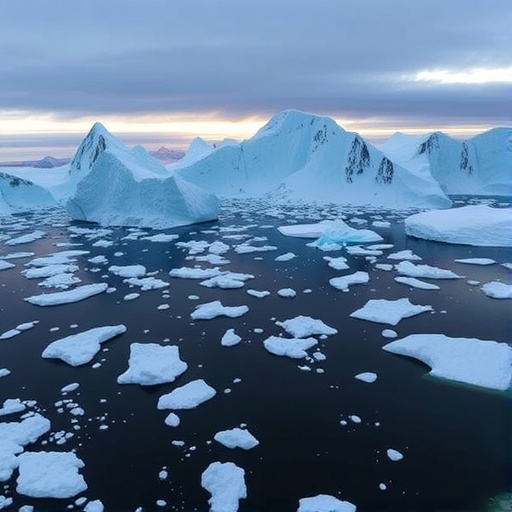
In a groundbreaking new study published in Communications Earth & Environment, researchers D.H. Bromwich, X. Zou, and S.H. Wang reveal compelling evidence that the interior of Antarctica, long considered the coldest and most stable region on Earth, is undergoing significant and rapid climate change. This revelation challenges previous assumptions that the continent’s heartland remained relatively unaffected by contemporary global warming trends observed at its coasts and surrounding seas, with profound implications for our understanding of polar climate dynamics and global climate models.
Historically, scientific focus on Antarctic warming has concentrated predominantly on the Peninsula and coastal regions, where ice mass loss and atmospheric warming have been well documented. These areas have demonstrated marked increases in temperature and accelerated ice melt. However, the interior of Antarctica, shielded by vast ice sheets, high altitudes, and extreme climatic conditions, was believed to be insulated from such changes. The new investigation upends this view by detailing measurable climate shifts within the continent’s central plateau, suggesting that interior Antarctica is not a static, frozen desert but a dynamic system responding to global temperature increases.
The study employs comprehensive climate modeling combined with extensive atmospheric data collection to highlight changes in temperature, precipitation patterns, and atmospheric circulation deep within the Antarctic interior. Of particular significance is the documented increase in summertime temperatures, which, although slight in absolute terms, represent unprecedented warming in an environment where even minor temperature fluctuations can initiate cascading effects across the cryosphere. These changes have potential to alter ice mass balance by subtly increasing surface melting and refreezing processes, which may impact ice sheet stability over decades.
Moreover, the researchers identify an intensification of the Antarctic continental interior’s hydrological cycle. With warming temperatures, there is evidence of altered snowfall patterns—both in frequency and volume—that suggest a shift towards increased precipitation during certain seasons. This change reflects a more humid atmosphere sustaining new ice accumulation and melt cycles, which could complicate previous projections of ice sheet behavior. These findings underscore the sensitivity of the Antarctic climate system to broader atmospheric changes, such as shifts in wind patterns and jet stream dynamics.
Analyzing atmospheric circulation patterns, the authors note alterations in the Southern Hemisphere’s polar vortex and the high-pressure systems dominating the Antarctic interior. These large-scale atmospheric phenomena are instrumental in regulating heat and moisture transport across the continent. The observed weakening and meandering of the polar vortex facilitate more frequent intrusions of relatively warmer air masses into the interior, thereby accelerating local warming processes. Additionally, shifts in the phases of Southern Annular Mode (SAM) are implicated in modifying surface climate conditions, further validating the study’s diagnosis of substantial climate perturbations.
Beyond temperature and precipitation changes, the study explores implications for ice sheet dynamics, particularly in relation to firn air content and basal melting processes. Warming may lead to firn densification, which reduces the capacity of the surface layers to absorb meltwater, potentially increasing runoff and groundwater flow beneath the ice sheet. Basal melting, driven by geothermal heat and now potentially influenced by altered surface thermal regimes, could exacerbate ice sheet movement and increase vulnerability to collapse. These mechanisms, though subtle at present, might initiate feedback loops accelerating ice sheet loss and thereby impacting global sea levels.
A key technical advancement underpinning this research lies in the high-resolution regional climate models tailored specifically for Antarctic conditions. These models integrate atmospheric physics, surface energy balance, and snowpack dynamics at unparalleled spatial and temporal scales. The fidelity of the simulations offers a nuanced picture of how microphysical processes translate to macro-scale climate alterations. Coupled with satellite observations and in situ meteorological measurements, this integrative approach provides robust evidence dismantling prior assumptions of Antarctic interior climatic stability.
The implications of these findings extend well beyond polar science. The Antarctic ice sheet is a critical global freshwater reservoir, and shifts in its mass balance have direct consequences for sea level rise, ocean circulation, and climate feedback mechanisms worldwide. Interior Antarctica’s newly identified responsiveness to warming suggests that existing projections of ice sheet contributions to future sea level may underestimate risk. This calls for urgent refinement of climate models to incorporate interior Antarctic responses, enabling more accurate forecasting and adaptive strategies on a planetary scale.
Interestingly, the study touches on potential biome effects, revealing that warmer and wetter interior conditions might influence microbial life and biogeochemical cycles previously assumed dormant due to extreme cold and aridity. These ecological shifts, although not yet fully quantified, raise fundamental questions about Antarctica’s role in global carbon cycling and its unexpected contributions to biogeochemical feedbacks in a warming world.
Furthermore, the paper discusses how interior Antarctic climate changes might interact with ocean-ice-atmosphere coupling mechanisms. Changes in ice sheet meltwater input can modify Southern Ocean stratification, altering nutrient distributions and impacting marine ecosystems. These processes illustrate the interconnectedness of Antarctic interior climate dynamics with broader Earth system functions, emphasizing the continent’s integral role in moderating and responding to anthropogenic climate change.
One notable aspect is the temporal scale of changes documented. The authors identify early 21st century trends correlated with satellite-era observations but also reconstruct long-term climatic shifts using ice core and reanalysis data. This historical perspective reveals that recent warming is unprecedented in intensity and rates, breaking from natural variability and underscoring anthropogenic forcing as a primary driver. By contextualizing recent changes within a paleoclimatic framework, the study strengthens the case for urgent global climate mitigation efforts.
The researchers highlight several challenges and uncertainties that remain in fully understanding Antarctic interior climate complexities. Sparse observational data, extreme environmental conditions impeding instrumentation, and the intricate interactions between atmospheric chemistry, ice physics, and oceanography constrain precise forecasting. Nonetheless, this pioneering study lays a solid foundation for future multidisciplinary investigations that will deepen comprehension and inform policymaking.
In conclusion, Bromwich, Zou, and Wang’s research compellingly demonstrates that interior Antarctica is far from isolated in the global climate context. Their evidence of marked climate change in the continent’s interior demands reevaluation of long-held scientific paradigms and models. As the planet continues to warm, the fate of Antarctica’s ice dynamically intertwines with global stability, making this new knowledge critical for shaping climate science and international environmental policy. It is a vivid reminder that no corner of Earth remains untouched by the accelerating pulse of anthropogenic change.
Cite Scienmag News
Hazel L. (March 15, 2026). Interior Antarctica Faces Rapid Climate Change Shift. Scienmag. https://scienmag.com/interior-antarctica-faces-rapid-climate-change-shift/
Hazel L. "Interior Antarctica Faces Rapid Climate Change Shift." Scienmag, 15 March 2026, https://scienmag.com/interior-antarctica-faces-rapid-climate-change-shift/. Accessed 29 August 2026.
Hazel L. "Interior Antarctica Faces Rapid Climate Change Shift." Scienmag. March 15, 2026. https://scienmag.com/interior-antarctica-faces-rapid-climate-change-shift/


