


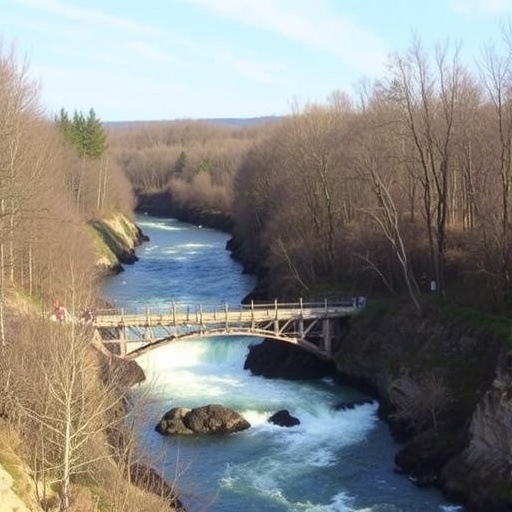
In the constantly shifting landscapes sculpted by flowing water, rivers are among the most mesmerizing and complex natural phenomena. Their channels twist and bend, weaving intricate paths that continuously reshape the earth. A groundbreaking study by researchers Noh and Wani, soon to be published in Communications Earth & Environment, reveals a critical insight into the chaotic behaviors governing river channel evolution—a discovery with profound implications for geomorphology and environmental management.
Rivers have long been recognized as dynamic systems where water and sediment interact in intricate ways, giving rise to diverse channel patterns. Among these patterns, the phenomenon known as a “cutoff” holds particular significance. Cutoffs occur when a river creates a new, shorter channel path, often abandoning a meander loop. This natural process is widely observed and has been considered a routine part of river dynamics. However, Noh and Wani’s research elevates the role of cutoffs from a mere geomorphological curiosity to a fundamental driver of chaotic evolution in river channels.
The study introduces a novel theoretical framework that identifies cutoffs as a sufficient condition for chaos in kinematic river evolution. Chaos, in this context, refers to highly sensitive, nonlinear, and unpredictable changes in channel morphology over time. Prior models of river dynamics often struggled to predict or explain abrupt morphological shifts, which are now understood through this lens of cutoff-triggered chaos. This insight advances our comprehension of riverine systems beyond traditional linear or steady-state perspectives.
By applying advanced mathematical techniques and computational modeling, the researchers demonstrated how the initiation of a cutoff can drastically alter the flow and sediment transport regimes. These shifts create feedback loops where small perturbations amplify rapidly, leading to highly erratic channel changes. Such feedback was previously underappreciated but now emerges as a core mechanistic element explaining the complexity and variability observed in many meandering rivers worldwide.
This discovery is particularly vital for practical applications. Predicting river course changes has significant ramifications for flood risk management, habitat conservation, and infrastructure planning. By understanding cutoffs as instigators of chaotic dynamics, scientists and engineers can refine their models to anticipate sudden alterations in river paths, thereby enhancing the resilience of communities and ecosystems dependent on river behavior.
The researchers employed long-term observational data from multiple river systems, integrating satellite imagery and historical flow measurements, to validate their theoretical propositions. Their approach bridged the gap between abstract mathematical models and tangible natural phenomena. The congruence between modeled and observed channel evolution underscores the robustness and applicability of their findings.
Moreover, the study sheds light on the conditions under which cutoffs are likely to induce chaos. Not all cutoffs result in unpredictable channel patterns; rather, specific hydrological and sedimentological thresholds must be met. Identifying these thresholds equips geomorphologists with diagnostic tools to forecast when a river might transition from relatively stable meandering to chaotic rewiring of its channels.
A compelling aspect of the research lies in its interdisciplinary nature. It weaves together principles from fluid dynamics, sediment transport theory, and nonlinear systems science. By doing so, Noh and Wani offer a comprehensive perspective on river morphodynamics that transcends disciplinary silos, fostering new avenues for collaborative investigations into Earth surface processes.
The intricate dance of water and sediment in river channels is also intimately linked to ecological function. Rapidly changing river landscapes driven by chaotic cutoff dynamics can create diverse habitats, but they can also disrupt sensitive ecosystems. The study’s findings therefore hold ecological significance, informing conservation strategies that account for the inherently unpredictable nature of riverine environments.
Climate change and human interventions further complicate river dynamics. Altered precipitation patterns, land use changes, and engineered river modifications influence the likelihood and impact of cutoffs. Understanding the chaotic consequences elucidated in this research enables better assessment of how anthropogenic factors may amplify or mitigate natural river evolution processes in the future.
Importantly, this research reframes cutoffs not just as isolated geomorphic events but as pivotal moments that steer the long-term trajectory of river channels. Recognizing this paradigm shift enriches the scientific narrative about river behavior, emphasizing that sudden, chaotic changes are not anomalous but intrinsic features of fluvial landscapes.
Technological advances in remote sensing and computational power have been essential in enabling this discovery. High-resolution satellite monitoring and sophisticated algorithms allow for detailed tracking and simulation of river channel morphodynamics, which were previously inaccessible. These technological tools, combined with theoretical breakthroughs, underscore the evolving frontier of Earth system science.
In sum, Noh and Wani’s work marks a milestone in our understanding of rivers, revealing how cutoffs act as natural catalysts for chaos in channel evolution. This revelation prompts a re-examination of how we model, manage, and coexist with river systems amid environmental change. It invites scientists, policymakers, and the public to appreciate the delicate balance governing the earth’s ever-transforming waterways.
As research continues, the implications of this study may extend beyond rivers to other evolving natural systems exhibiting similar nonlinear behaviors. The concept that discrete, localized events can drive system-wide chaotic dynamics resonates across fields, from ecology to climate science, accentuating the universality of nonlinear processes in nature.
Ultimately, this pioneering research illuminates the hidden complexity behind the serene beauty of rivers, reminding us that beneath their tranquil surfaces lies a world of dynamic chaos shaping our planet’s surface. Understanding these processes in greater depth promises to enhance our stewardship of natural environments in an era defined by rapid ecological and societal transformations.
Cite Scienmag News
Gavin Prescott. (March 13, 2026). Cutoffs Trigger Chaos in Kinematic River Evolution. Scienmag. https://scienmag.com/cutoffs-trigger-chaos-in-kinematic-river-evolution/
Gavin Prescott. "Cutoffs Trigger Chaos in Kinematic River Evolution." Scienmag, 13 March 2026, https://scienmag.com/cutoffs-trigger-chaos-in-kinematic-river-evolution/. Accessed 30 August 2026.
Gavin Prescott. "Cutoffs Trigger Chaos in Kinematic River Evolution." Scienmag. March 13, 2026. https://scienmag.com/cutoffs-trigger-chaos-in-kinematic-river-evolution/


