


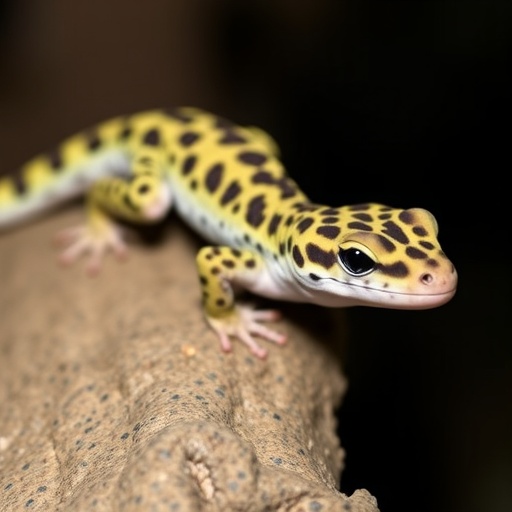
Temperature-dependent sex determination (TSD) is a fascinating biological phenomenon observed in many reptiles, where the ambient temperature during critical windows of embryonic development dictates the sex of the offspring. While TSD has been extensively studied in species like turtles and crocodilians, its underlying mechanisms within squamates—an expansive group encompassing lizards and snakes—have remained largely enigmatic. A groundbreaking study led by Professor Shinichi Miyagawa at the Tokyo University of Science is now shedding unprecedented light on this evolutionary and developmental puzzle, focusing particularly on the leopard gecko (Eublepharis macularius), a species renowned for its temperature-driven sex outcomes.
The leopard gecko serves as an exemplary model for investigating TSD because its sex ratio can be predictably skewed by incubation temperature: cooler settings around 26.5°C yield exclusively females, whereas warmer environments near 31.5°C predominantly produce males. This clear dichotomy presented an ideal system for Miyagawa’s team to decipher the temporal and molecular dynamics that govern sexual fate in reptiles. Their research, poised to be published in Developmental Biology, employs a rigorous combination of histological examination and transcriptome-wide gene expression profiling to map how temperature steers gonadal development.
By incubating leopard gecko eggs at both female- and male-producing temperatures, and orchestrating controlled temperature shifts during key embryonic stages, the researchers delineated a defined temperature-sensitive period terminating at embryonic stage 36. Prior to this juncture, temperature transitions could reverse the sex trajectory, but beyond it, sex became irreversibly fixed. This critical finding finely demarcates the developmental window during which environmental cues exert their transformative influence on gonadal fate, expanding our understanding of the plasticity and constraints inherent in TSD systems.
Intriguingly, morphological differentiation between male and female embryos emerged only after initial molecular divergences had already taken place. Both temperature groups’ embryos were morphologically indistinguishable early on, indicating that gene expression shifts precede overt anatomical features. At the genetic level, the male development pathway was marked by the upregulation of genes such as AMH (Anti-Müllerian Hormone), DMRT1 (Doublesex and Mab-3 Related Transcription Factor 1), and SOX9, all pivotal regulators promoting testes formation. Conversely, female pathways showcased enhanced activity in genes like FOXL2 and CYP19A1, integral to ovarian differentiation. These gene expression patterns anticipate and drive the subsequent gonadal remodeling.
Beyond confirming well-characterized sex-determining genes, the study unveiled lineage-specific molecular nuances that challenge generalized paradigms. Notably, KDM6B, a gene previously implicated as a critical mediator in turtle male determination, displayed a distinct regulatory trajectory in the leopard gecko. Such divergence hints at evolutionary flexibility within the TSD framework, suggesting that while core genetic players may be conserved across reptiles, their temperature-sensitivity and hierarchical influence can evolve differentially across taxa. This nuance underscores the complex interplay of genetics and environment shaping vertebrate sex determination.
Furthermore, the research underscored the early activation of temperature-responsive genes related to RNA splicing and cellular adhesion dynamics, processes not traditionally associated directly with sex determination. This intimates that molecular responses to temperature begin at deeper, perhaps epigenetic or post-transcriptional, regulatory levels well before sex differentiation manifests physically. The involvement of such cellular machinery broadens the conceptual landscape of TSD, pointing to sophisticated networks through which thermal cues modulate gene expression.
The experimental approach also illuminated the deterministic effect of incubation temperature on sex ratios. Incubation at female-preferred temperatures consistently yielded exclusively female hatchlings, while male-favoring temperatures produced a predominantly male cohort but with a small proportion of females. This quantitative sex ratio control is emblematic of the leopard gecko’s tightly regulated TSD mechanism and serves as a robust benchmark for future ecological and molecular studies dissecting environmental sex determination in fluctuating habitats.
Importantly, Miyagawa and colleagues acknowledge the potential influence of maternal effects, including the thermal conditions experienced by gravid females and consequent egg maternal provisioning, which may modulate embryonic developmental trajectories and sex outcomes. Variability between experimental laboratories further highlights the importance of considering both intrinsic and extrinsic factors that converge to fine-tune TSD mechanisms. These complexities reveal that TSD is not only a product of incubation temperature but integrates broader ecological and physiological contexts.
This pioneering study fills a crucial phylogenetic void in TSD research, expanding molecular insights from turtles and crocodilians into squamate lizards. By linking transcriptomic changes to developmental stages within a well-characterized temporal framework, it provides a comprehensive map of how environmental cues are transduced into genetic programs that delineate sexual phenotype. Such integrative perspectives are indispensable for understanding the evolutionary plasticity that enables reptiles to adapt sex determination strategies to diverse ecological niches.
Moreover, the findings offer valuable implications for conservation biology, especially as global climate change exerts unprecedented impacts on habitat temperatures. Species with TSD systems, including the leopard gecko, may face skewed sex ratios under rising temperatures, threatening population viability. Understanding the molecular underpinnings and temporal sensitivity of TSD equips researchers and conservationists with predictive tools to monitor and perhaps mitigate these impacts through targeted interventions.
Professor Miyagawa reflects on the broader significance: “Our research not only unravels the intricate molecular choreography of temperature-induced sex determination in leopard geckos but also opens pathways to explore how environmental factors direct biological fate at the genomic and epigenetic levels across vertebrates.” Such insights transcend herpetology, contributing fundamentally to developmental biology, evolutionary theory, and environmental sciences.
Looking ahead, continued investigations building on these transcriptomic foundations are expected to clarify the downstream signaling cascades, epigenetic modifications, and potential feedback loops involved in TSD. The distinct regulatory patterns observed suggest species-specific adaptations worthy of detailed mechanistic exploration. Moreover, integrating physiological studies on maternal contributions and ecological variability will deepen our holistic understanding of how reptiles navigate the interplay between genes, environment, and development.
This landmark study, supported by Japan Society for the Promotion of Science grants and embraced by an interdisciplinary research ethos at Tokyo University of Science, exemplifies the power of combining developmental biology, genomics, and environmental physiology. As it unpacks the temperature-sex nexus with exquisite detail, it stands to influence a wide array of scientific fields and spark renewed interest in the molecular biology of TSD across vertebrates.
Cite Scienmag News
Juliet Wilcox. (March 13, 2026). New Study Reveals How Temperature Influences Sex Development in Leopard Geckos. Scienmag. https://scienmag.com/new-study-reveals-how-temperature-influences-sex-development-in-leopard-geckos/
Juliet Wilcox. "New Study Reveals How Temperature Influences Sex Development in Leopard Geckos." Scienmag, 13 March 2026, https://scienmag.com/new-study-reveals-how-temperature-influences-sex-development-in-leopard-geckos/. Accessed 3 September 2026.
Juliet Wilcox. "New Study Reveals How Temperature Influences Sex Development in Leopard Geckos." Scienmag. March 13, 2026. https://scienmag.com/new-study-reveals-how-temperature-influences-sex-development-in-leopard-geckos/


