


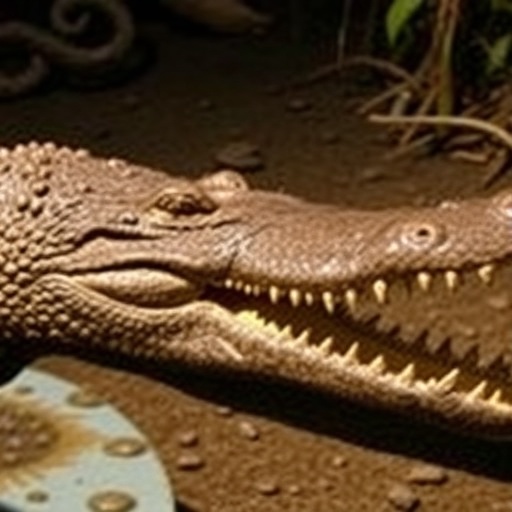
More than three million years ago, the African landscape—home to early hominins such as the iconic Lucy—was dominated by a fearsome predator far different from the large carnivores we commonly imagine. A recently identified species of crocodile, described by a team led by the University of Iowa, emerges as this ancient ecosystem’s top predator, a lurking threat that would have hunted the very ancestors who charted the evolutionary course toward modern humans. Named Crocodylus lucivenator, or “Lucy’s hunter,” this newly christened crocodile species remarkably overlapped both in space and time with Australopithecus afarensis, the hominin species to which Lucy belongs.
Published in the Journal of Systematic Palaeontology, the study provides a detailed systematic review of fossil remains discovered at the Hadar Formation in the Afar region of northeastern Ethiopia, a critical paleoanthropological site. This region, renowned for yielding crucial insights into human evolution, now reveals an additional dimension of the Pliocene epoch’s complex ecosystem: a dominant crocodilian predator that has evoked a reevaluation of predator-prey dynamics during this formative period. The Hadar site, a UNESCO World Heritage location since 1980, allows researchers to concretely contextualize C. lucivenator within a habitat mosaic of rivers, wetlands, shrublands, and diverse woodland environments.
Measuring between 12 to 15 feet in length and weighing roughly 600 to 1,300 pounds in adulthood, Crocodylus lucivenator was far from a modest reptilian presence. Its anatomical features are particularly striking; the crocodile possessed a pronounced cranial lump or dorsal hump on its snout, evocative of the American crocodile but unprecedented for Nile crocodiles, endemic to Africa today. This morphological specialization likely served a sexual display function for males, signaling fitness to potential mates via visual head-lowering gestures—an intriguing example of behavioral continuity within extant crocodilian species and their extinct relatives.
The snout morphology of C. lucivenator also diverged from other contemporary species. The elongated rostrum, extending beyond the nostrils, shares closer resemblance with modern crocodilian species than with any known extinct African counterparts. This morphological trait may reflect specialized predatory adaptations, perhaps optimizing hydrodynamic efficiency and prey capture, positioning this crocodile as a highly effective ambush predator in the Pliocene aquatic ecosystems it inhabited.
The research team meticulously examined 121 fossil specimens, primarily skull fragments, teeth, and jaw portions, reconstructing dozens of individual crocodiles to establish a comprehensive morphological and taxonomic characterization. One specimen, documenting partially healed injuries on its jaws, reveals intraspecific aggressive behavior consistent with modern crocodilian combat rituals. Such face-biting behavior underpins a continuity of social interaction strategies across evolutionary time, underscoring the profound stasis in crocodilian behavioral ecology spanning millions of years.
Within the paleoecological context, C. lucivenator was seemingly the apex predator, outcompeting other carnivorous mammals such as lions and hyenas within its range. While at least three other crocodile species resided in the broader Eastern Rift Valley region, this newly described species evidently dominated the Hadar Formation territory exclusively, adapting to the ecotonal habitats composed of open and closed woodlands, gallery forests, and wet grasslands. This exclusivity suggests niche partitioning and territorial fidelity, providing valuable insights into Pliocene ecosystem structuring.
The implications for understanding hominin-crocodile interactions are profound. Lucy and her kin would have coexisted alongside this potent predator, navigating landscapes where lethal encounters with crocodiles represented a significant survival challenge. While direct evidence of predation events is unobtainable, it is plausible the crocodile’s presence exerted evolutionary pressures influencing hominin behavior, habitat preference, and predator avoidance strategies—perhaps even playing an underappreciated role in shaping early hominin evolutionary pathways.
Christopher Brochu, the study’s lead author and expert on crocodylian paleontology, highlights the serendipitous nature of the discovery, having initially encountered these enigmatic fossils during a 2016 museum visit in Addis Ababa. The unique combination of morphological characters observed in the fossils defied initial expectations, ultimately culminating in the formal recognition of a distinct species that enriches our understanding of crocodilian evolutionary diversity in Africa’s Pliocene ecosystems.
This discovery exemplifies the critical importance of integrative paleontology, combining classical systematic taxonomy with nuanced paleoecological inference, to illuminate the multifaceted roles extinct taxa played within ancient landscapes. Crocodylus lucivenator stands as a testament to the complex predator-prey matrix in which early humans evolved, offering a tangible reminder of the perils and adaptations that shaped the earliest chapters of our lineage.
Supported by funding from the U.S. National Science Foundation, the Leakey Foundation, and the University of Iowa, this collaborative effort also included contributions from researchers affiliated with the University of Tennessee, Arizona State University, the National Museum of Ethiopia, and the University of Cambridge. Their combined expertise underscores the interdisciplinary and international nature of paleontological research that bridges deep time and human origins.
As the fossil record continues to yield remarkable specimens such as those representing Crocodylus lucivenator, our understanding of Pliocene ecosystems grows richer, revealing predators once feared by our ancestors lurking silently beneath the river surfaces. This potent intersection of hominin and crocodile evolutionary history, preserved in the Hadar Formation, enriches the narrative of survival and adaptation amidst the dynamic forces of natural selection.
Cite Scienmag News
Gavin Prescott. (March 12, 2026). Iowa-Led Research Team Identifies and Describes New Crocodile Species That Preyed on Iconic Lucy’s Ancestor. Scienmag. https://scienmag.com/iowa-led-research-team-identifies-and-describes-new-crocodile-species-that-preyed-on-iconic-lucys-ancestor/
Gavin Prescott. "Iowa-Led Research Team Identifies and Describes New Crocodile Species That Preyed on Iconic Lucy’s Ancestor." Scienmag, 12 March 2026, https://scienmag.com/iowa-led-research-team-identifies-and-describes-new-crocodile-species-that-preyed-on-iconic-lucys-ancestor/. Accessed 3 September 2026.
Gavin Prescott. "Iowa-Led Research Team Identifies and Describes New Crocodile Species That Preyed on Iconic Lucy’s Ancestor." Scienmag. March 12, 2026. https://scienmag.com/iowa-led-research-team-identifies-and-describes-new-crocodile-species-that-preyed-on-iconic-lucys-ancestor/


