


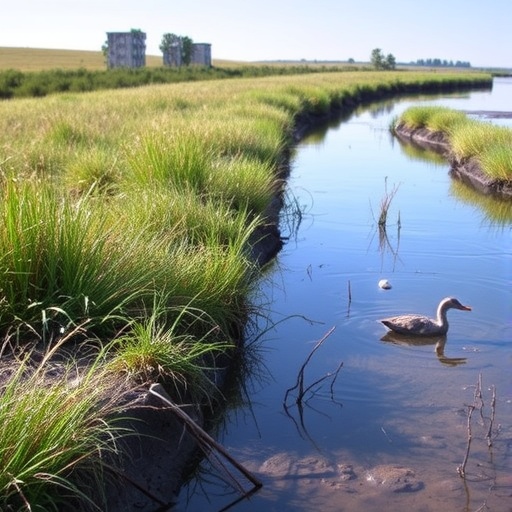
In the vast and varied landscapes of the northern Great Plains, water behaves in ways that are both complex and critical to understanding regional hydrology. A groundbreaking study, recently published in Communications Earth & Environment, reveals that wetlands in this region play a pivotal role in controlling the annual runoff that shapes ecosystems, agriculture, and water resources. This research challenges long-held assumptions about runoff patterns and offers fresh insights into the hydrological significance of wetlands amidst changing climatic conditions.
The northern Great Plains stretch over a large swath of North America, characterized by rolling prairies, interspersed with numerous wetland systems. These wetlands, often considered isolated or marginal features, actually serve as vital regulators in the movement and storage of water. The authors, led by Rahmani, Creed, and Badiou, employed advanced hydrological modeling combined with extensive field observations to dissect how these wetlands influence annual water fluxes across the landscape.
Central to the study’s findings is the concept that wetlands do not merely passively store water but actively set the rhythm for the timing and volume of runoff. Traditional perspectives have typically treated wetlands as downstream recipients of runoff, but this new research highlights their role as moderators, buffering peak flows and releasing water gradually, thus sustaining ecosystems during dry intervals. Such buffering also contributes considerably to flood mitigation, which is of increasing importance given the rising incidence of extreme weather events.
The research team utilized innovative techniques including remote sensing, geospatial analysis, and machine learning algorithms to map wetland distribution and quantify their hydrological influence with unprecedented precision. Their integrative approach allowed them to examine not just the physical characteristics of wetlands, but also their dynamic interactions with soil moisture, groundwater recharge, and evapotranspiration processes that collectively define the hydrological budget of the Great Plains.
One of the study’s most striking revelations concerns how wetlands accelerate or decelerate annual runoff depending on seasonal precipitation patterns and antecedent moisture conditions. In years of high precipitation, wetlands can temporarily hold vast amounts of water, reducing the immediacy and magnitude of downstream flows. Conversely, during dry years, the stored water is released at a slower rate, thereby extending wet periods for dependent habitats and buffering agricultural water supplies.
These insights bear profound implications for land and water management practices across the northern Great Plains. Recognizing wetlands as hydrological linchpins emphasizes the need for their conservation and restoration, not solely for biodiversity but also for maintaining water security. This is particularly relevant as anthropogenic activities such as drainage for agriculture and urban expansion continue to threaten wetland areas, potentially disrupting critical hydrological functions.
Climate change projections for the Great Plains indicate altered precipitation regimes and increased variability in both drought and flood frequencies. The study suggests that wetlands could serve as resilient natural infrastructure, inherently adaptive to these fluctuations. By storing water during wet months and releasing it during dry spells, wetlands might alleviate some of the stress on human water systems and natural ecosystems alike.
Moreover, the interplay of wetlands with surrounding landscapes creates feedback loops impacting soil health, carbon storage, and nutrient cycling. The research draws attention to the multifaceted ecosystem services provided by wetlands, extending beyond hydrology to include climate regulation and habitat support. This integrated perspective enhances our appreciation of wetlands as keystone features in the northern Great Plains.
The study also addresses challenges in scaling wetland hydrological impact assessments from local to regional extents. The authors demonstrate that incorporating wetland characteristics into large-scale hydrological models significantly improves runoff predictions, which can aid policymakers and water resource managers in making informed decisions under uncertainty.
By quantifying the role of wetlands in modulating water flow, the researchers open avenues for incorporating natural features into engineered water infrastructure designs. This nature-based approach promises sustainable solutions that harmonize ecological health with socioeconomic demands, a critical balance in regions heavily reliant on agriculture and natural resources.
Scientific innovation is at the heart of this research. The synthesis of cutting-edge satellite data combined with in situ measurements provides a holistic understanding unprecedented in scale and detail. This methodological advancement sets a new standard for future hydrological studies and promotes cross-disciplinary collaboration between hydrologists, ecologists, geographers, and policymakers.
As wetlands function both as water reservoirs and buffers, protecting them enhances resilience against drought and flood extremes which are projected to intensify due to climate change. The findings reinforce global calls to integrate wetland conservation into climate adaptation and mitigation strategies.
The northern Great Plains, often underappreciated for their ecological complexity, are thus revealed as dynamic landscapes where wetlands orchestrate the annual flow of water. Their ability to influence runoff underscores wetlands’ value not just locally but within broader continental water cycles. Recognizing their significance transforms how we think about water management in prairie environments.
Ultimately, Rahmani and colleagues’ study offers a compelling narrative: that preserving and restoring wetlands is not only an ecological imperative but also a strategic water resource management approach. This paradigm shift aligns natural and human interests in confronting the challenges posed by a rapidly changing environment.
This research ignites fresh discourse about integrating natural systems into regional water governance structures, underscoring a future where ecosystem function guides infrastructure planning and policy formulation. It stands as a clarion call to scientists and stakeholders alike—to elevate wetlands from overlooked features to celebrated stewards of the hydrological landscape.
The implications stretch far beyond geography. Understanding how wetlands modulate runoff in the northern Great Plains invites researchers worldwide to rethink wetland functions in diverse environmental contexts. It encourages the development of innovative water management models combining traditional engineering with ecosystem-based solutions.
In a world increasingly grappling with water scarcity and climate variability, this research represents a beacon of hope. It positions wetlands as nature’s water managers — silently shaping the hydrological tempo upon which both natural and human communities depend.
Cite Scienmag News
Violet Maxwell. (March 12, 2026). Wetlands Control Annual Runoff in Northern Plains. Scienmag. https://scienmag.com/wetlands-control-annual-runoff-in-northern-plains/
Violet Maxwell. "Wetlands Control Annual Runoff in Northern Plains." Scienmag, 12 March 2026, https://scienmag.com/wetlands-control-annual-runoff-in-northern-plains/. Accessed 9 September 2026.
Violet Maxwell. "Wetlands Control Annual Runoff in Northern Plains." Scienmag. March 12, 2026. https://scienmag.com/wetlands-control-annual-runoff-in-northern-plains/


