


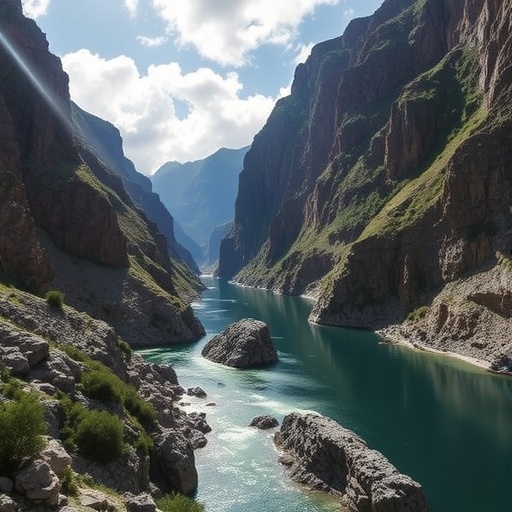
In a groundbreaking study published recently in Communications Earth & Environment, researchers have revealed that tectonic activity combined with the proximity of river mouths plays a crucial role in driving the retreat of submarine canyons along the Italian coasts. This discovery offers unprecedented insights into the dynamic processes shaping the marine landscape beneath the sea surface, providing a new framework for understanding geological evolution, sedimentary processes, and coastal hazards in seismically active regions.
Submarine canyons—steep-sided valleys carved into the seabed—are among the most significant underwater geological features globally. These canyons extend from continental shelves down to the deep sea and serve as conduits for sediment transfer from land to the ocean basin. Their morphology and evolution are influenced by a complex interplay of factors including hydrodynamic forces, sediment supply, and tectonics. However, the exact mechanisms driving their retreat, especially along tectonically active coastlines, have long remained elusive.
The Italian coastline, with its intricate tectonic setting due to the convergence of the African and Eurasian plates, offers a natural laboratory for studying these submarine processes. The peninsula is bordered by several significant river systems that discharge sediment-rich water into the Mediterranean Sea. By combining high-resolution bathymetric data, geological surveys, and sediment transport models, the research team meticulously traced the retreat patterns of multiple submarine canyons along these shores.
The study emphasizes the pivotal influence of tectonic activity on the structural integrity and progression of canyon systems. Seismic events and fault movements induce vertical displacement and fracturing of the seabed, weakening canyon walls and catalyzing collapses. These rapid geomorphic changes contribute significantly to canyon head retreat—where the canyon cuts back toward the coastline—ultimately reshaping underwater topography at a rate previously underestimated.
Simultaneously, the proximity to river mouths profoundly affects the sedimentary dynamics feeding these submarine canyons. Rivers discharge not only sediments but also freshwater pulses that alter the density and flow of nearshore waters, enhancing sediment transport processes. The study identified that canyons located closer to major river outlets exhibit more accelerated retreat patterns, fueled by episodic sediment influx and fluctuating hydrodynamic forces, which together undermine canyon head stability.
The interplay between tectonic uplift and subsidence phenomena with varying sediment supply was found to create highly localized erosional and depositional environments. In certain regions, tectonic uplift elevates portions of the seafloor, counteracting subsidence-driven sediment accumulation, thus promoting canyon head erosion. Conversely, subsidence zones may enhance sediment infilling, modifying sediment transport routes and canyon morphology over geological timescales.
Crucially, the research utilized seismic reflection profiles synchronized with sediment core sampling to reconstruct the sedimentary history surrounding these canyons. This temporal perspective elucidated how past tectonic episodes influenced canyon morphology and retreat patterns through time, establishing a correlation between periods of heightened seismicity and dramatic geomorphic shifts observed in the seafloor topography.
Understanding the mechanisms promoting submarine canyon retreat carries significant implications for coastal risk management, sediment budgeting, and marine habitat conservation. Submarine canyon instability can trigger underwater landslides leading to tsunamigenic events, posing hazards to nearby coastal communities. Additionally, sediments transported through these canyons impact nutrient dynamics and biological productivity in the marine environment.
This study’s novel approach, integrating multidisciplinary datasets and modeling techniques, establishes a critical baseline for predicting future canyon evolution amid changing climate and tectonic regimes. With increasing anthropogenic pressures on coastal systems and rising sea levels, comprehending these underwater processes helps anticipate alterations in sediment pathways and geological hazards, facilitating more resilient marine and coastal infrastructure planning.
Beyond the Italian coasts, this research offers a global blueprint for evaluating submarine canyon dynamics in other tectonically active margins. The findings suggest that similar mechanisms may operate in regions such as the Pacific Rim and the eastern Mediterranean, where complex interplay between seismic activity and fluvial sediment supply governs underwater canyon morphology.
Importantly, this work also challenges conventional views that submarine canyons primarily evolve due to deep-sea turbidity currents or gradual fluvial erosion. Instead, it highlights the episodic yet powerful role of tectonics and riverine interactions in rapidly reshaping these underwater features. This paradigm shift propels forward the scientific understanding of continental shelf to deep-sea connectivity and sedimentary fluxes.
Moreover, the sedimentary records preserved in these submarine canyon structures could serve as archives of past tectonic activity and climatic changes. By decoding these morphological signatures, geoscientists can better reconstruct Earth’s dynamic history and improve models forecasting how marine landscapes respond to natural and anthropogenic forces.
The study also underscores the necessity for enhanced monitoring and mapping technologies capable of detecting subtle seabed changes over time. Advances in autonomous underwater vehicles, remote sensing, and geophysical survey methods promise to refine knowledge of subterranean processes and assist in early warning systems for underwater landslides and submarine canyon instability.
In conclusion, the elucidation of how tectonic activity and river mouth proximity govern submarine canyon retreat redefines the understanding of underwater geomorphology along the Italian coasts and beyond. These findings hold transformative potential for marine geology, coastal hazard assessment, and environmental stewardship, paving the way for future interdisciplinary research at the intersection of tectonics, sedimentology, and oceanography.
As researchers continue to unravel the complex interactions shaping submarine environments, the insights offered by this study illuminate the subtle yet powerful forces sculpting the hidden canyons beneath the waves—reminding us that even seemingly static underwater landscapes are constantly evolving in response to Earth’s restless geological heartbeat.
Cite Scienmag News
Violet Maxwell. (March 12, 2026). Tectonics, Rivers Fuel Submarine Canyon Retreat Italy. Scienmag. https://scienmag.com/tectonics-rivers-fuel-submarine-canyon-retreat-italy/
Violet Maxwell. "Tectonics, Rivers Fuel Submarine Canyon Retreat Italy." Scienmag, 12 March 2026, https://scienmag.com/tectonics-rivers-fuel-submarine-canyon-retreat-italy/. Accessed 3 September 2026.
Violet Maxwell. "Tectonics, Rivers Fuel Submarine Canyon Retreat Italy." Scienmag. March 12, 2026. https://scienmag.com/tectonics-rivers-fuel-submarine-canyon-retreat-italy/


