


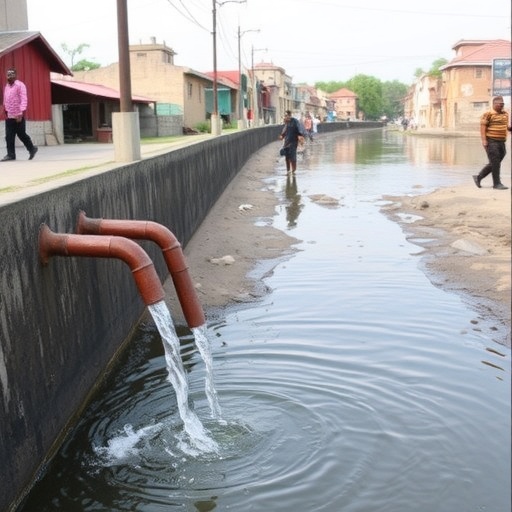
As Pune, one of India’s fastest-growing urban centers, confronts the looming threat of prolonged multi-year droughts, a groundbreaking study unveils the precarious future of water security for millions of its residents. This city, poised to become a megacity with a population exceeding 11 million by 2050, exemplifies the multifaceted challenges that burgeoning urban hubs in the Global South will face amid shifting climate patterns and mounting resource demands. Without immediate, strategic interventions, Pune’s water reservoirs are projected to desiccate, and groundwater reserves are expected to plunge dramatically by mid-century, placing water access and affordability in jeopardy for its most vulnerable populations.
The research, published in the prestigious journal Earth’s Future, intricately models Pune’s water landscape under various climate scenarios including both moderate mitigation pathways that see emissions begin to decline around 2040 and high-emission trajectories stretching to the century’s end. It integrates disciplines spanning hydrology, economics, urban sociology, and agricultural sciences to construct a multifaceted predictive framework. This modeling not only anticipates physical water supply changes but also incorporates economic behaviors and demographic growth, simulating interactions between human and environmental systems with unprecedented granularity.
Central to the study’s findings is the stark reality that, if Pune continues on its current trajectory without policy shifts, low-income residents will suffer disproportionately. Water costs could surge to nearly 20% of their income, an untenable financial burden that also coincides with a severe reduction in water availability—falling to less than half the minimum daily volume needed to maintain basic hygiene and health standards. This inequity is exacerbated by the city’s infrastructural deficiencies, including aging water systems and informal settlements lacking piped water, alongside the competing demands from an irrigation-heavy agricultural sector rooted in water-intensive sugarcane cultivation.
However, the study offers a beacon of hope: achieving sustainable water security for Pune does not necessitate exponential increases in total water supply. Rather, it demands comprehensive, coordinated policy innovations that leverage existing resources while transforming water governance and consumption patterns. Among the proposed interventions, implementing a regulated water market enabling the sale of irrigation water from farmers to urban users—facilitated via licensed tanker trucks—emerges as a particularly potent measure. Modeling suggests this mechanism alone could reduce water costs for vulnerable communities by nearly 80%, significantly improving affordability and access.
The analysis further delineates how piecemeal policy action is insufficient. Isolated efforts such as repairing infrastructure leaks, clamping down on water theft, instituting higher tariffs for disproportionate water users, or capping groundwater extraction yield marginal benefits. Even reallocating water from a major dam offers limited relief unless it is part of an integrated suite of strategies. This insight underscores the necessity of multifaceted interventions, which when deployed simultaneously, can produce synergistic effects—expanding total water availability by a mere 1% while ensuring all residents receive at least 40 liters per day, the baseline recommended by the World Health Organization.
The robustness of the study’s predictive models owes much to sustained engagement with local stakeholders, including municipal officials, civil servants, NGOs, and academic experts. This collaborative approach ensured access to granular hydrologic, agricultural, demographic, and socioeconomic datasets, enabling the models to reflect complex real-world interactions and uncertainties. By incorporating diverse disciplinary expertise and local knowledge, the research transcends traditional siloed water studies and offers a replicable framework adaptable to other cities facing similar climatic and demographic pressures.
Globally, the implications of Pune’s water challenges reverberate far beyond India. Over 80 major cities worldwide, from Cape Town to São Paulo to Chennai, have grappled with extreme droughts since the turn of the millennium. Projections indicate that by 2050, up to half of the urban population globally could experience chronic water scarcity, emphasizing the urgency for scalable, data-driven water management innovations. Pune thus serves as an emblematic case study, illustrating the need for integrated policy responses that align urban growth trajectories with sustainable resource stewardship amid climate change.
Policy adaptation in Pune is already underway, reflecting the study’s practical relevance. The city has commenced initiatives to transfer water allocations from regional dams, install metering infrastructure, and regulate private tanker truck operations. These steps lay critical groundwork for operationalizing water markets and curbing inefficiencies. Nonetheless, the research cautions that without holistic policy packages encompassing governance, pricing reforms, infrastructural investments, and behavioral shifts, Pune’s water security remains fragile.
A notable feature of this study is its rigorous testing of intervention efficacy against a backdrop of uncertainties related to population growth, economic development, and climate pathways. By simulating an array of futures, the models equip policymakers with evidence-based projections that guide decision-making, enabling them to prioritize high-impact actions while avoiding costly or ineffective measures. This approach embodies a paradigm shift in urban water planning, favoring anticipatory governance informed by dynamic system modeling over reactive crisis management.
On a broader scientific front, this research exemplifies the power of coupled multi-agent systems models that integrate human decision-making with environmental processes. The complex, adaptive human-water systems in Pune highlight the interplay of socio-economic drivers, political constraints, and environmental feedbacks. Such modeling advances the frontier of sustainability science, offering tools to navigate the intricate trade-offs and leverage points that define water security in a rapidly urbanizing and warming world.
Ultimately, Pune’s path forward is a clarion call for integrating scientific insights with pragmatic governance frameworks that embrace complexity, equity, and resilience. With the right mix of policy innovation, stakeholder coordination, and technical capacity-building, the city can avoid the dire projections of water insecurity and craft a sustainable urban future. The lessons distilled here provide a valuable blueprint for other emerging megacities poised at the intersection of unprecedented demographic expansion and escalating climate stressors.
Cite Scienmag News
Russell Cooper. (March 10, 2026). New Study Reveals Solutions for Affordable Water in Rapidly Expanding Cities. Scienmag. https://scienmag.com/new-study-reveals-solutions-for-affordable-water-in-rapidly-expanding-cities/
Russell Cooper. "New Study Reveals Solutions for Affordable Water in Rapidly Expanding Cities." Scienmag, 10 March 2026, https://scienmag.com/new-study-reveals-solutions-for-affordable-water-in-rapidly-expanding-cities/. Accessed 6 September 2026.
Russell Cooper. "New Study Reveals Solutions for Affordable Water in Rapidly Expanding Cities." Scienmag. March 10, 2026. https://scienmag.com/new-study-reveals-solutions-for-affordable-water-in-rapidly-expanding-cities/


