


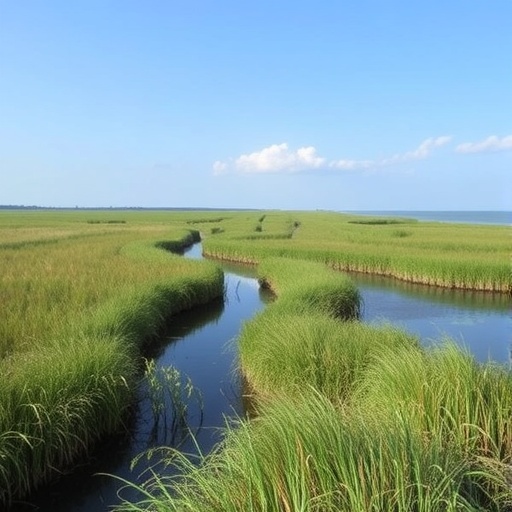
In the face of escalating environmental challenges, coastal wetlands have emerged as crucial ecosystems providing indispensable services that support biodiversity, regulate climate, and sustain human livelihoods. A groundbreaking study by Zhi, Li, and colleagues, published in Communications Earth & Environment in 2026, proposes an integrated strategy to maximize the cobenefits of conservation and restoration in these vital habitats. Their research signals a transformative approach, combining advanced ecological modeling with socio-economic considerations, to protect and rehabilitate coastal wetlands in ways that amplify ecosystem service outcomes.
Coastal wetlands are dynamic interfaces where terrestrial and marine environments converge, encompassing salt marshes, mangroves, and tidal flats. These ecosystems act as natural buffers against storm surges, sequester significant amounts of carbon, and provide nursery grounds for countless marine species. However, they are under relentless pressure from urbanization, pollution, and climate change-induced sea-level rise. Conventional conservation and restoration efforts have often operated in siloes, focusing either on biodiversity preservation or habitat restoration without fully integrating these aims to deliver multifaceted benefits.
Zhi et al.’s integrated strategy marks a paradigm shift by systematically combining conservation priorities with restoration efforts to maximize both ecological and socio-economic outcomes. They employed a suite of spatially explicit ecological models linked with ecosystem service valuation frameworks. This approach enables practitioners to pinpoint priority areas where conservation can prevent degradation while restoration can reinstate critical ecosystem functions, ultimately enhancing the delivery of multiple ecosystem services.
One of the fundamental innovations in this work lies in its ability to quantify the cobenefits arising from integrated actions. For instance, mangrove restoration in areas prioritized not only for habitat connectivity but also for carbon storage potential results in enhanced climate regulation benefits alongside biodiversity gains. Similarly, conserving salt marshes that support fish populations intersects with benefits for local fisheries, thereby aligning ecological objectives with economic resilience for coastal communities.
The authors utilized state-of-the-art remote sensing data combined with field observations to map current ecosystem conditions and model future scenarios under varied intervention strategies. By doing so, they created decision-support tools capable of guiding policymakers and conservationists in allocating limited resources more efficiently. This addresses a long-standing challenge in coastal wetland management—balancing ecological integrity with human needs amid uncertain environmental futures.
In examining the restoration techniques applied, the study underscores the importance of adaptive management. This involves monitoring ecological responses and socio-economic impacts in real-time, allowing fine-tuning of interventions to optimize outcomes. The integrated strategy thus promotes a feedback loop where evolving data continually informs conservation and restoration practices, ensuring they remain effective and contextually relevant as conditions change.
From a technical standpoint, one of the critical challenges tackled was modeling the nonlinear interactions among ecosystem services. For example, sediment accretion rates in wetlands influence both carbon sequestration and habitat stability, but these relationships are complex and site-specific. Through mechanistic models calibrated with empirical data, the researchers captured these dynamics, enabling more accurate predictions of how different management actions influence multiple services concurrently.
Furthermore, Zhi et al. highlight the socio-political dimensions pivotal to successful implementation. Protecting coastal wetlands requires cross-sector collaboration, involving stakeholders from fisheries, urban development, indigenous groups, and environmental NGOs. Their approach integrates stakeholder input into the prioritization process, ensuring that diverse values and needs shape conservation and restoration strategies. This inclusivity drives broader support and sustainability of interventions over the long term.
The implications of this integrated strategy extend well beyond coastal wetlands. It presents a template for ecosystem-based management that is scalable and transferable to other complex ecosystems fraught with trade-offs between development and conservation. The methodology’s reliance on cutting-edge technology coupled with grounded stakeholder engagement epitomizes the future of ecosystem restoration science.
Perhaps most compelling is the study’s demonstration of how maximizing cobenefits can transform the narrative around conservation and restoration from a zero-sum conflict into a synergistic opportunity. By capturing multiple ecosystem services simultaneously, the approach reveals that economic development and environmental sustainability can be mutually reinforcing rather than antagonistic.
The authors also explore how climate change exacerbates the urgency of integrated wetland management. Rising sea levels, increased storm intensity, and altered hydrological cycles threaten the structural integrity and functionality of coastal wetlands. Integrated strategies are essential to enhance ecosystem resilience, enabling wetlands to adapt to and recover from these stressors, thereby safeguarding their critical services into the future.
From a policy perspective, the findings advocate for integrated planning frameworks that explicitly recognize and incentivize cobenefits. This includes revising wetland management policies to support coordinated conservation and restoration initiatives, securing funding mechanisms that value multiple ecosystem services, and embedding these concepts into spatial planning at regional scales.
In sum, Zhi, Li, and colleagues provide a comprehensive, scalable roadmap to elevate coastal wetland management by embracing integration as the cornerstone of maximizing ecosystem service cobenefits. Their work serves as a clarion call for the scientific community, policymakers, and conservation practitioners to rethink traditional approaches and harness innovative strategies to protect these indispensable natural assets in a rapidly changing world.
The study’s contribution lies not only in its methodological rigor but also in its actionable insights, demonstrating that the future of ecosystem restoration hinges on interdisciplinary collaboration that bridges ecological science, economic valuation, and societal engagement. This integrated strategy exemplifies science’s potential to inspire and guide effective stewardship of natural capital essential for planetary health.
As this approach gains traction, it may catalyze a global movement towards ecosystem restoration that balances human wellbeing with biodiversity conservation, reestablishing coastal wetlands as bastions of resilience and productivity. The legacy of this research could profoundly influence how humanity coexists with coastal environments, illustrating that thoughtful intervention can restore nature’s capacity to sustain life and livelihoods alike.
Cite Scienmag News
Gavin Prescott. (March 10, 2026). Integrated Strategy Boosts Coastal Wetland Ecosystem Services. Scienmag. https://scienmag.com/integrated-strategy-boosts-coastal-wetland-ecosystem-services/
Gavin Prescott. "Integrated Strategy Boosts Coastal Wetland Ecosystem Services." Scienmag, 10 March 2026, https://scienmag.com/integrated-strategy-boosts-coastal-wetland-ecosystem-services/. Accessed 5 September 2026.
Gavin Prescott. "Integrated Strategy Boosts Coastal Wetland Ecosystem Services." Scienmag. March 10, 2026. https://scienmag.com/integrated-strategy-boosts-coastal-wetland-ecosystem-services/


