


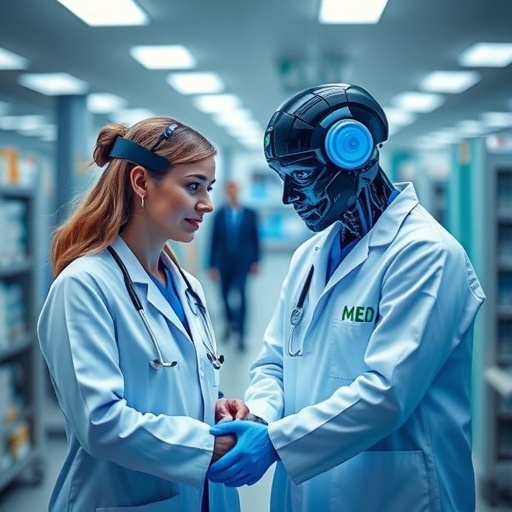
In recent years, the potential of artificial intelligence (AI) to transform medicine has grown exponentially, driven by advances in deep learning and large-scale data analysis. One category of AI models, known as Generalist Foundation Models (GFMs), has recently garnered attention due to their ability to handle a wide variety of tasks with remarkable adaptability. GFMs leverage extensive pretraining on massive datasets, enabling them to generalize their learning to numerous downstream applications without task-specific retraining. Nonetheless, the challenge in medicine is that precision often hinges on deep, domain-specific expertise—something that generalist models, by design, struggle to capture fully.
Addressing this crucial balance between generalizability and precision, a team of researchers has introduced a novel framework called the Generalist–Specialist Collaboration (GSCo). This approach harnesses the complementary strengths of powerful generalist models and highly specialized lightweight models to enhance clinical AI performance across diverse medical tasks. By deploying specialists to provide expert-level diagnostic insights and reference clinical examples as contextual inputs, the generalist model is better equipped to deliver accurate and nuanced final diagnoses. This methodology promises to resolve the long-standing tension between broad applicability and focused expertise in medical AI.
At the cornerstone of this breakthrough is MedDr, an open-source generalist foundation model engineered specifically for medical applications. Unlike conventional GFMs built for broad domains, MedDr incorporates medical knowledge and reasoning capabilities, enabling it to outperform existing state-of-the-art models on multiple medical datasets. Complementing MedDr’s broad diagnostic capability are lightweight specialist models tailored for specific clinical tasks and imaging modalities. These specialists act as expert consultants, offering precise guidance that enriches the generalist’s understanding and decision-making process.
The researchers subjected this Generalist–Specialist collaboration to a rigorous evaluation across 32 datasets encompassing a wide array of medical imaging types and clinical scenarios. These datasets span different imaging modalities such as radiology, pathology, dermatology, and ophthalmology, reflecting the diversity of real-world clinical practice. The comprehensive evaluation demonstrated that MedDr alone surpasses competing GFMs in accuracy and robustness on downstream medical tasks. More profoundly, the GSCo framework consistently outperformed both the standalone generalist and the individual specialist models in key tasks like medical image diagnosis and automated report generation.
Medical image analysis is a quintessential challenge for AI, requiring both the recognition of subtle visual patterns and the integration of clinical context. The GSCo framework leverages the specialists’ focused expertise to highlight visually similar cases or provide diagnostic predictions that serve as a rich context for the generalist. This combination enables a holistic interpretation that mimics expert clinical reasoning, supporting more reliable and explainable AI outputs. Consequently, this collaboration framework not only boosts accuracy but also enhances trustworthiness and interpretability—critical factors for clinical adoption.
Computational efficiency is another significant advantage of the GSCo approach. Generalist foundation models, owing to their vast parameters and broad training regimes, typically necessitate substantial computational resources. By introducing specialized lightweight models that augment the generalist only when needed, the system reduces the overall computational cost without compromising diagnostic performance. This efficient synergy makes GSCo more feasible for real-world clinical deployment, especially in resource-constrained settings where computational power and latency are critical concerns.
Beyond diagnostic tasks, the GSCo framework shows promise in automating the generation of medical reports, a labor-intensive task conventionally done by medical professionals. By integrating specialist insights with the generalist’s comprehensive understanding, the system can generate detailed, contextually relevant clinical descriptions and interpretations of imaging studies. This capability has far-reaching implications for increasing workflow efficiency and reducing clinician burnout, as well as standardizing report quality across institutions.
One of the critical technological innovations underpinning this success is the mechanism by which specialist models communicate with the generalist. Instead of operating independently or in sequential pipelines, specialists feed their outputs directly as enriched contextual information. This design allows the generalist model to assimilate domain-specific insights dynamically, producing more informed and precise clinical decisions. This differs fundamentally from traditional ensemble methods or multi-model voting, establishing a new paradigm for integrated AI in healthcare.
Importantly, the open-source nature of MedDr and its accompanying specialist suite encourages transparency, collaboration, and continuous improvement from the wider research and clinical communities. Open access to these models facilitates adaptability to emerging clinical needs and rapid iteration based on real-world feedback, accelerating the maturation of AI tools for medicine. It addresses one of the key bottlenecks in clinical AI deployments—access to reliable, validated models that can be trusted and scrutinized by healthcare providers.
The implications of this work extend beyond improving diagnostic metrics. The GSCo framework exemplifies a scalable model architecture that could harmonize the increased complexity of AI systems with the nuanced knowledge demands of medicine. As healthcare increasingly embraces AI, ensuring that systems maintain expert levels of precision without sacrificing flexibility will be paramount. GSCo presents a practical blueprint for such systems by balancing the deep specialization required for clinical excellence with the broad applicability demanded by diverse medical conditions.
Looking forward, further research will likely explore the integration of additional specialist models covering broader modalities and subspecialties—from genomics to complex multi-organ imaging studies. While the current work focuses predominantly on imaging and report generation, the framework has potential applications in therapeutic recommendations, longitudinal patient monitoring, and personalized medicine. By continually enriching the collaboration between generalists and specialists, AI systems might more closely replicate the multidisciplinary teams that define modern clinical care.
Moreover, ethical and regulatory considerations will play a crucial role in the widespread adoption of GSCo-powered AI. The transparency and interpretability embedded in the framework will aid compliance with legal standards and ethical principles around decision accountability and patient safety. By enabling clinicians to understand the rationale behind AI-driven suggestions through explicit specialist inputs, the system can foster greater acceptance and prudent clinical use.
This research signifies a pivotal step toward the long-envisioned future of AI-augmented medicine, where smart systems seamlessly combine broad medical intelligence with pinpoint specialty knowledge. The marriage of generalist and specialist AI creates a synergy that propels clinical tools beyond the capabilities of either approach alone. Such hybrid intelligence could catalyze a new era in diagnostics, improving patient outcomes while effectively managing the complexity inherent in medical care.
In summary, the introduction of MedDr and the Generalist–Specialist Collaboration framework offers an elegant yet powerful solution to the challenge of developing AI systems that are both generalizable and highly precise in medical applications. This approach leverages the complementary strengths of generalist foundation models and specialized clinical experts embedded in lightweight models, enabling state-of-the-art performance across a range of diagnostic and reporting tasks. By addressing computational efficiency and encouraging open innovation, GSCo positions itself as a practical and scalable paradigm for AI’s transformative impact on healthcare.
As AI continues to evolve, frameworks like GSCo could become foundational in how medical technology integrates learning across disciplines to advance patient care. This collaborative model points toward an ecosystem where AI acts not only as a tool but as a synergistic partner in healthcare, adapting and specializing as clinical complexity demands. The future of medicine may well be shaped by such intelligent alliances, bridging the gap between the versatility of generalist models and the exacting rigor of specialist expertise.
Cite Scienmag News
Ophelia Keating. (May 1, 2026). Collaborating Generalist and Specialist AI Advances Medicine. Scienmag. https://scienmag.com/collaborating-generalist-and-specialist-ai-advances-medicine/
Ophelia Keating. "Collaborating Generalist and Specialist AI Advances Medicine." Scienmag, 1 May 2026, https://scienmag.com/collaborating-generalist-and-specialist-ai-advances-medicine/. Accessed 4 September 2026.
Ophelia Keating. "Collaborating Generalist and Specialist AI Advances Medicine." Scienmag. May 1, 2026. https://scienmag.com/collaborating-generalist-and-specialist-ai-advances-medicine/


